In 2026, the primary hurdle for Indian sales leaders is the operational friction of managing distributed frontline teams across Tier 2 and Tier 3 cities. Despite massive investments in expansion, most organizations struggle with a "leaky bucket" of productivity where field agents operate with outdated product knowledge and inconsistent sales pitches. The reality on the ground is often a fragmented mess of manual reporting on WhatsApp and static PDF training manuals that agents rarely open.
The traditional model of relying on layers of middle management to enforce standards has hit a breaking point. High churn rates and the cost of retraining new hires mean that by the time a field agent becomes proficient, they are often halfway out the door. This disconnect between corporate strategy and ground-level execution results in lost revenue and a poor customer experience that varies wildly from one pincode to the next.
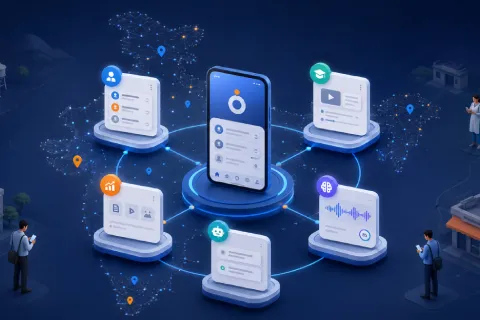
Solving this requires moving away from isolated tools toward a unified sales stack designed for the mobile-first Indian workforce. By integrating CRM, LMS, and real-time enablement with AI agents, companies are now able to provide personalized coaching at scale. This shift ensures that an agent in Nagpur has the same level of support and data-driven insights as one in Bangalore, turning a distributed workforce into a synchronized revenue engine.
Table of Contents:

Traditional CRMs were designed as record-keeping systems for desk-bound managers, not as productivity tools for field agents navigating the unique infrastructure of India. In 2026, the gap between a static database and the reality of a distributed sales force has become too wide to ignore. These teams are no longer just operating in metros; they are penetrating Tier 3 and Tier 4 markets where consumer behavior is dictated by instant trust and hyper-local context. When a salesperson has to stop their flow to manually update a complex form, the "CRM-first" approach stops being an asset and starts being a hurdle.
The primary failure of the CRM-only model is its reactive nature. It relies on the salesperson to input data after an interaction has occurred. In the current high-velocity market, lead decay happens in minutes, not hours. A distributed team needs a system that pushes intelligence to them rather than waiting for them to pull data from it. If your field agent in Nagpur is waiting for a desktop-synced update to know which lead to visit next, they have already lost the window of opportunity to a competitor who uses an execution-led mobile interface.
Consumer expectations in 2026 revolve around "Now." Whether it is a home loan application, a solar panel installation, or a retail stocking request, the consumer wants an immediate status update. Traditional CRMs often lack the deep integration with local communication stacks like WhatsApp, which serves as the primary business operating system in India. When the CRM is disconnected from the actual channel of conversation, data silos form. The "official" record in the CRM and the "real" conversation on the agent’s phone never meet, leading to a fragmented customer experience and zero visibility for leadership.
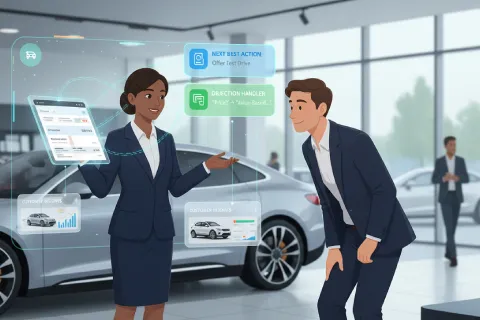
Furthermore, the "one-size-fits-all" UI of global CRMs fails the linguistic and functional diversity of the Indian workforce. A distributed team needs task-specific workflows that guide them through their day with "Next Best Action" prompts. Without this, the CRM becomes a "digital graveyard"—a place where leads go to be forgotten because the interface is too cumbersome for a person on a moving scooter or in a noisy marketplace to navigate.
To solve these challenges and move beyond the limitations of traditional CRMs, implement these strategic shifts:
- Prioritize "Mobile-First Execution" over "Desktop-First Recording." Ensure your field team can complete 100% of their daily tasks—including lead updates, document uploads, and route planning—within three taps on a mobile device.
- Implement Automated Nudge Theory. Instead of asking managers to call agents for updates, use a system that sends automated, context-aware notifications. For example, if a lead is marked as "Interested" but no follow-up is scheduled within 15 minutes, the system should automatically prompt the agent with a suggested time slot.
- Integrate Deeply with WhatsApp and Local Voice. Since most Indian consumers prefer voice notes and WhatsApp messages, your tech stack must capture these interactions automatically. Eliminating manual data entry ensures that the "ground truth" is always reflected in your analytics.
- Deploy Offline-Sync Capabilities. Field agents in remote areas cannot rely on 100% uptime. Your platform must allow for full functionality in offline mode, syncing data the moment the device hits a stable network, preventing data loss and frustration.
- Gamify Regional Performance. Use real-time leaderboards that reflect the specific challenges of different territories. A sale in a rural district often requires more touchpoints than one in a metro; your system should recognize and reward these effort-based metrics to keep distributed teams motivated.
Pro Tip : Shift your focus from "Data Collection" to "Workflow Automation." In 2026, the most successful distributed teams treat their sales tech as a co-pilot that handles the administrative burden. If an action doesn't directly help the salesperson close a deal or help the consumer get an answer faster, automate it or remove it from the workflow entirely. Your goal is to maximize "face-time" with the consumer, not "screen-time" with the CRM.
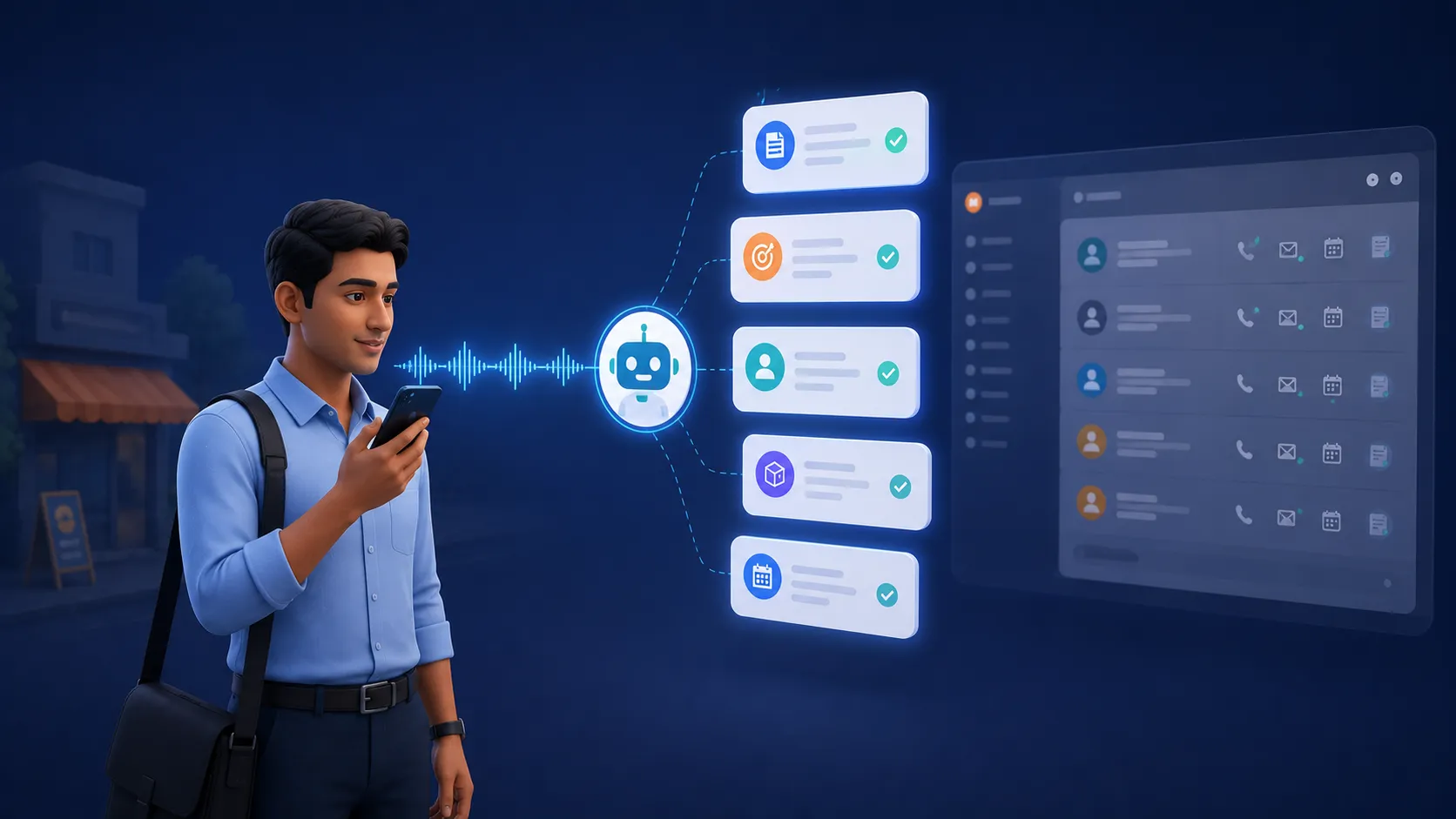
AI agents eliminate manual reporting by shifting the burden from the human operator to an intelligent background layer. Traditionally, field reps spend the last hour of their shift—or worse, their personal time—transcribing notes, uploading photos, and reconciling service codes into a CRM or ERP system. This "admin debt" often leads to inaccurate data, as memories fade and details are omitted for the sake of speed. In 2026, AI agents solve this by functioning as ambient observers that capture and structure data in real-time during the site visit itself.
One primary mechanism is voice-to-structured-data conversion. Instead of navigating complex dropdown menus on a mobile screen, a rep can provide a verbal summary or keep a hands-free device active during the service call. The AI agent parses the natural language, extracts specific entities—such as parts replaced, labor hours, or client sentiment—and automatically maps them to the corresponding fields in the backend system. This transforms a three-minute typing task into a zero-second background process.
Visual intelligence further reduces the reporting load. Field reps often take photos for compliance or proof of work. Standard systems treat these photos as static attachments that require manual labeling. AI agents equipped with computer vision analyze these images instantly to verify that a job meets safety standards or that a specific component has been installed correctly. The agent then auto-fills the "completion status" and "inventory used" sections of the report based solely on the visual evidence, requiring the rep only to provide a final digital sign-off.
Actionable implementation steps for field teams:
- Deploy ambient voice capture tools that allow reps to dictate site notes while driving to the next appointment, rather than waiting until the end of the day.
- Integrate computer vision agents into your mobile app to automatically identify serial numbers or damage patterns from uploaded photos, bypassing manual data entry.
- Configure "exception-only" reporting workflows where the AI agent fills out 95% of the standard documentation, flagging only unusual occurrences or missing safety checks for human review.
- Connect AI agents to your inventory management system so that "parts used" mentioned in a summary are automatically deducted from truck stock and added to the customer invoice in real-time.
Beyond simple data entry, these agents act as real-time auditors. If a rep forgets to document a mandatory safety check or skips a required photo of a utility meter, the agent prompts them before they leave the site. This prevents "return-to-site" incidents caused by incomplete documentation. For the end consumer, this means faster billing cycles, more detailed service history, and a more professional interaction with the rep who is now focused on the task rather than their tablet.
Pro Tip: Stop asking your reps to fill out "Notes" fields. Instead, have them record a 30-second summary at the end of each job and let the AI agent extract the sentiment, follow-up actions, and technical specs. This increases data volume by 4x while decreasing rep effort by 80%.
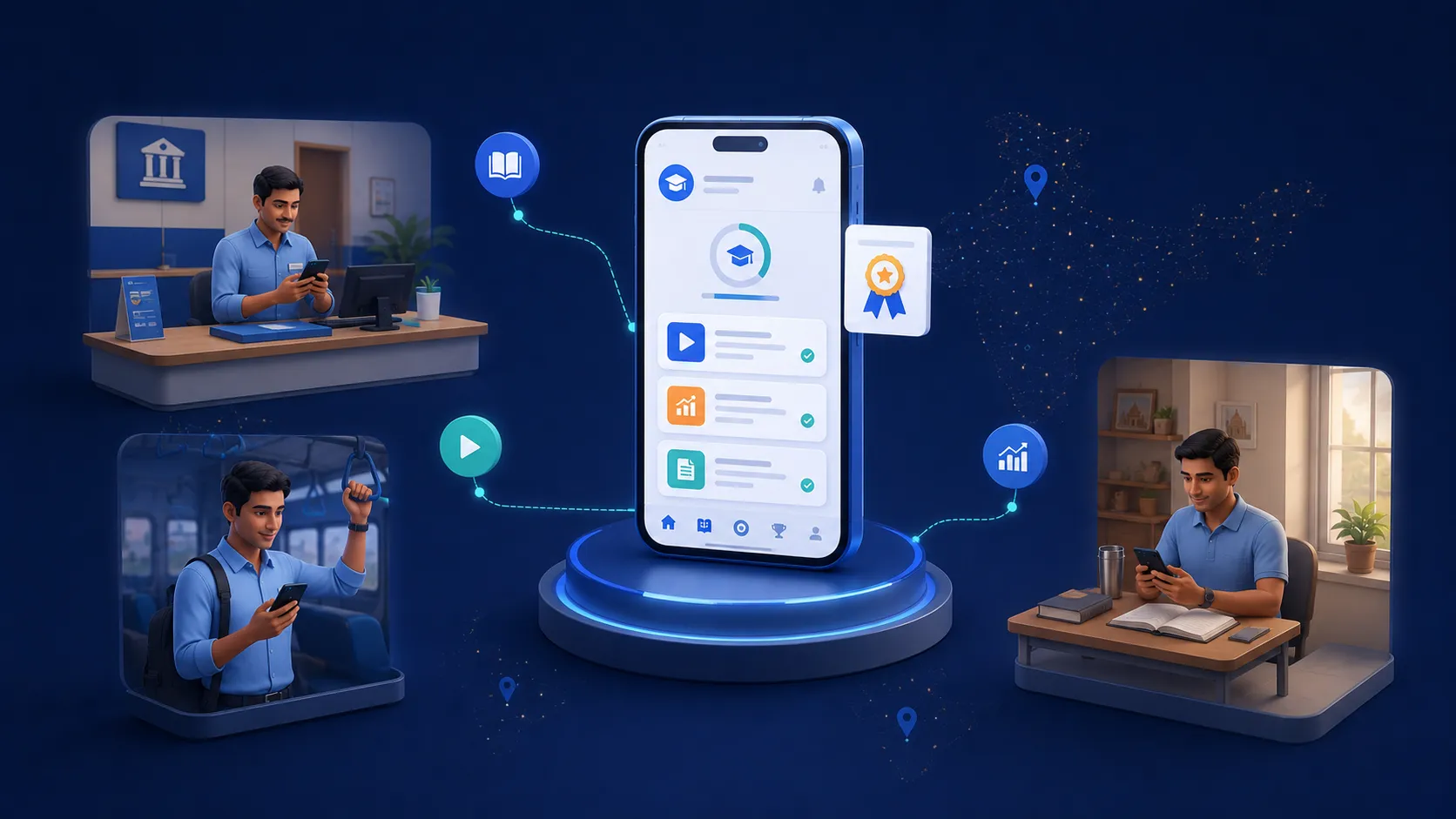
The churn problem in Indian remote teams is rarely about the work itself; it is about the friction between the employee and the organization’s ecosystem. In 2026, the Indian workforce is overwhelmingly mobile-centric, with professionals across Tier-1 and Tier-2 cities relying on smartphones for everything from banking to entertainment. When a company forces a remote employee to use a clunky, desktop-only Learning Management System (LMS) for mandatory training, it creates an immediate barrier. A mobile-first LMS solves this by aligning professional development with the natural digital habits of the user, turning training from a chore into a seamless part of their day.
Early-stage churn is often the result of "onboarding shock," where a remote hire feels isolated and overwhelmed by technical documentation. A mobile-first approach allows for micro-learning—breaking down complex processes into two-minute videos or interactive cards. This format fits into the small gaps of a remote worker's day, whether they are between meetings or in transit. By delivering information in digestible bites, you reduce the cognitive load and help the employee feel competent and supported from day one. When an employee feels they are winning early on, their likelihood of staying past the six-month mark increases significantly.
Career stagnation is the second biggest driver of churn in the Indian remote sector. Employees often feel that remote work limits their visibility and growth opportunities. A mobile-first LMS democratizes upskilling by making it accessible anywhere. Features like gamified leaderboards and instant certification sharing allow remote workers to demonstrate their progress to the wider organization. When a team member can complete a module on their phone and immediately see their standing improve on a regional leaderboard, it creates a sense of belonging and progress that is often missing in distributed environments.
Technical infrastructure remains a hurdle for many remote teams in India. Not every employee has a dedicated high-speed fiber connection at home, especially during power outages or while traveling. Traditional web-based LMS platforms fail in low-bandwidth scenarios. Mobile-first systems are built for these realities, offering offline modes and data-light interfaces. This reliability ensures that learning is never interrupted by external factors. By providing a tool that actually works in their specific environment, you demonstrate a level of empathy for the employee's situation, which is a powerful driver of long-term loyalty.
Actionables for implementing a mobile-first retention strategy:
- Audit Content for Vertical Viewing: Reformat all existing training videos to 9:16 aspect ratios. Content designed for a desktop monitor feels dated and difficult to consume on a smartphone.
- Deploy "Nudge" Notifications: Use push notifications sparingly to remind employees of upcoming deadlines or new modules. Unlike emails, which get buried, a well-timed notification has a much higher engagement rate.
- Simplify the Login Process: Implement biometric or SMS-based logins. Forcing remote workers to remember complex passwords for a training portal is a point of friction that leads to abandonment.
- Incentivize Peer-to-Peer Knowledge Sharing: Allow employees to upload their own "pro-tips" or short video solutions via the mobile app. This fosters a community atmosphere even when teams are thousands of miles apart.
- Measure Engagement, Not Just Completion: Track how often employees return to the app voluntarily. High voluntary usage is a leading indicator of a healthy, engaged workforce.
Pro Tip: Enable "Download and Go" functionality for all core modules. In the Indian context, allowing remote teams to sync their training over stable Wi-Fi and complete it offline eliminates the frustration of data fluctuations. This small technical feature shows you respect their local constraints, which builds significant institutional trust.

Tier 2 and Tier 3 markets are defined by localized trust and relational commerce. Unlike the transactional nature of Tier 1 urban centers, these regions rely heavily on the personal credibility of the seller. Sales enablement becomes a secret weapon because it bridges the gap between high-level brand strategy and the specific, often nuanced, needs of a local consumer. In 2026, the competitive advantage is no longer just having a product available; it is having a sales force—whether internal or via third-party distributors—that can articulate value in a way that resonates with regional sensibilities.
Sales enablement provides the framework to translate complex product features into local benefits. In these markets, consumers are often more risk-averse and value-conscious. Enablement tools, such as localized case studies and vernacular-based sales collateral, ensure that the salesperson is not just a vendor but a trusted advisor. This transition from "selling" to "consulting" is what secures market share where brand loyalty is still being formed. Without structured enablement, your message gets diluted as it travels further from the head office, leading to inconsistent customer experiences and lost revenue.
To effectively penetrate these markets, sales enablement must focus on the following actionable strategies:
- Develop Vernacular Playbooks: Standard English or generic marketing materials often fail in Tier 2 and Tier 3 regions. Create sales playbooks and customer-facing assets in the local language or dialect. Ensure the imagery and cultural references reflect the local lifestyle rather than a distant urban reality.
- Mobile-First Asset Delivery: Infrastructure in these regions can be inconsistent. Equip your sales teams with mobile-first, offline-capable tools. If a rep cannot pull up a product demo or a pricing sheet because of a poor internet connection, the lead is often lost. Use lightweight apps that sync data when a connection is available but function perfectly without one.
- Modular Training for Intermediaries: Often, your "sales force" in these markets consists of local retailers or distributors who handle multiple brands. Create bite-sized, gamified training modules that they can consume on their phones. Focus on "Why this helps your customer" rather than just technical specifications.
- Localized Objection Handling: Tier 2 and 3 consumers have different barriers to entry, often related to logistics, after-sales service, or traditional habits. Build a dynamic objection-handling database specifically for these regions. This should include testimonials from other local customers to provide social proof that feels relevant and attainable.
- Hyper-Local Social Proof: National success stories carry little weight in a small town. Enable your team to collect and share "neighbor-scale" success stories. A video testimonial from a business owner in a nearby district is worth more than a celebrity endorsement from the capital city.
The objective is to reduce the cognitive load on the salesperson. When a rep in a Tier 3 market has to guess how to explain a new technology or a service contract, they usually default to talking about price. This leads to a race to the bottom. Sales enablement provides the "why" and the "how," allowing the rep to maintain price integrity by focusing on the specific ROI relevant to that local community.
As we move through 2026, the brands winning in rural and semi-urban areas are those that treat sales enablement as a continuous feedback loop. They don't just push information down; they use enablement platforms to gather insights from the field about what local consumers are actually saying. This allows for rapid iteration of the sales message, ensuring that the brand remains agile and relevant in a fragmented market landscape.
Pro Tip: Implement a "Shadow Training" program where your best-performing reps in Tier 2 cities record their actual sales conversations (with permission). Use these real-world recordings as the primary training material for new hires in similar regions. Authenticity in tone and phrasing beats a polished corporate script every time.

The fundamental constraint in scaling a customer-facing team is the manager-to-employee ratio. Traditionally, as you hire more front-line staff to handle customer demand, you must hire more managers to oversee quality, provide feedback, and catch errors. This creates a linear cost structure that eats into margins. Real-time AI coaching breaks this dependency by decoupling performance oversight from human availability. It functions as a digital supervisor that sits on every call or chat simultaneously, providing the immediate course correction that a human manager physically cannot deliver to more than one person at a time.
Skill gaps often manifest as "dead air," hesitation, or the mishandling of complex objections. When a staff member hits a wall, they usually have to pause the interaction, search a knowledge base, or flag a manager for help. This friction results in poor customer experiences and lost revenue. Real-time AI bridges this gap by analyzing the live dialogue and surfacing the exact information or "nudge" required at that specific moment. If a customer mentions a competitor’s pricing, the AI instantly displays a comparison battlecard. If the staff member’s tone becomes defensive, the AI prompts a sentiment shift. This immediate feedback loop turns every interaction into a training session, accelerating the learning curve without requiring a manager to listen to recordings hours or days later.
In 2026, the speed of information makes delayed feedback obsolete. Waiting for a weekly 1:1 to discuss a mistake made on Monday means the staff member has already repeated that mistake fifty times by Friday. AI coaching provides "just-in-time" learning, which is neurologically more effective for skill retention than classroom-style training. By catching errors the moment they happen, the AI prevents bad habits from forming. This allows companies to hire for core competencies like empathy and curiosity, while relying on the AI to supplement technical knowledge and process adherence.
This technology also standardizes excellence across the board. In a typical team, you have "A-players" and "B-players." Managers spend the majority of their time trying to move B-players to the A-level. Real-time AI democratizes the techniques of your top performers by codifying their successful behaviors into the coaching engine. When the AI suggests a specific closing phrase or a clarifying question that has historically led to high satisfaction scores, it effectively elevates the entire team to the level of your best employee. The manager's role then shifts from basic monitoring to high-level strategy and handling the emotional nuances that AI cannot yet grasp.
Actionable steps for implementation:
- Identify the top three "friction points" in your customer interactions where staff frequently get stuck or escalate to a supervisor.
- Program the AI to recognize these specific triggers—whether they are keywords, long pauses, or negative sentiment shifts.
- Create "Micro-Nudges" which are short, 1-5 word prompts that appear on the screen to guide the staff member without distracting them from the conversation.
- Integrate your live knowledge base with the AI so that relevant documentation is pulled up automatically based on the context of the conversation.
- Use the post-interaction data to identify recurring skill gaps across the whole team, allowing you to address systemic issues in one go rather than coaching individuals one-on-one.
Pro Tip: To ensure high adoption, frame the AI coach as a "co-pilot" rather than a "monitor." Staff are more likely to embrace the technology if they see it as a tool that reduces their cognitive load and helps them hit their performance bonuses, rather than a "Big Brother" tool used for discipline. Focus your initial deployment on the most complex product areas where staff feel the least confident.

Vanity metrics like course completion rates, quiz scores, and time-spent-learning provide zero evidence of business impact. They prove that an employee or customer interacted with content, but they do not prove that the interaction generated revenue or saved costs. To calculate a true Return on Investment (ROI), you must connect the "learning activity" in your LMS to the "business outcome" stored in your CRM. Without this integration, your training department remains a cost center rather than a profit driver.
The CRM serves as the definitive source of truth for customer behavior, sales performance, and retention. By syncing LMS data into this environment, you can move from speculative correlations to hard attribution. For example, in a customer education context, you can track whether users who complete a specific "Advanced Features" module have a higher Customer Lifetime Value (CLV) or lower churn rate compared to those who do not. This isn't just about showing that training is "good"; it is about proving that trained users contribute X% more to the bottom line.
Integration allows for sophisticated cohort analysis. In 2026, leading organizations are using this data to identify the "Success Gap"—the space between a customer purchasing a product and actually achieving their desired outcome. If CRM data shows a drop-off in product usage at the 30-day mark, and LMS data shows that these same users skipped the onboarding certification, you have identified a direct, revenue-impacting friction point. Solving this through targeted training and then seeing the subsequent rise in CRM-tracked renewal rates is the only way to demonstrate ROI that satisfies a CFO.
This data bridge also enables personalized, automated intervention. When a lead or customer reaches a certain stage in the CRM—such as "Trialing" or "At-Risk"—the LMS can automatically trigger the relevant educational path. By tracking the conversion rate of these specific cohorts back in the CRM, you can assign a dollar value to every course completed. This transforms the LMS from a passive library into an active engine for growth and retention.
Actionable Steps for Proving ROI
- Map User Identifiers: Ensure your LMS and CRM use a single unique identifier (usually an email address or a specific User ID) to prevent data fragmentation.
- Define Financial KPIs: Before looking at learning data, identify which CRM metrics you want to influence. Common targets include reduced support ticket volume, increased upsell rates, or faster "time to first value."
- Run Longitudinal Cohort Studies: Compare a group of users who completed a specific training path against a control group of similar users who did not. Use CRM data to measure the difference in revenue generated by both groups over a six-month period.
- Automate Feedback Loops: Use CRM "Closed/Lost" data to analyze if those customers missed specific training milestones. Use these insights to refine your curriculum to address the specific reasons customers fail or leave.
- Report in Currency, Not Percentages: When presenting to stakeholders, translate "80% completion rate" into "Users who completed this course represent $500,000 more in upsell revenue than those who didn't."
Pro Tip: Use CRM triggers to push "just-in-time" learning. If a customer’s health score in the CRM drops below a certain threshold, automatically enroll them in a "Success Re-engagement" path in the LMS. By measuring the subsequent "bounce back" in their health score within the CRM, you create a direct line of sight between a training intervention and a saved account.

AI agents in 2026 no longer rely on clunky, word-for-word translation layers that stripped away the intent behind local communication. Modern systems utilize Large Language Models (LLMs) specifically fine-tuned on massive Indic datasets, such as those provided by Bhashini or AI4Bharat. These agents process language through neural embeddings that understand the semantic weight of regional terms rather than just their dictionary definitions. For an Indian team, this means the AI recognizes the difference between "thoda" as a literal quantity and "thoda" used as a conversational filler to soften a request.
The most significant hurdle for Indian customer interactions has always been "code-switching"—the tendency for users to mix English with regional languages like Hindi, Tamil, or Bengali (e.g., Hinglish or Tanglish). Current AI agents handle this through bilingual tokenization. Instead of crashing when it sees a hybrid sentence like "Booking cancel kar do," the agent identifies the hybrid syntax and maps it to a single intent. This allows teams to maintain a natural rapport with customers who do not speak a "pure" version of any single language.
Linguistic nuance extends beyond vocabulary into cultural context and honorifics. In many Indian regions, the level of formality changes based on the seniority of the person being addressed or the urgency of the situation. AI agents now use context-aware prompting to adjust their tone. If a customer uses "Aap" instead of "Tum," or adds a respectful suffix like "Garu" or "Ji," the agent detects this shift in sentiment and adjusts its response architecture to match that level of professional courtesy. This prevents the "robotic" friction that often occurs when Western-centric AI models are deployed in the Indian market.
For voice-based agents, the challenge is even steeper due to the diversity of accents across the subcontinent. Modern Automatic Speech Recognition (ASR) engines integrated into these agents are trained on diverse phonetic data. This allows them to accurately transcribe speech from a user in Kochi just as effectively as a user in Ludhiana, despite the vast differences in intonation and pace. By filtering out ambient noise typical in Indian urban environments, these agents ensure that the core message—the customer’s pain point—is captured without requiring the user to repeat themselves.
To effectively deploy these agents, your team should focus on several strategic actions:
- Audit your historical customer chat logs to identify the specific "hybrid" phrases or slang terms most common to your specific industry and region.
- Implement a "Human-in-the-loop" (HITL) system for the first 90 days of deployment to catch and correct regional nuances the AI might initially misinterpret.
- Use "Few-Shot Prompting" by providing the AI with 5-10 examples of localized conversations that represent your brand's specific voice.
- Prioritize agents that offer native support for Devanagari and Dravidian scripts to ensure that text-based communication remains grammatically accurate when users switch from English script.
- Regularly update your Knowledge Base with regional FAQs, as customer terminology for the same product can vary significantly between Tier 1 and Tier 3 cities.
Pro Tip: Don't aim for "perfect" formal language. In the Indian market, high-converting AI agents are those that mirror the customer's specific level of code-switching. If a customer is comfortable using 40% English and 60% Marathi, configure your agent's response parameters to reflect that same ratio. This builds immediate psychological safety and trust with the user, leading to higher resolution rates and better customer satisfaction scores.

A 2026 sales stack built for scale must move beyond traditional record-keeping. The era of the CRM acting as a manual digital filing cabinet is over. To scale in this environment, your stack must prioritize **Agentic Sales Orchestration**. This means your tools do not just store data; they act on it autonomously. An elite stack must feature AI agents capable of performing research, qualifying leads through natural dialogue, and updating records without human intervention. If your team is still manually logging calls or typing out "meeting summaries," your stack is failing the scalability test.
The foundation of a scalable stack is a **Unified Data Layer**. By 2026, data silos are a terminal illness for growth. Your stack must ensure that every touchpoint—from a customer’s interaction with a LinkedIn ad to their last support ticket—is resolved to a single identity in real-time. This "entity resolution" allows your sales team to walk into every conversation with a complete history of the consumer's needs. Without this, your outreach remains generic, and generic outreach does not scale in a market where consumers expect hyper-relevance.
**Real-time Intent Monitoring** is the third non-negotiable. Building a pipeline based on static lists is an expensive way to fail. A scalable stack integrates third-party intent signals and first-party behavioral data to tell your reps exactly who is in-market right now. In 2026, the competitive advantage belongs to the company that reaches the prospect during their "window of dissatisfaction"—that brief moment when they are actively looking for a change. Your stack must trigger automated workflows the second these signals are detected.
Actionable Steps for Implementation:
- Audit for API-First Connectivity: Ensure every tool in your stack has robust, two-way API capabilities. If a tool cannot share data in real-time with your primary data warehouse, it is a liability.
- Deploy Autonomous Prospecting Agents: Replace manual top-of-funnel research with AI agents that scrape social signals, financial reports, and news to draft personalized opening hooks for your reps.
- Shift to Consumption-Based Tooling: Evaluate your software spend based on outcomes rather than seat licenses. Scalable stacks in 2026 favor vendors that charge for successful lead qualifications or closed data loops.
- Implement "Clean Room" Privacy Protocols: Ensure your stack has built-in data governance that automatically scrubs sensitive consumer information to stay compliant with evolving global privacy laws without slowing down the sales process.
Dynamic Content Personalization must be baked into the delivery layer. Scaling your sales efforts shouldn't mean sending more emails; it should mean sending better ones. Your stack needs the ability to generate personalized video demos, custom landing pages, and tailored proposals automatically based on the prospect’s industry and pain points. If your "personalization" is limited to [First_Name] and [Company_Name], you are not scaling; you are just polluting the market.
Finally, the stack must provide **Revenue Intelligence** that looks forward, not backward. Traditional reporting tells you what you did last month. A 2026 stack uses predictive modeling to tell you where your pipeline will be in ninety days based on current activity levels and historical conversion rates. This allows leadership to make proactive adjustments to headcounts or marketing spend before a revenue gap occurs.
Pro Tip: Stop focusing on "all-in-one" platforms that claim to do everything but lack depth. Instead, build a "best-of-breed" stack connected by a robust middleware layer or a centralized data warehouse (like Snowflake or BigQuery). This allows you to swap out specific AI modules as the technology evolves in 2026 without having to rebuild your entire sales infrastructure.
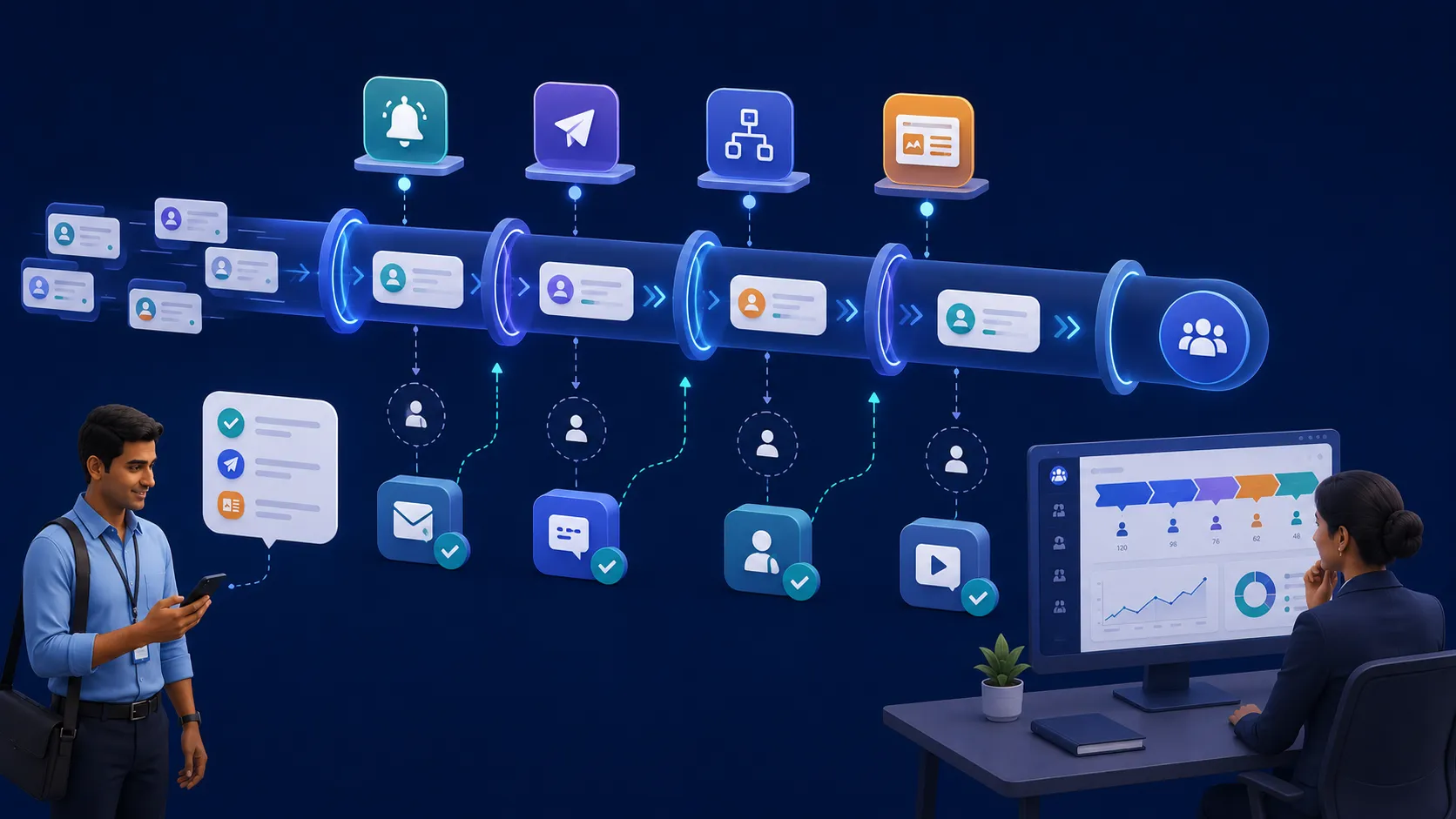
Lead leakage in distributed environments typically occurs because the distance between central marketing operations and local execution creates a visibility gap. When leads are passed from a central hub to decentralized agents, dealers, or franchisees, the "speed-to-lead" metric often collapses. Without automated enablement, local partners rely on manual entry or sporadic email checks, allowing high-intent prospects to go cold. To stop this, you must implement a system that removes manual decision-making from the local partner's plate.
Automated lead routing is the first line of defense. In 2026, relying on a basic "first-come, first-served" email notification is insufficient. You need an orchestration layer that triggers instant SMS or push notifications to local agents based on proximity and capacity. If the lead is not claimed or contacted within a strictly defined window—such as 10 minutes—the system should automatically re-route that lead to the next available partner or pull it back into a centralized nurture sequence. This prevents leads from sitting in an unread inbox while the prospect moves on to a competitor.
Enablement must also focus on "Ready-to-Use" localized content. A major cause of leakage is the local partner’s inability to respond professionally and quickly. Automated enablement platforms solve this by providing pre-approved, dynamic templates that pull in the local partner's specific contact details and the prospect’s interest data. When a lead arrives, the agent shouldn't have to write an email; they should simply approve a pre-configured response that is already optimized for conversion. This ensures brand consistency and drastically lowers the barrier to execution for busy local teams.
- Implement automated "ghost-call" technology that connects the local agent to the prospect via a bridge line the moment a form is submitted.
- Deploy "Lead-to-Account" matching to ensure a prospect is always routed to the agent they have previously interacted with, preventing fragmented communication.
- Set up automated "Nurture-on-Behalf" programs. If a local agent marks a lead as "no contact," the central system should automatically trigger a long-term re-engagement sequence under the agent’s name.
- Use real-time dashboards that rank local partners by their response speed, creating a transparent environment where the best-performing partners receive the highest quality leads.
Visibility is the final component of stopping leakage. You must integrate local CRM data with your central marketing automation platform. When a lead "leaks," it is often because it entered a "black hole" where the central team has no idea if a sale was made or if the lead was simply ignored. Automated enablement tools now allow for "closed-loop" reporting where local disposition data (e.g., "Sold," "Dead Lead," "In Progress") is automatically pushed back to the central hub. This allows you to stop sending leads to partners who consistently fail to follow up, effectively reallocating your budget toward the channels that actually convert.
Pro Tip: Implement a "Lead Reclamation" trigger. If a local partner does not update a lead status within 48 hours, use automation to move that lead into a "Centralized Recovery" bucket. Have a dedicated corporate team or an automated AI agent reach out to re-qualify the lead. If the lead is still active, re-assign it to a different partner. This ensures no marketing dollar is wasted on a lead that has been abandoned by a local agent.

The traditional command-and-control model in Indian sales leadership is reaching its breaking point. For decades, the focus was on volume—more calls, more meetings, and more pressure. However, the 2026 Indian consumer is too sophisticated for these tactics. Whether in B2B or high-ticket B2C sectors, customers now demand a consultative approach that emphasizes empathy and problem-solving over aggressive closing techniques. Sales leaders are finding that they simply do not have the hours in the day to transform their teams into these high-level consultants while also managing operational targets.
Coaching-as-a-Service (CaaS) addresses this structural deficit by decoupling management from coaching. In the typical Indian corporate structure, a manager is expected to be a recruiter, a strategist, a closer, and a mentor. This rarely works. Most managers default to the roles that have the most immediate impact on their own KPIs, which usually means closing deals and reporting numbers. Mentorship falls to the bottom of the list. By 2026, the most successful organizations have realized that coaching is a specialized skill set that requires dedicated external experts and data-driven platforms to be effective.
The move toward CaaS is also driven by the need to close the "Middle-Performer Gap." In most Indian sales teams, the top 10% of reps are self-sufficient, while the bottom 20% are often churned. The real growth opportunity lies in the middle 70%, who have the potential but lack the specific behavioral tweaks to reach the next level. CaaS providers use AI-driven conversation intelligence to analyze thousands of sales interactions, identifying specific patterns that lead to lost deals—such as talking too much, failing to handle objections early, or missing key emotional cues from the consumer.
Furthermore, the 2026 landscape is defined by the hybrid work model. With sales teams distributed across various regions, the traditional "ride-along" or "shadowing" method of training is no longer feasible. CaaS provides a digital infrastructure for continuous learning that transcends geography. It allows for a level of personalization that internal training programs cannot match, offering feedback tailored to the specific challenges a rep faces in their unique territory or segment. This ensures that the end consumer receives a consistent, high-quality experience regardless of which representative they speak to.
Actionable Steps for Sales Leaders:
- Identify the Coaching Gap: Calculate exactly how many hours your managers spend per week on one-on-one skill development versus administrative tasks. If it is less than 20% of their total time, you need an external coaching solution.
- Focus on the Middle 60%: Do not waste coaching resources on your top performers or your consistent underperformers. The highest ROI comes from moving your "B" players to "A" players.
- Demand Data-Backed Feedback: Move away from subjective coaching based on "gut feelings." Use objective data such as talk-to-listen ratios and objection-handling speed to drive improvement.
- Incentivize Coaching Adoption: Make participation in coaching sessions a part of the rep’s quarterly performance review, but decouple it from their sales quota to encourage honest participation and vulnerability.
- Standardize the Playbook: Use CaaS to ensure that your brand’s value proposition remains consistent across all demographics, whether the salesperson is operating from a major metro or a Tier 2 city.
Pro Tip: To maximize CaaS impact, ensure your external coaches have access to your CRM's "lost deal" notes. The most valuable coaching doesn't happen when a deal is won; it happens when a coach analyzes the specific friction points that caused a consumer to walk away, allowing the rep to pivot their strategy in real-time for the next prospect.
Conclusion
Managing a distributed sales force across India’s diverse geography requires more than just a digital ledger. In 2026, the competitive edge for Indian enterprises lies in how well they synchronize their CRM, training, and AI capabilities. Success is no longer measured by the volume of tools in your stack, but by the speed at which actionable insights move from your strategy team to a frontline agent in a Tier 2 city.
Deployment reality dictates that technology must be invisible to the user. For an Indian field agent, a tool only works if it functions on variable bandwidth, supports local context, and solves a specific problem in under thirty seconds. High-impact stacks prioritize these field realities over complex executive dashboards. When the stack serves the agent's immediate needs, the data quality for leadership improves naturally.
The convergence of LMS and AI coaching is the most significant shift currently driving growth. By using AI agents to simulate real-world objections and using CRM data to identify specific skill gaps, companies are moving away from generic monthly training sessions. This creates a continuous improvement cycle that addresses high turnover rates while maintaining a consistent brand voice across thousands of distributed representatives.
Audit your current sales infrastructure to ensure your CRM, training modules, and coaching tools share data in real-time. If these systems remain siloed, your team is losing revenue to avoidable friction. Start by identifying the single biggest bottleneck in your frontline's daily workflow and replace fragmented processes with an integrated pilot program today.
What’s a Rich Text element?
The rich text element allows you to create and format headings, paragraphs, blockquotes, images, and video all in one place instead of having to add and format them individually. Just double-click and easily create content.
Static and dynamic content editing
A rich text element can be used with static or dynamic content. For static content, just drop it into any page and begin editing. For dynamic content, add a rich text field to any collection and then connect a rich text element to that field in the settings panel. Voila!
How to customize formatting for each rich text
Headings, paragraphs, blockquotes, figures, images, and figure captions can all be styled after a class is added to the rich text element using the "When inside of" nested selector system.
zdxfhgfg
- sdnslk,xdv
- SDlknjsdv
- SDvlknj
- sdgdf v