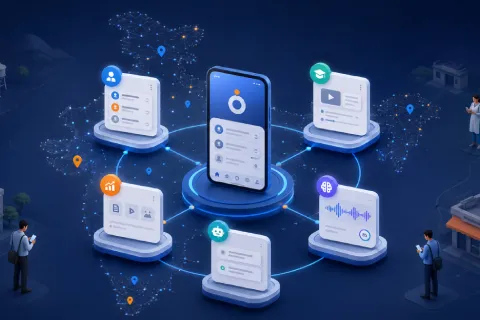

Sales enablement has evolved more in the past 18 months than it did in the previous decade. What started as a support function has transformed into a strategic revenue driver that directly impacts win rates, productivity, and quota attainment for mid-to-large sales teams.
But here's what's becoming clear: the approaches that worked brilliantly in 2023 are showing cracks in 2025. And those cracks are widening fast as we move into 2026.
This isn't about being behind or ahead. Mid-sized and large sales organisations at every maturity level are facing the same challenge: how do you enable hundreds or thousands of frontline reps in a market that's evolving faster than your planning cycles?
The data tells a clear story:
• Companies with mature enablement functions achieve 27% higher customer lifetime value
• Companies with mature enablement functions achieve 32% higher quota attainment
• This holds true only when enablement adapts to how markets, customers, and technology have fundamentally changed
If you're managing a distributed sales force across multiple regions, products, and customer segments, these shifts are particularly critical. Let's explore five major shifts reshaping sales enablement in 2026, what the data reveals, and what it means for how you build your strategy going forward.
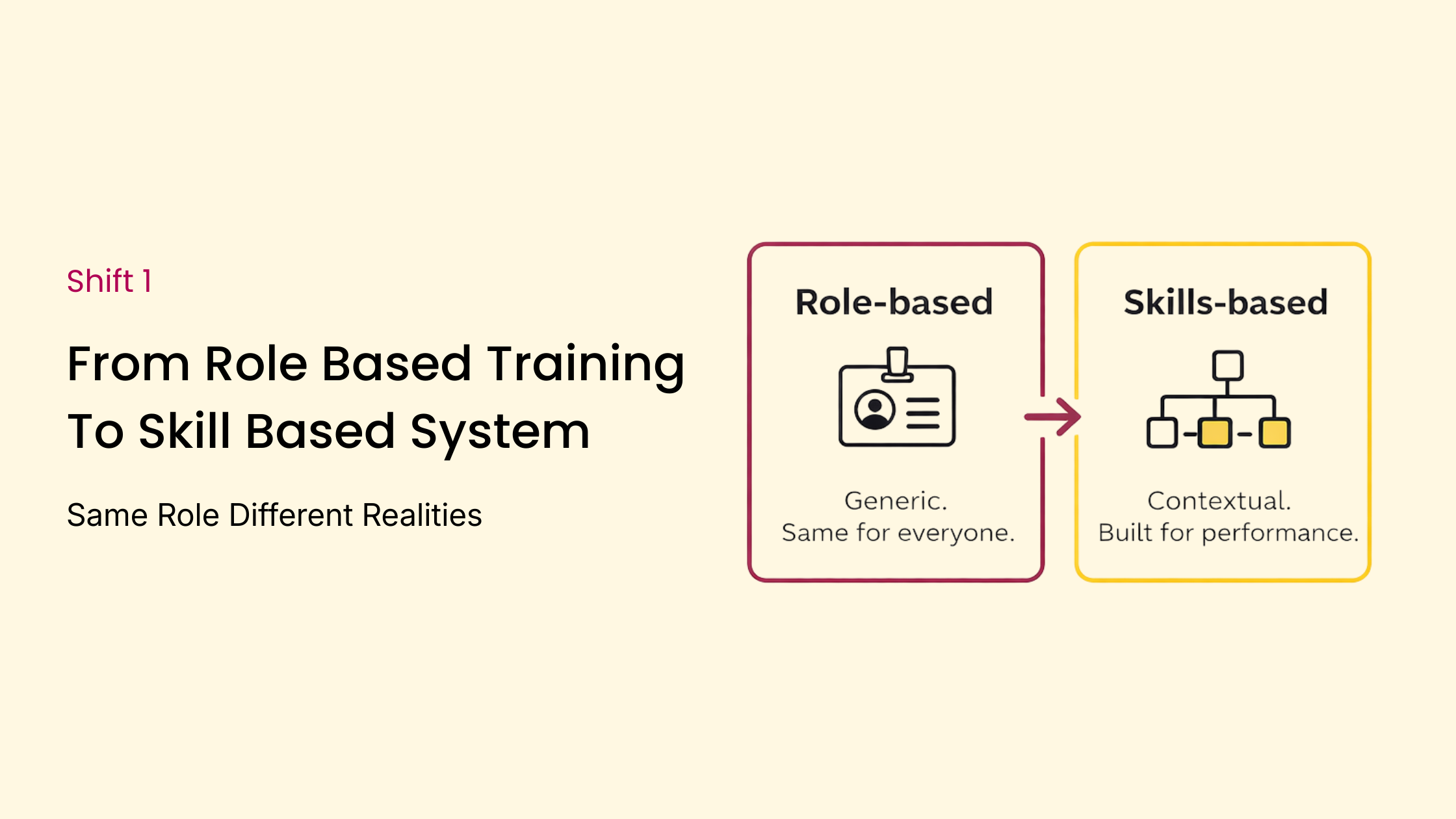
Shift 1: From Role-Based Training to Skills-Based Performance Systems
For years, organising training by role made perfect sense. Clean, logical, and aligned with how large organisations think about structure.
But the data reveals a problem for mid-market and large teams: only 30% of marketing-created content is actually used by sales teams. The primary reason? Generic, role-based materials don't address the specific challenges reps face in their unique contexts.
Here's what's happening in frontline sales environments: Two reps with the same title, selling the same offerings, can have completely different daily realities. One works an urban patch with faster cycles and higher walk-in intent. Another manages relationship-heavy territories where trust and follow-through matter more than volume. Traditional role-based training treats them identically, even though their needs are vastly different.
Similarly, someone selling into large institutions needs different skills than someone selling into smaller accounts. A rep in a flagship location faces different challenges than one in a neighbourhood outlet. A seller working with premium products operates differently from one focused on value segments.
What the data shows for frontline sales teams:
• Sales reps spend only 28% of their time actually selling, with the rest consumed by internal meetings, compliance requirements, and administrative tasks
• Organisations making the shift to skills-based enablement report 22% shorter sales cycles
• 67% of sales leaders at mid-market and large companies cite improving rep productivity as their top enablement priority for 2026
What's changing in enablement:
Leading organisations are moving from role-based to skills-based enablement. Instead of asking "what does this role need to know?" they're asking "what does this specific rep need to master to succeed in their territory, customer segment, and product mix?"
This means:
• Competency mapping that accounts for territory dynamics, customer demographics, and product complexity.
• Personalised learning journeys that recognise the difference between reps managing high-volume transactional sales versus those building long-term customer relationships.
• Micro-credentials that demonstrate capability in specific scenarios like handling objections, navigating regulatory questions, or managing pricing and trade-in discussions.
• Dynamic coaching that adapts based on customer interaction patterns and conversion challenges.
For teams managing large rep counts across diverse markets, the shift requires more sophisticated systems than traditional programs. But the alternative, continuing to deliver generic training that most of your frontline reps ignore, has clear costs in productivity and performance.

Shift 2: Sales Enablement Content - From Libraries to Intelligent Content Delivery
Sales teams spend 440 hours per year searching for or creating content. That's 11 full work weeks per person wasted on activities that don't directly generate revenue. For organisations with large field teams, this productivity drain adds up to millions in lost selling time.
The statistics on content are striking:
• Reps recreate content that already exists 40% of the time because they can't find what they need
• Only 30% of marketing-created content gets used by sales teams
• Organisations with centralised content libraries see 25% higher usage rates, but that still leaves most content unused
• 78% of sales leaders at mid-market and large companies acknowledge their teams lack easy access to the content needed to close deals
Here's the problem:
Traditional content management systems, no matter how well organised, require reps to actively search for materials. In practice, when a rep is mid-conversation, they need instant access to the right information. Searching through folders isn't an option.
Consider a simple real-world scenario: a customer asks a detailed comparison question, then follows up with eligibility, then asks for a quick ROI or savings example. If the rep has to toggle between PDFs, portals, and calculators, the conversation loses momentum - and trust.
What's changing in enablement: The most effective enablement teams are moving from content libraries that wait to be searched to intelligent delivery systems that proactively surface the right materials at the right moment.
This looks like:
• Contextual intelligence where systems understand customer intent, product interest, regulatory requirements, and conversation stage, then automatically surface relevant materials
• Performance-based scoring where AI tracks which content actually moves customers to conversion in specific scenarios
• Dynamic personalisation where systems help reps create customised materials for individual customers while maintaining compliance and brand consistency
The impact is measurable:
• AI-powered content recommendations drive 41% improvement in content relevance
• They reduce time spent searching by 28%
• Personalized content drives 3x higher engagement
For organizations managing large sales forces, the shift isn't about better organization. It's about eliminating the need for reps to organize or search at all during customer interactions.
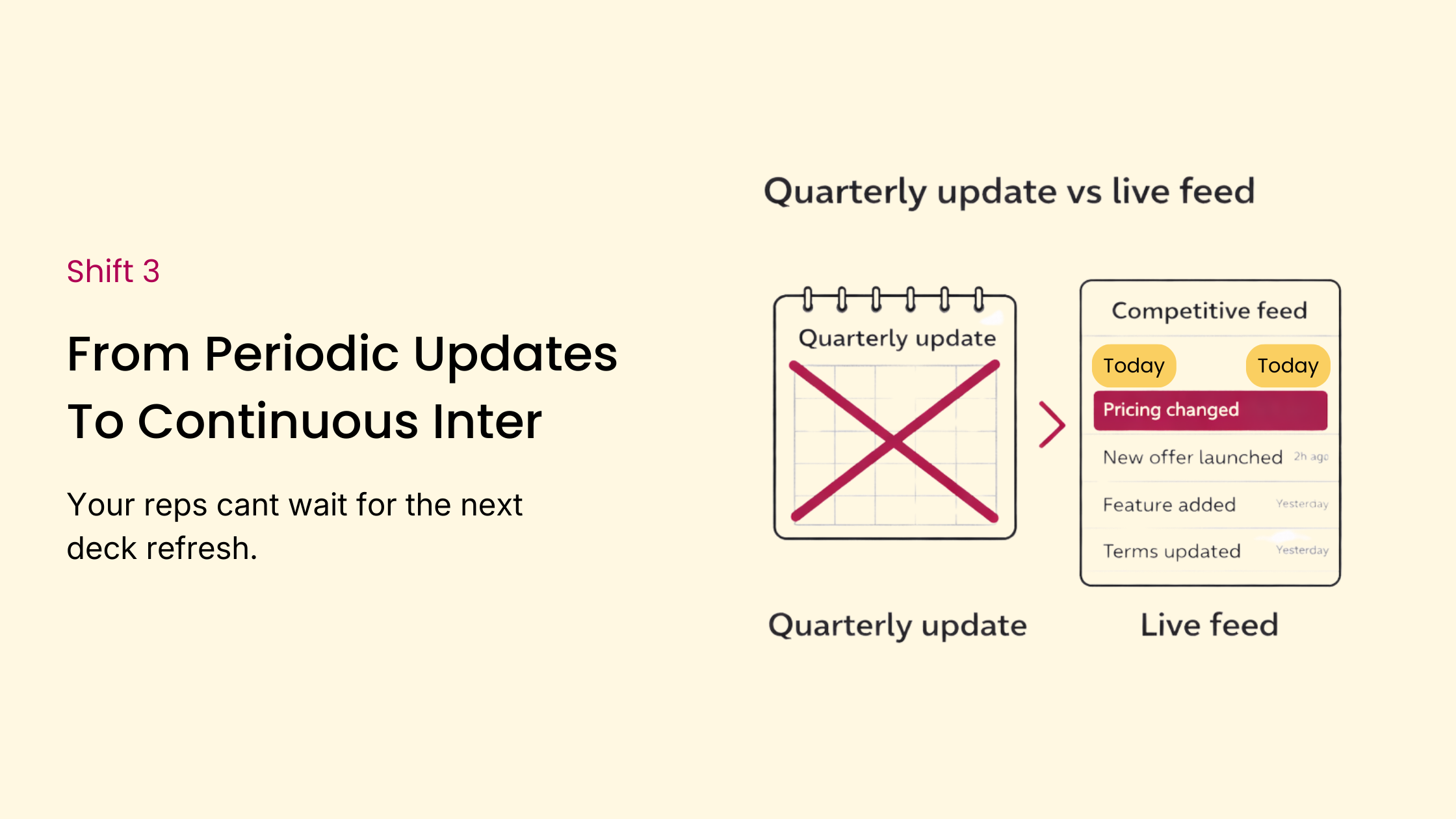
Shift 3: From Periodic Updates to Continuous Competitive Intelligence
In frontline sales, competitive dynamics shift rapidly. A competitor can launch new features, adjust pricing, or change promotional offers faster than most large organizations can schedule a meeting to discuss updating materials.
The data reveals the urgency:
• Only 29% of reps feel they have adequate information about competitors
• 47% of customers now compare 3 or more options before making purchase decisions
• Teams with regularly updated competitive intelligence win 23% more competitive sales
• Sales organisations updating competitive information quarterly or more frequently see 18% higher win rates than those updating annually
Here's the gap:
• Your competitor changed an offer this morning
• Their reps are using it in customer conversations the same day
• Your reps discover it during objections, negotiation pressure, and lost deals
What's changing for enablement teams:
Leading enablement functions are moving from periodic competitive updates to always-on intelligence systems that treat market awareness as a continuous feed.
This requires different infrastructure:
• Real-time monitoring that tracks competitor moves across marketing, product launches, pricing changes, and customer feedback
• Signal synthesis that translates raw data into actionable talking points for specific segments and deal types
• Embedded access where competitive intelligence surfaces inside the workflows reps already use
• Continuous learning loops where every competitive win or loss generates new intelligence incorporated within days
Organisations stuck in quarterly update cycles are essentially conceding customers to competitors who operate faster.
And in 2026, reps aren't just competing against direct competitors. Customers are evaluating:
• staying with the current provider
• doing nothing
• choosing a completely different option
Effective competitive intelligence needs to cover the full spectrum of alternatives customers consider.
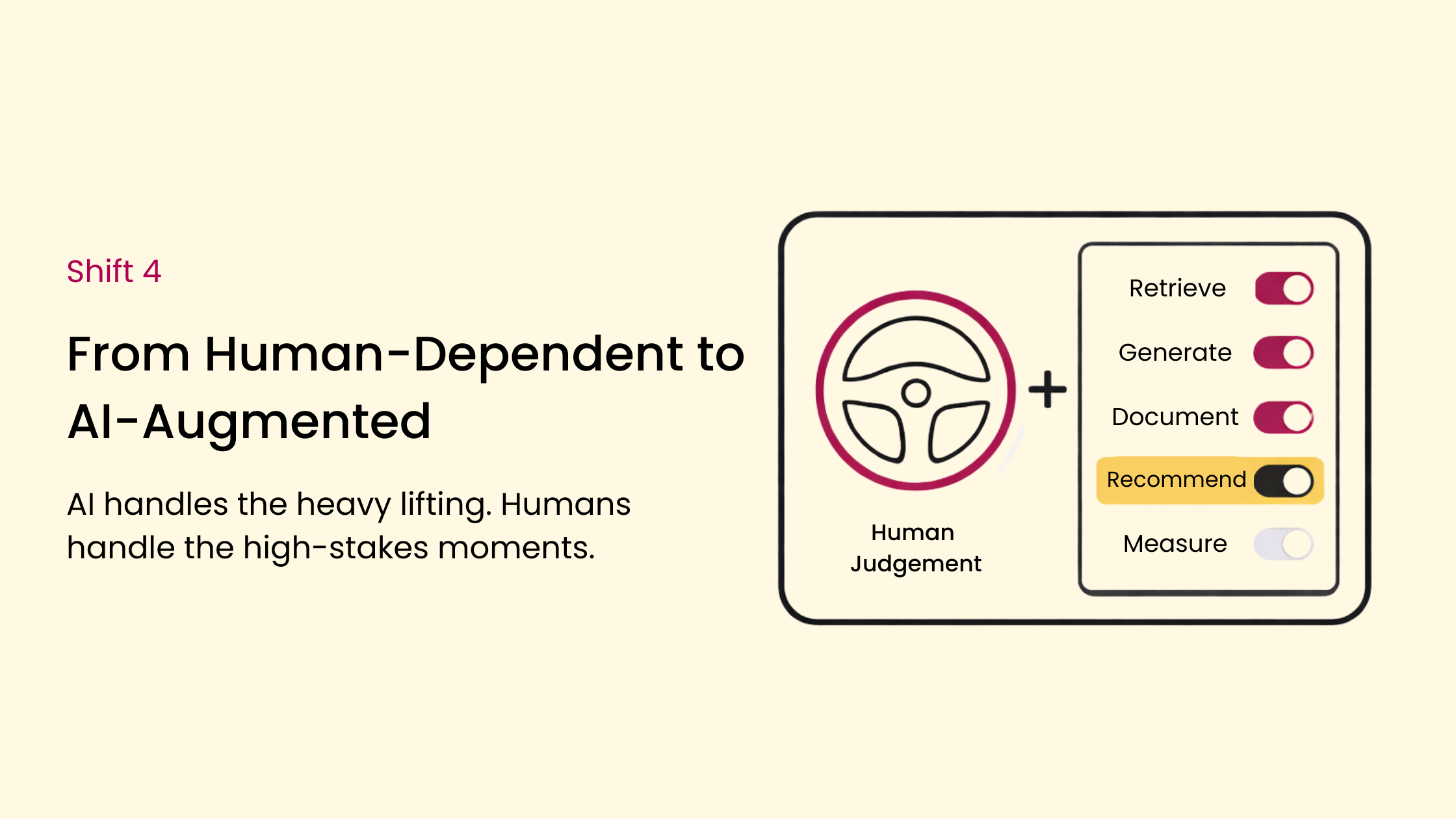
Shift 4: From Human-Dependent Workflows to AI-Augmented Capacity
Let's address the conversation every sales leader is having about AI and frontline roles.
There's considerable discussion about AI replacing salespeople. Here's what's actually happening in mid-market and large sales organisations: leaders have moved past the initial anxiety and are understanding where AI genuinely adds value for frontline teams.
AI excels at pattern recognition, data processing, and surfacing signals at scale. It can identify at-risk accounts, auto-populate applications, and summarise dozens of customer interactions in seconds.
What AI can't do: build trusted relationships, navigate sensitive situations, earn credibility through empathy, or close hesitant buyers through authentic human connection.
Think of it this way: Humans handle the relationship questions and customer goals. AI handles the information retrieval, documentation, and routine processing. Your reps ask the questions that matter. They set the direction. AI does the fact-finding and automation that gets them there.
The data on AI augmentation is compelling:
• Frontline reps spend a meaningful chunk of time on documentation and compliance paperwork that could be automated
• Organisations implementing AI support tools report 40% increase in rep capacity without adding headcount
• Effective enablement programs increase selling time by 20%, giving reps back nearly a full day per week for customer relationships
• Teams using AI-enabled tools report 30% faster response times to customer inquiries and 26% improvement in response quality
What's changing in sales operations:
Organizations managing large frontline teams are reimagining workflows around human judgment plus AI capability, rather than bolting AI onto existing processes.
This looks like:
• AI handles initial customer queries about features, pricing, and eligibility, so reps focus on relationship building and closing
• AI auto-populates forms based on customer information, allowing reps to review and personalise rather than starting from scratch
• AI captures conversation details and updates CRM systems automatically, so reps stay focused on the interaction
• AI surfacing relevant recommendations based on profile, history, and stated needs
A concrete example: in regulated environments like banking or insurance, AI can reduce the "search and paperwork" load during conversations, while the rep focuses on trust, needs, and decision-making.
But here's where many implementations fall short: they layer AI onto existing workflows without redesigning anything. Real augmentation means reimagining what reps should spend time doing, then building AI systems that handle everything else that doesn't require human judgment and relationship skills.
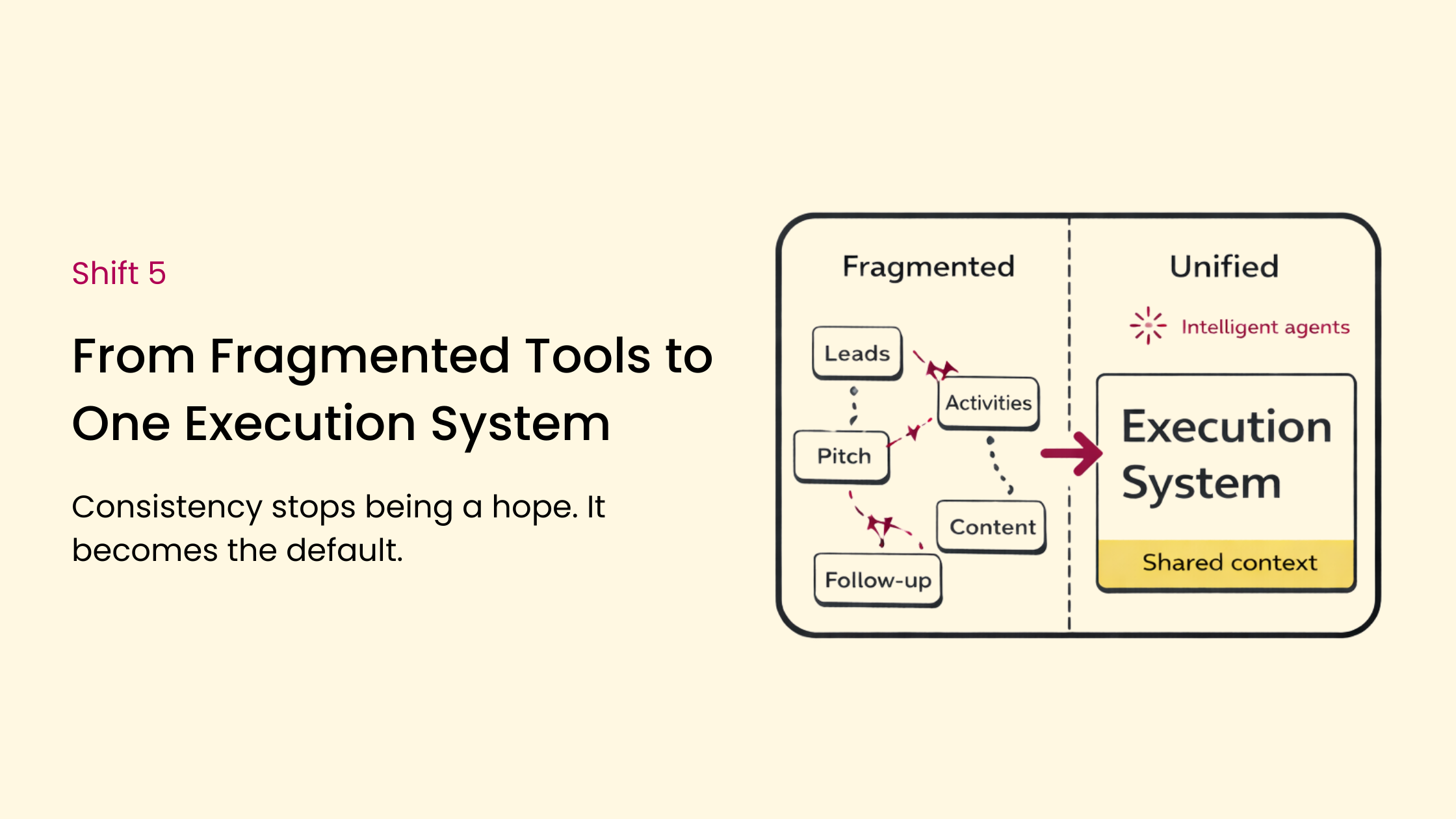
Shift 5: Sales Enablement Execution - From Fragmented Tools to One Execution System
Most enablement strategies still assume a messy reality: reps sell across disconnected systems. One for leads, another for activities, another for product knowledge, another for content, another for follow-ups, plus a dozen informal workarounds.
That fragmentation is not just inefficient. It quietly breaks execution.
Because when the workflow is split across tools, consistency becomes optional. What gets pitched depends on the rep. What gets shared depends on what they can find. What gets followed up on depends on what they remember. And what managers see is, at best, a partial story.
In 2026, the shift is straightforward but structural: enablement has to move from “supporting selling” to running selling as a system.
What does that mean?
It means ending fragmented execution across the core motion - lead handling, customer context, product pitch, sales conversations, and follow-ups - and replacing it with one integrated flow that works the same way for every rep, every time.
A single system creates shared context: who the customer is, what they need, what stage they’re in, what was discussed last time, what content was shown, and what objections came up. Then, intelligent agents use that context to help the rep in the moment - not after the meeting, not in a separate dashboard.
This is where AI actually earns its place in frontline selling. Not by “replacing” reps, but by making good execution repeatable:
• Recommendations shows up faster
• Pitches get generated in the moment
• Answers are instantly available
• Follow-ups happen without manual effort
And most importantly, the organisation finally gets a system of record for what actually happened in customer conversations - not just deal stages and numbers.
The outcome is simple: consistent frontline execution at scale, powered by shared context and intelligent agents, instead of scattered execution that depends on individual heroics.
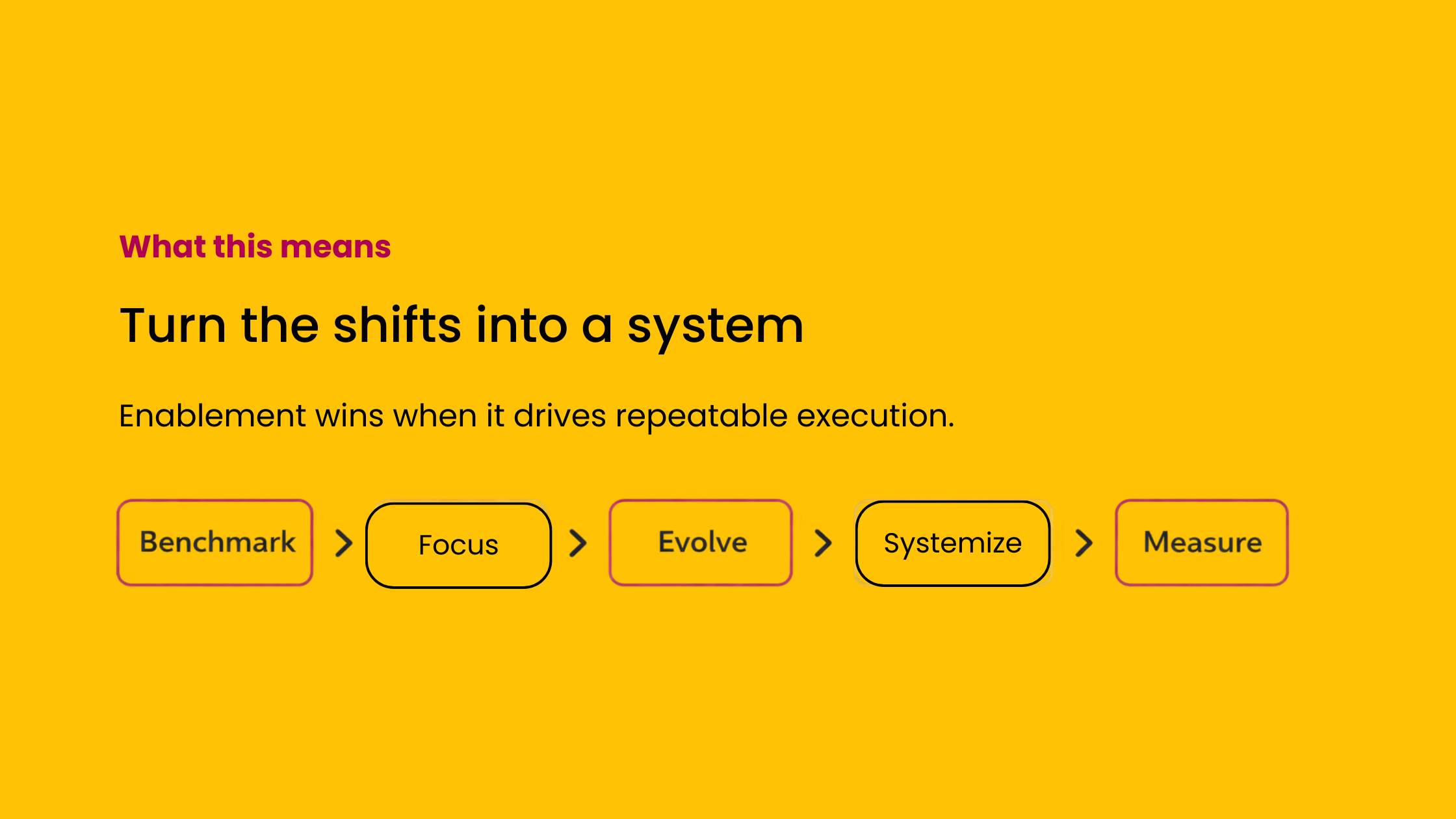
What This Means for Your Enablement Strategy
These shifts aren't theoretical. They're operational realities reshaping how effective mid-market and large organisations enable their frontline sales teams in 2026.
Here's how to apply these insights to your organisation:
1. Benchmark your current performance
Compare your existing performance against these numbers. Where are your reps strong? Where do gaps exist in conversion and retention? Use this assessment to build an evidence-based case for strategic investments in your enablement function.
2. Focus on what matters most
Not every metric will apply equally to your business. Prioritise areas that align with your goals, whether that's faster ramp time for new hires, higher conversion rates, improved engagement, or better closing rates across regions and products.
3. Treat enablement as continuous evolution
The strongest programs evolve over time using feedback and performance data. Build systems that can adapt as your market, customer expectations, and competitive landscape continue to change.
4. Elevate enablement's strategic role
Organisations with mature enablement functions achieve significantly higher results. But only when enablement operates as a strategic orchestrator of your revenue engine, not just a training and content function supporting sales.
5. Measure what drives revenue
Only 35% of companies have clear metrics for enablement effectiveness. The average ROI for mature enablement programs is 4:1. But you only get that return by measuring outcomes that matter: conversion rates, sales cycle length, quota attainment across your rep population, customer lifetime value, and retention.
Looking Forward
The enablement function for mid-market and large sales teams has evolved dramatically, and that evolution is accelerating. The organisations thriving share a common trait: they're willing to continuously rethink how enablement works for frontline sales environments.
They're not asking "how do we get better at what we're doing?" They're asking, "What should we fundamentally change about how we enable revenue generation for our sales teams, given how markets, customers, and technology have evolved?"
The data validates this approach. Companies with formal enablement programs see 49% higher win rates on forecasted deals. Sales teams with integrated tech stacks see 24% higher productivity across their rep populations. Organisations that regularly measure enablement ROI invest 41% more in these programs because they can justify the spend with concrete results from their frontline teams.
The frontline of sales has evolved. Your enablement approach needs to evolve with it. The question isn't whether to adapt. The question is how intentionally you'll lead that evolution for your reps, managers, and field teams.
Frequently Asked Questions
1) What are the most important sales enablement trends in 2026?
The biggest shifts are moving from role-based training to skills-based systems, from content libraries to intelligent delivery, from periodic updates to continuous competitive intelligence, from human-dependent workflows to AI-augmented capacity, and from fragmented tools to one execution system.
2) How do you scale sales enablement for hundreds or thousands of reps without losing consistency?
You stop relying on people to “remember the right way” and you build the system that makes the right execution the default. That means shared context across the sales motion, intelligent delivery of pitch and content in the moment, and workflows that reduce tool switching and manual follow-ups.
3) Will AI replace frontline sales reps in 2026?
No. AI will replace a lot of the invisible work around selling - searching, drafting, documenting, retrieving, and repeating. The rep’s value shifts upward: trust-building, judgment, and moving hesitant buyers to decisions. The winners will be teams that redesign the workflow around that partnership instead of bolting AI onto old processes.
What’s a Rich Text element?
The rich text element allows you to create and format headings, paragraphs, blockquotes, images, and video all in one place instead of having to add and format them individually. Just double-click and easily create content.
Static and dynamic content editing
A rich text element can be used with static or dynamic content. For static content, just drop it into any page and begin editing. For dynamic content, add a rich text field to any collection and then connect a rich text element to that field in the settings panel. Voila!
How to customize formatting for each rich text
Headings, paragraphs, blockquotes, figures, images, and figure captions can all be styled after a class is added to the rich text element using the "When inside of" nested selector system.
zdxfhgfg
- sdnslk,xdv
- SDlknjsdv
- SDvlknj
- sdgdf v