
Voice-Enabled Lead Management Systems for Frontline Sales Teams: From "Admin Later" to "Action Now”

Frontline selling is messy by design. It happens in branches, showrooms, clinic corridors, shop floors, and on the road. Leads come from everywhere. Conversations move fast. And the biggest leakage is rarely "lack of leads" - it is lack of follow-through.

Voice-Enabled Lead Management Systems for Frontline Sales Teams: From "Admin Later" to "Action Now”

Frontline selling is messy by design. It happens in branches, showrooms, clinic corridors, shop floors, and on the road. Leads come from everywhere. Conversations move fast. And the biggest leakage is rarely "lack of leads" - it is lack of follow-through.

That's why lead management is evolving from forms and fields to something closer to how frontline selling actually works: voice-first, conversation-driven, and AI-assisted. Instead of forcing reps to type updates after the meeting, a voice-enabled Lead Management System turns what the rep says into structured next steps, automatically.

The numbers back this shift. McKinsey estimates that generative AI could add $0.8 trillion to $1.2 trillion in productivity across sales and marketing, with the potential to increase sales productivity by approximately 3 to 5 percent of current global sales expenditures. About 20% of current sales-team functions could be automated with AI, and companies using data-driven sales processes experience 5-6% higher productivity.

What Is a Lead Management System?
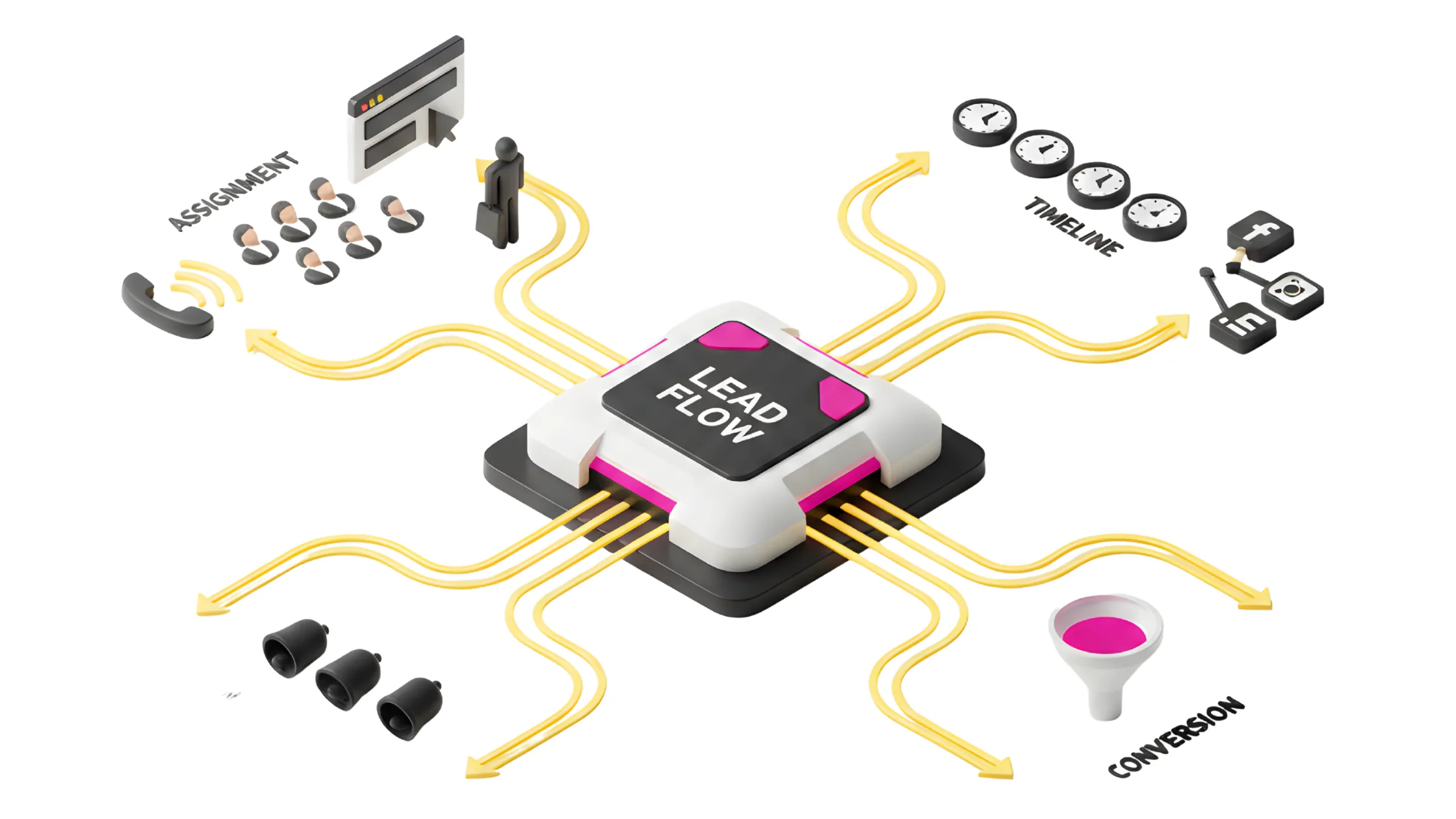
A Lead Management System is the system that helps sales teams:

  • Capture leads from multiple sources
  • Assign and route leads to the right reps
  • Track engagement history and next steps
  • Ensure follow-ups happen on time
  • Move leads through qualification to conversion
  • Measure funnel performance and rep productivity

In simple terms: it's the system that ensures every lead gets the right action, at the right time, by the right person.

How Traditional Lead Management System Used to Work (And Why It Breaks for Frontline Teams)
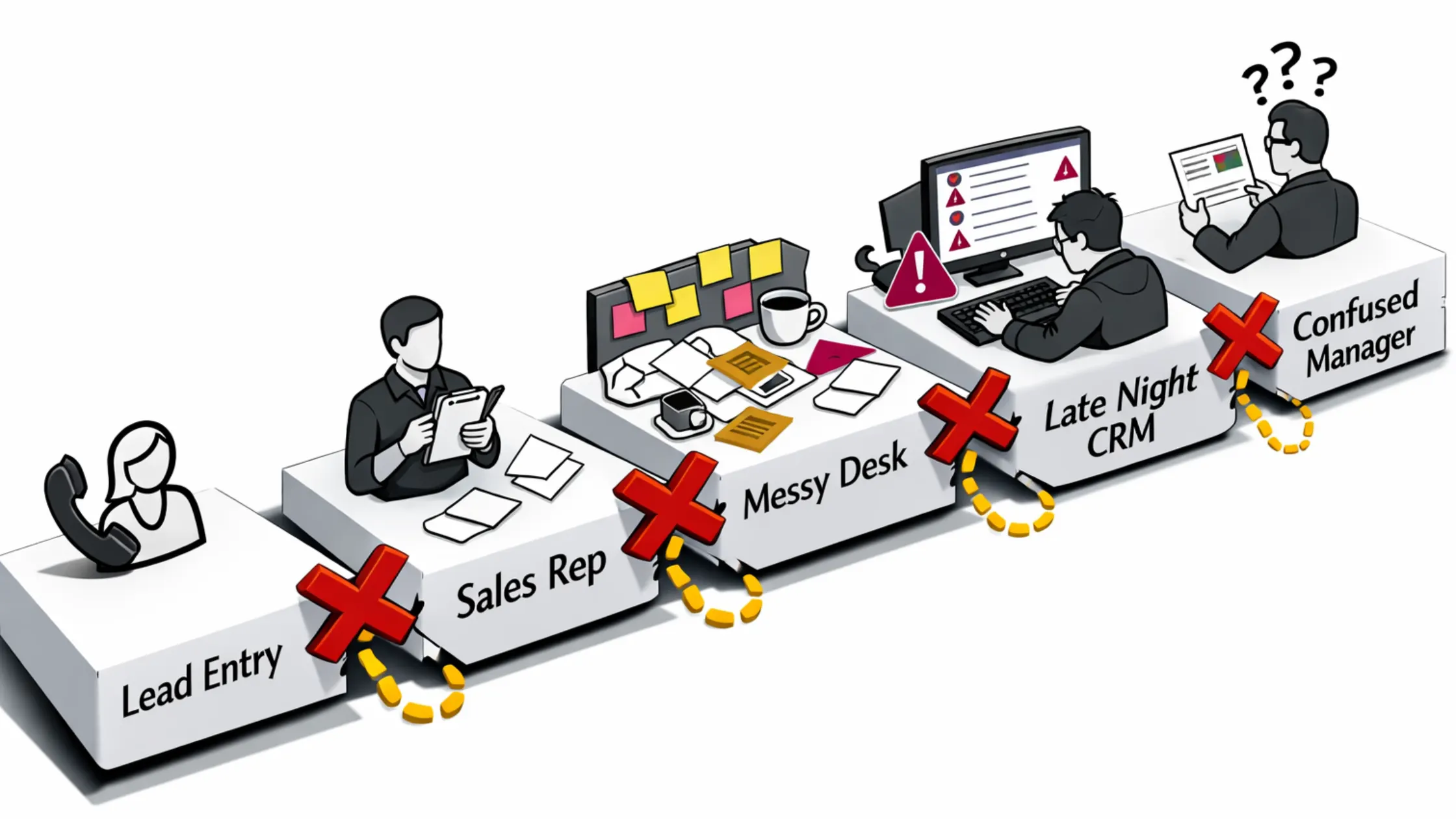
Traditional Lead Management System workflows usually look like this:

  1. Lead comes in and gets assigned
  2. Rep calls or visits
  3. Rep takes notes somewhere (paper, WhatsApp, memory)
  4. Later, rep updates Lead Management System/CRM manually
  5. Managers review funnel reports and follow-up status

The Hidden Cost of Manual Data Entry

This breaks in the real world because:

  • Manual data entry gets delayed (or skipped) - Reps prioritize selling over admin
  • Follow-ups become inconsistent and depend on rep discipline
  • Systems capture outcomes, not conversations - "Call done" vs. what was actually discussed
  • Coaching is weak because managers don't see patterns inside conversations

Why Speed-to-Lead Matters More Than Ever
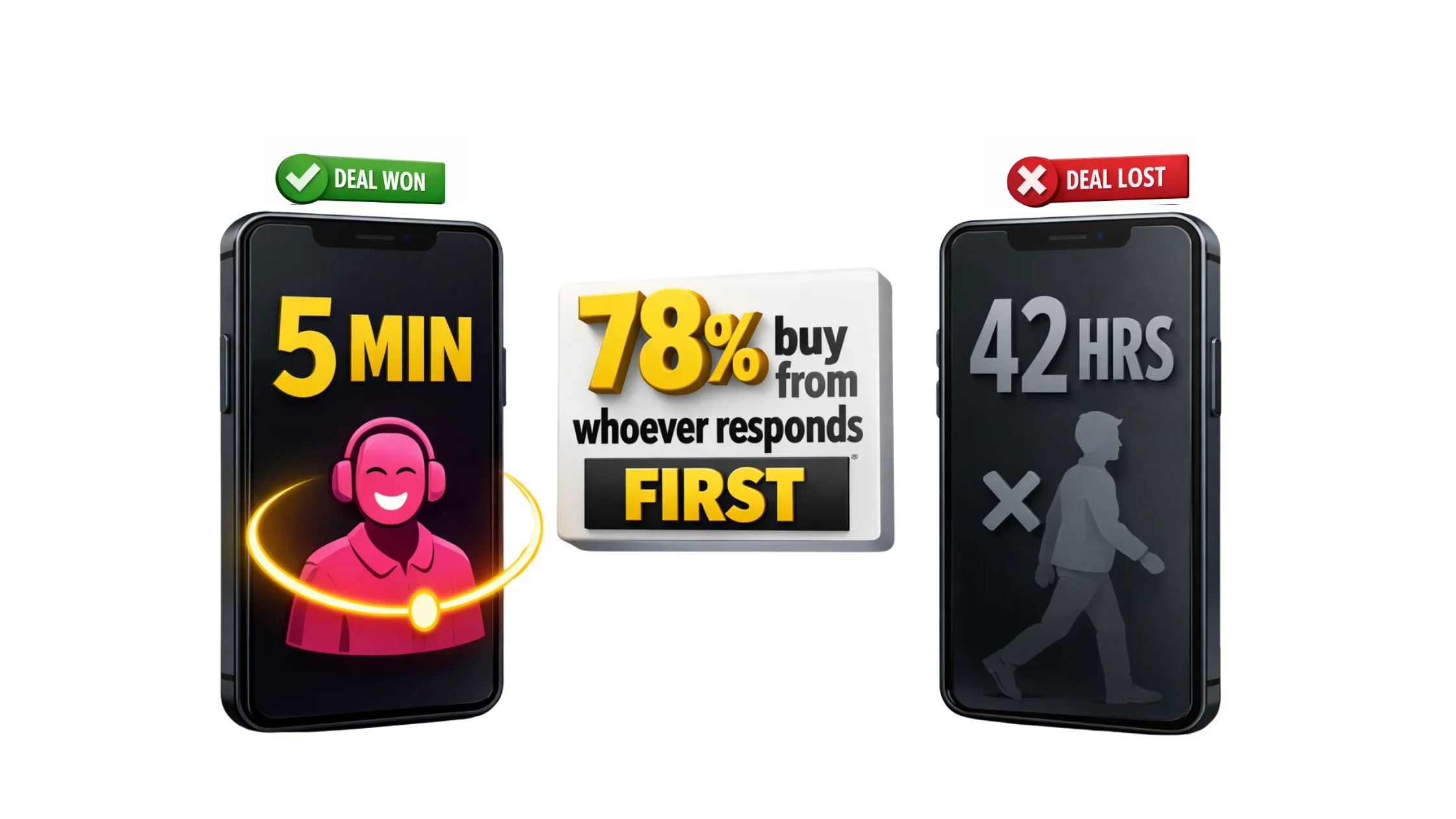
Lead response speed is critical. Research shows that the odds of contacting a lead in 5 minutes versus 30 minutes drop by 100 times, and the odds of qualifying a lead drop 21 times. Even more telling: 78% of customers end up buying from the company that responds first.

Yet the average lead response time across industries is 42 hours, and more than 30% of leads are never contacted at all.

This is exactly the window where frontline teams lose deals - not because they lack leads, but because traditional systems can't keep pace with how fast-moving frontline selling actually happens.

The 2024-2025 Shift: From Voice Commands to AI Agents

The evolution accelerated dramatically in 2024-2025. What started as simple voice-to-text has transformed into AI agents that don't just record - they act.

What Top-Performing Teams Are Already Doing

Key developments:

  • AI agent adoption has surged, with high performers 3x more likely to be scaling agent use than peers
  • 73% of sales professionals report AI has significantly improved team productivity
  • AI sales tools can increase leads by 50% and cut costs by up to 60%
  • Sales professionals using AI are 47% more productive, saving 12 hours per week

The shift is clear: companies can automate roughly a fifth of current sales functions, and automation and AI can free up roughly 20% of a sales team's capacity. The question isn't whether AI will reshape lead management - it's whether your team will adopt it before your competitors do.

How AI-Based Voice-Enabled Lead Management System Works Now

A modern voice-enabled Lead Management System isn't just "voice commands on a CRM." It's a conversation-to-workflow system that transforms how reps capture, process, and act on leads.

The Five-Minute Window That Changes Everything

Here's what changes:

1. Voice Capture Replaces Typing

The rep speaks naturally:

"Customer wants premium comparison, spouse is decision-maker, follow up tomorrow 11am, share plan options."

No forms. No fields. No typing while the customer waits.

2. Speech-to-Structure Converts Talk into CRM-Ready Data

The system automatically extracts and logs:

  • Intent and product interest - Which product category and variant
  • Key needs and constraints - Budget, timeline, decision factors
  • Objections - Price, trust, documentation, timing concerns
  • Decision-makers and timeline - Who's involved, when they need it
  • Next steps with reminders and tasks

3. AI Adds Next-Best Action, Not Just Notes

Based on what was said, the Lead Management System can prompt:

  • "Ask these 3 qualification questions"
  • "Send this comparison"
  • "Schedule a visit"
  • "Collect these documents"
  • "Escalate to manager if no response in 24 hours"

The system doesn't just record what happened - it tells the rep what to do next.

4. Auto-Logging Improves Compliance and Governance

For regulated categories, voice-driven structured logging can enforce:

  • Approved messaging and disclosures - Ensure regulatory compliance
  • Clear audit trails - Complete conversation history
  • Consistent pitch flows - Standardized sales processes

5. Managers Get Coaching Signals from Reality

Instead of only seeing pipeline numbers, managers see patterns like:

  • Top objections by product - What's blocking deals most often
  • Steps missed most often - Where reps drop the ball
  • Lead sources generating poor quality - Which channels need adjustment
  • Which talk tracks correlate with conversion - What messaging actually works

Put simply: voice-enabled Lead Management System reduces admin, increases follow-up discipline, and upgrades conversation quality.

How It Helps Frontline Sales Reps (In Day-to-Day Reality)

Voice-enabled Lead Management System helps reps in four very practical ways:

1. Less Admin, More Selling

Reps stop "updating later" and spend more time with customers. Instead of choosing between admin and activity, they do both simultaneously.

2. Faster Follow-Up, Lower Lead Leakage

Tasks and reminders are created instantly, so leads don't die because someone forgot. The system remembers even when the rep doesn't.

3. Better Qualification

Reps get nudges on what to ask, what to capture, and what step comes next. Even average performers sound prepared because the system guides them.

4. More Confident Conversations

When the system can surface the right info and actions quickly, reps don't freeze when customers ask tough questions. They have answers ready.

A useful way to think about it: Traditional Lead Management System tracks leads. Voice-enabled Lead Management System drives the next action.

Industry-Specific: What Changes When Lead Management System Becomes Voice-First

Insurance 

In insurance, conversations involve high product complexity and compliance risk. Voice-enabled Lead Management System helps capture life-stage details, coverage gaps, and objections immediately after the meeting, then prompts the rep with the right comparison, rider discussion, and next document step.

Impact: Reduces mis-selling risk by ensuring key needs and rationale are recorded, not improvised. Compliance officers can audit conversations, not just outcomes.

Banking and NBFCs 

Banking lead cycles involve eligibility, documentation, and follow-up coordination. A voice-enabled Lead Management System can instantly log profile details (income band, purpose, risk comfort), trigger a documentation checklist, and keep follow-ups on track.

Impact: Helps managers enforce funnel hygiene without chasing reps for updates. Reduces drop-off between application and document submission.

Auto 

Auto sales is fast, multi-touch, and highly competitive. Voice-enabled Lead Management System captures test drive feedback, variant preference, finance intent, exchange requirements, and family decision-maker context right away. It then schedules a follow-up with tailored collateral and financing options, instead of generic reminders.

Impact: Speed matters. The first dealer to respond with a personalized quote often wins. Voice Lead Management System cuts response time from hours to minutes.

Pharma 

Pharma selling is relationship-heavy and visit-driven. Voice-enabled Lead Management System helps reps record doctor feedback, brand objections, patient-type context, and next visit objective quickly, even on the move.

Impact: Managers get better visibility into field realities without relying on end-of-day manual reporting. Territory planning improves when you know what doctors actually said.

Retail 

Retail leads are often "soft leads" that die quickly. Voice-enabled Lead Management System helps store staff capture preference, budget range, delivery constraints, and contact consent in seconds, then triggers immediate follow-ups, offers, and availability checks.

Impact: Critical where speed-to-response drives conversion. A WhatsApp message with product availability sent within 5 minutes can close a deal that would otherwise go to a competitor.

Consumer Durables 

Consumer durables sales often involve price sensitivity, EMI discussions, installation, and post-sale coordination. Voice-enabled Lead Management System captures the exact requirement and context, triggers the right value explanation, and ensures follow-up tasks like installation scheduling, warranty explanation, and upsell accessories are not missed.

Impact: Prevents post-sale drop-off. Installation delays and unclear warranty terms are top complaint drivers—voice Lead Management System ensures these get tracked and executed.

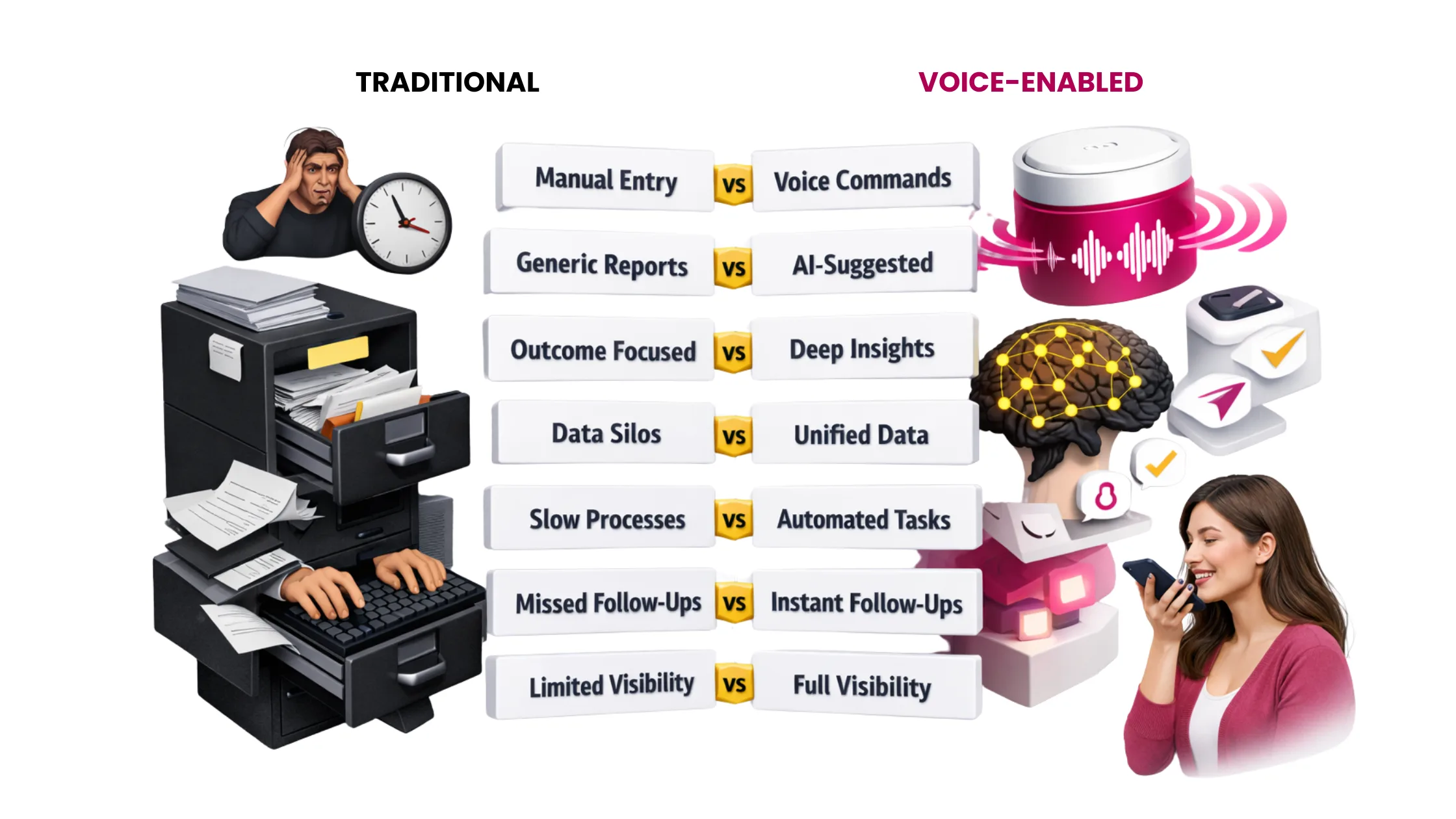
Traditional Lead Management System vs. Voice-Enabled AI Lead Management System: The Key Differences
Conclusion: The System That Matches How Frontline Selling Actually Happens

The frontline sales problem isn't that teams lack tools - it's that traditional tools were built for desks, not the field. Voice-enabled Lead Management System flips this model: it listens to what happened, converts it into structured next steps, and drives action immediately.

The data is clear: companies can automate a fifth of current sales functions, and teams using AI see 47% higher productivity. But technology alone isn't the answer. The shift improves follow-up discipline, reduces lead leakage, and upgrades conversation quality at scale - especially critical in high-volume industries where 78% of customers buy from whoever responds first.

For insurance, banking, auto, pharma, retail, and consumer durables sales teams - where one missed call can mean a lost customer - voice-enabled Lead Management System isn't a nice-to-have anymore. It's becoming table stakes for competitive execution.

The question isn't whether to adopt voice-enabled systems. It's whether you can afford not to while your competitors already are.

Want to see how voice-enabled lead management can transform your frontline team's performance? Book a demo to explore how AI-powered execution systems are reshaping sales productivity.

Sources:
McKinsey & Company - "The economic potential of generative AI: The next productivity frontier"

  • The “New Normal” for Pharma Sales post the lockdown
  • Why organizations look for Sales Enablement
  • How Sales Enablement is different from traditional LMS or CRM
  • The industry best practices for Sales Enablement
  • Implementation challenges and how to overcome them
  • Ensuring higher adoption

Aman Vasishth

Aman Vasishth is a B2B marketing leader who simplifies complex products through storytelling-driven strategy. He has led brand, growth, and content initiatives across fintech and F&B, building scalable marketing systems that drive measurable business impact.

Voice-Enabled Lead Management Systems for Frontline Sales Teams: From "Admin Later" to "Action Now”

Voice-Enabled Lead Management Systems for Frontline Sales Teams: From "Admin Later" to "Action Now”

Frontline selling is messy by design. It happens in branches, showrooms, clinic corridors, shop floors, and on the road. Leads come from everywhere. Conversations move fast. And the biggest leakage is rarely "lack of leads" - it is lack of follow-through.
Aman Vasishth
January 7, 2026

Frontline selling is messy by design. It happens in branches, showrooms, clinic corridors, shop floors, and on the road. Leads come from everywhere. Conversations move fast. And the biggest leakage is rarely "lack of leads" - it is lack of follow-through.

That's why lead management is evolving from forms and fields to something closer to how frontline selling actually works: voice-first, conversation-driven, and AI-assisted. Instead of forcing reps to type updates after the meeting, a voice-enabled Lead Management System turns what the rep says into structured next steps, automatically.

The numbers back this shift. McKinsey estimates that generative AI could add $0.8 trillion to $1.2 trillion in productivity across sales and marketing, with the potential to increase sales productivity by approximately 3 to 5 percent of current global sales expenditures. About 20% of current sales-team functions could be automated with AI, and companies using data-driven sales processes experience 5-6% higher productivity.

What Is a Lead Management System?

A Lead Management System is the system that helps sales teams:

  • Capture leads from multiple sources
  • Assign and route leads to the right reps
  • Track engagement history and next steps
  • Ensure follow-ups happen on time
  • Move leads through qualification to conversion
  • Measure funnel performance and rep productivity

In simple terms: it's the system that ensures every lead gets the right action, at the right time, by the right person.

How Traditional Lead Management System Used to Work (And Why It Breaks for Frontline Teams)

Traditional Lead Management System workflows usually look like this:

  1. Lead comes in and gets assigned
  2. Rep calls or visits
  3. Rep takes notes somewhere (paper, WhatsApp, memory)
  4. Later, rep updates Lead Management System/CRM manually
  5. Managers review funnel reports and follow-up status

The Hidden Cost of Manual Data Entry

This breaks in the real world because:

  • Manual data entry gets delayed (or skipped) - Reps prioritize selling over admin
  • Follow-ups become inconsistent and depend on rep discipline
  • Systems capture outcomes, not conversations - "Call done" vs. what was actually discussed
  • Coaching is weak because managers don't see patterns inside conversations

Why Speed-to-Lead Matters More Than Ever

Lead response speed is critical. Research shows that the odds of contacting a lead in 5 minutes versus 30 minutes drop by 100 times, and the odds of qualifying a lead drop 21 times. Even more telling: 78% of customers end up buying from the company that responds first.

Yet the average lead response time across industries is 42 hours, and more than 30% of leads are never contacted at all.

This is exactly the window where frontline teams lose deals - not because they lack leads, but because traditional systems can't keep pace with how fast-moving frontline selling actually happens.

The 2024-2025 Shift: From Voice Commands to AI Agents

The evolution accelerated dramatically in 2024-2025. What started as simple voice-to-text has transformed into AI agents that don't just record - they act.

What Top-Performing Teams Are Already Doing

Key developments:

  • AI agent adoption has surged, with high performers 3x more likely to be scaling agent use than peers
  • 73% of sales professionals report AI has significantly improved team productivity
  • AI sales tools can increase leads by 50% and cut costs by up to 60%
  • Sales professionals using AI are 47% more productive, saving 12 hours per week

The shift is clear: companies can automate roughly a fifth of current sales functions, and automation and AI can free up roughly 20% of a sales team's capacity. The question isn't whether AI will reshape lead management - it's whether your team will adopt it before your competitors do.

How AI-Based Voice-Enabled Lead Management System Works Now

A modern voice-enabled Lead Management System isn't just "voice commands on a CRM." It's a conversation-to-workflow system that transforms how reps capture, process, and act on leads.

The Five-Minute Window That Changes Everything

Here's what changes:

1. Voice Capture Replaces Typing

The rep speaks naturally:

"Customer wants premium comparison, spouse is decision-maker, follow up tomorrow 11am, share plan options."

No forms. No fields. No typing while the customer waits.

2. Speech-to-Structure Converts Talk into CRM-Ready Data

The system automatically extracts and logs:

  • Intent and product interest - Which product category and variant
  • Key needs and constraints - Budget, timeline, decision factors
  • Objections - Price, trust, documentation, timing concerns
  • Decision-makers and timeline - Who's involved, when they need it
  • Next steps with reminders and tasks

3. AI Adds Next-Best Action, Not Just Notes

Based on what was said, the Lead Management System can prompt:

  • "Ask these 3 qualification questions"
  • "Send this comparison"
  • "Schedule a visit"
  • "Collect these documents"
  • "Escalate to manager if no response in 24 hours"

The system doesn't just record what happened - it tells the rep what to do next.

4. Auto-Logging Improves Compliance and Governance

For regulated categories, voice-driven structured logging can enforce:

  • Approved messaging and disclosures - Ensure regulatory compliance
  • Clear audit trails - Complete conversation history
  • Consistent pitch flows - Standardized sales processes

5. Managers Get Coaching Signals from Reality

Instead of only seeing pipeline numbers, managers see patterns like:

  • Top objections by product - What's blocking deals most often
  • Steps missed most often - Where reps drop the ball
  • Lead sources generating poor quality - Which channels need adjustment
  • Which talk tracks correlate with conversion - What messaging actually works

Put simply: voice-enabled Lead Management System reduces admin, increases follow-up discipline, and upgrades conversation quality.

How It Helps Frontline Sales Reps (In Day-to-Day Reality)

Voice-enabled Lead Management System helps reps in four very practical ways:

1. Less Admin, More Selling

Reps stop "updating later" and spend more time with customers. Instead of choosing between admin and activity, they do both simultaneously.

2. Faster Follow-Up, Lower Lead Leakage

Tasks and reminders are created instantly, so leads don't die because someone forgot. The system remembers even when the rep doesn't.

3. Better Qualification

Reps get nudges on what to ask, what to capture, and what step comes next. Even average performers sound prepared because the system guides them.

4. More Confident Conversations

When the system can surface the right info and actions quickly, reps don't freeze when customers ask tough questions. They have answers ready.

A useful way to think about it: Traditional Lead Management System tracks leads. Voice-enabled Lead Management System drives the next action.

Industry-Specific: What Changes When Lead Management System Becomes Voice-First

Insurance 

In insurance, conversations involve high product complexity and compliance risk. Voice-enabled Lead Management System helps capture life-stage details, coverage gaps, and objections immediately after the meeting, then prompts the rep with the right comparison, rider discussion, and next document step.

Impact: Reduces mis-selling risk by ensuring key needs and rationale are recorded, not improvised. Compliance officers can audit conversations, not just outcomes.

Banking and NBFCs 

Banking lead cycles involve eligibility, documentation, and follow-up coordination. A voice-enabled Lead Management System can instantly log profile details (income band, purpose, risk comfort), trigger a documentation checklist, and keep follow-ups on track.

Impact: Helps managers enforce funnel hygiene without chasing reps for updates. Reduces drop-off between application and document submission.

Auto 

Auto sales is fast, multi-touch, and highly competitive. Voice-enabled Lead Management System captures test drive feedback, variant preference, finance intent, exchange requirements, and family decision-maker context right away. It then schedules a follow-up with tailored collateral and financing options, instead of generic reminders.

Impact: Speed matters. The first dealer to respond with a personalized quote often wins. Voice Lead Management System cuts response time from hours to minutes.

Pharma 

Pharma selling is relationship-heavy and visit-driven. Voice-enabled Lead Management System helps reps record doctor feedback, brand objections, patient-type context, and next visit objective quickly, even on the move.

Impact: Managers get better visibility into field realities without relying on end-of-day manual reporting. Territory planning improves when you know what doctors actually said.

Retail 

Retail leads are often "soft leads" that die quickly. Voice-enabled Lead Management System helps store staff capture preference, budget range, delivery constraints, and contact consent in seconds, then triggers immediate follow-ups, offers, and availability checks.

Impact: Critical where speed-to-response drives conversion. A WhatsApp message with product availability sent within 5 minutes can close a deal that would otherwise go to a competitor.

Consumer Durables 

Consumer durables sales often involve price sensitivity, EMI discussions, installation, and post-sale coordination. Voice-enabled Lead Management System captures the exact requirement and context, triggers the right value explanation, and ensures follow-up tasks like installation scheduling, warranty explanation, and upsell accessories are not missed.

Impact: Prevents post-sale drop-off. Installation delays and unclear warranty terms are top complaint drivers—voice Lead Management System ensures these get tracked and executed.

Traditional Lead Management System vs. Voice-Enabled AI Lead Management System: The Key Differences

Conclusion: The System That Matches How Frontline Selling Actually Happens

The frontline sales problem isn't that teams lack tools - it's that traditional tools were built for desks, not the field. Voice-enabled Lead Management System flips this model: it listens to what happened, converts it into structured next steps, and drives action immediately.

The data is clear: companies can automate a fifth of current sales functions, and teams using AI see 47% higher productivity. But technology alone isn't the answer. The shift improves follow-up discipline, reduces lead leakage, and upgrades conversation quality at scale - especially critical in high-volume industries where 78% of customers buy from whoever responds first.

For insurance, banking, auto, pharma, retail, and consumer durables sales teams - where one missed call can mean a lost customer - voice-enabled Lead Management System isn't a nice-to-have anymore. It's becoming table stakes for competitive execution.

The question isn't whether to adopt voice-enabled systems. It's whether you can afford not to while your competitors already are.

Want to see how voice-enabled lead management can transform your frontline team's performance? Book a demo to explore how AI-powered execution systems are reshaping sales productivity.

Sources:
McKinsey & Company - "The economic potential of generative AI: The next productivity frontier"

What’s a Rich Text element?

The rich text element allows you to create and format headings, paragraphs, blockquotes, images, and video all in one place instead of having to add and format them individually. Just double-click and easily create content.

Static and dynamic content editing

A rich text element can be used with static or dynamic content. For static content, just drop it into any page and begin editing. For dynamic content, add a rich text field to any collection and then connect a rich text element to that field in the settings panel. Voila!

How to customize formatting for each rich text

Headings, paragraphs, blockquotes, figures, images, and figure captions can all be styled after a class is added to the rich text element using the "When inside of" nested selector system.

zdxfhgfg

  1. sdnslk,xdv
  2. SDlknjsdv
  3. SDvlknj
  • sdgdf v

Voice-Enabled Lead Management Systems for Frontline Sales Teams: From "Admin Later" to "Action Now”

February 12, 2026
12 Min
Aman Vasishth
Aman Vasishth

Frontline selling is messy by design. It happens in branches, showrooms, clinic corridors, shop floors, and on the road. Leads come from everywhere. Conversations move fast. And the biggest leakage is rarely "lack of leads" - it is lack of follow-through.

That's why lead management is evolving from forms and fields to something closer to how frontline selling actually works: voice-first, conversation-driven, and AI-assisted. Instead of forcing reps to type updates after the meeting, a voice-enabled Lead Management System turns what the rep says into structured next steps, automatically.

The numbers back this shift. McKinsey estimates that generative AI could add $0.8 trillion to $1.2 trillion in productivity across sales and marketing, with the potential to increase sales productivity by approximately 3 to 5 percent of current global sales expenditures. About 20% of current sales-team functions could be automated with AI, and companies using data-driven sales processes experience 5-6% higher productivity.

What Is a Lead Management System?

A Lead Management System is the system that helps sales teams:

  • Capture leads from multiple sources
  • Assign and route leads to the right reps
  • Track engagement history and next steps
  • Ensure follow-ups happen on time
  • Move leads through qualification to conversion
  • Measure funnel performance and rep productivity

In simple terms: it's the system that ensures every lead gets the right action, at the right time, by the right person.

How Traditional Lead Management System Used to Work (And Why It Breaks for Frontline Teams)

Traditional Lead Management System workflows usually look like this:

  1. Lead comes in and gets assigned
  2. Rep calls or visits
  3. Rep takes notes somewhere (paper, WhatsApp, memory)
  4. Later, rep updates Lead Management System/CRM manually
  5. Managers review funnel reports and follow-up status

The Hidden Cost of Manual Data Entry

This breaks in the real world because:

  • Manual data entry gets delayed (or skipped) - Reps prioritize selling over admin
  • Follow-ups become inconsistent and depend on rep discipline
  • Systems capture outcomes, not conversations - "Call done" vs. what was actually discussed
  • Coaching is weak because managers don't see patterns inside conversations

Why Speed-to-Lead Matters More Than Ever

Lead response speed is critical. Research shows that the odds of contacting a lead in 5 minutes versus 30 minutes drop by 100 times, and the odds of qualifying a lead drop 21 times. Even more telling: 78% of customers end up buying from the company that responds first.

Yet the average lead response time across industries is 42 hours, and more than 30% of leads are never contacted at all.

This is exactly the window where frontline teams lose deals - not because they lack leads, but because traditional systems can't keep pace with how fast-moving frontline selling actually happens.

The 2024-2025 Shift: From Voice Commands to AI Agents

The evolution accelerated dramatically in 2024-2025. What started as simple voice-to-text has transformed into AI agents that don't just record - they act.

What Top-Performing Teams Are Already Doing

Key developments:

  • AI agent adoption has surged, with high performers 3x more likely to be scaling agent use than peers
  • 73% of sales professionals report AI has significantly improved team productivity
  • AI sales tools can increase leads by 50% and cut costs by up to 60%
  • Sales professionals using AI are 47% more productive, saving 12 hours per week

The shift is clear: companies can automate roughly a fifth of current sales functions, and automation and AI can free up roughly 20% of a sales team's capacity. The question isn't whether AI will reshape lead management - it's whether your team will adopt it before your competitors do.

How AI-Based Voice-Enabled Lead Management System Works Now

A modern voice-enabled Lead Management System isn't just "voice commands on a CRM." It's a conversation-to-workflow system that transforms how reps capture, process, and act on leads.

The Five-Minute Window That Changes Everything

Here's what changes:

1. Voice Capture Replaces Typing

The rep speaks naturally:

"Customer wants premium comparison, spouse is decision-maker, follow up tomorrow 11am, share plan options."

No forms. No fields. No typing while the customer waits.

2. Speech-to-Structure Converts Talk into CRM-Ready Data

The system automatically extracts and logs:

  • Intent and product interest - Which product category and variant
  • Key needs and constraints - Budget, timeline, decision factors
  • Objections - Price, trust, documentation, timing concerns
  • Decision-makers and timeline - Who's involved, when they need it
  • Next steps with reminders and tasks

3. AI Adds Next-Best Action, Not Just Notes

Based on what was said, the Lead Management System can prompt:

  • "Ask these 3 qualification questions"
  • "Send this comparison"
  • "Schedule a visit"
  • "Collect these documents"
  • "Escalate to manager if no response in 24 hours"

The system doesn't just record what happened - it tells the rep what to do next.

4. Auto-Logging Improves Compliance and Governance

For regulated categories, voice-driven structured logging can enforce:

  • Approved messaging and disclosures - Ensure regulatory compliance
  • Clear audit trails - Complete conversation history
  • Consistent pitch flows - Standardized sales processes

5. Managers Get Coaching Signals from Reality

Instead of only seeing pipeline numbers, managers see patterns like:

  • Top objections by product - What's blocking deals most often
  • Steps missed most often - Where reps drop the ball
  • Lead sources generating poor quality - Which channels need adjustment
  • Which talk tracks correlate with conversion - What messaging actually works

Put simply: voice-enabled Lead Management System reduces admin, increases follow-up discipline, and upgrades conversation quality.

How It Helps Frontline Sales Reps (In Day-to-Day Reality)

Voice-enabled Lead Management System helps reps in four very practical ways:

1. Less Admin, More Selling

Reps stop "updating later" and spend more time with customers. Instead of choosing between admin and activity, they do both simultaneously.

2. Faster Follow-Up, Lower Lead Leakage

Tasks and reminders are created instantly, so leads don't die because someone forgot. The system remembers even when the rep doesn't.

3. Better Qualification

Reps get nudges on what to ask, what to capture, and what step comes next. Even average performers sound prepared because the system guides them.

4. More Confident Conversations

When the system can surface the right info and actions quickly, reps don't freeze when customers ask tough questions. They have answers ready.

A useful way to think about it: Traditional Lead Management System tracks leads. Voice-enabled Lead Management System drives the next action.

Industry-Specific: What Changes When Lead Management System Becomes Voice-First

Insurance 

In insurance, conversations involve high product complexity and compliance risk. Voice-enabled Lead Management System helps capture life-stage details, coverage gaps, and objections immediately after the meeting, then prompts the rep with the right comparison, rider discussion, and next document step.

Impact: Reduces mis-selling risk by ensuring key needs and rationale are recorded, not improvised. Compliance officers can audit conversations, not just outcomes.

Banking and NBFCs 

Banking lead cycles involve eligibility, documentation, and follow-up coordination. A voice-enabled Lead Management System can instantly log profile details (income band, purpose, risk comfort), trigger a documentation checklist, and keep follow-ups on track.

Impact: Helps managers enforce funnel hygiene without chasing reps for updates. Reduces drop-off between application and document submission.

Auto 

Auto sales is fast, multi-touch, and highly competitive. Voice-enabled Lead Management System captures test drive feedback, variant preference, finance intent, exchange requirements, and family decision-maker context right away. It then schedules a follow-up with tailored collateral and financing options, instead of generic reminders.

Impact: Speed matters. The first dealer to respond with a personalized quote often wins. Voice Lead Management System cuts response time from hours to minutes.

Pharma 

Pharma selling is relationship-heavy and visit-driven. Voice-enabled Lead Management System helps reps record doctor feedback, brand objections, patient-type context, and next visit objective quickly, even on the move.

Impact: Managers get better visibility into field realities without relying on end-of-day manual reporting. Territory planning improves when you know what doctors actually said.

Retail 

Retail leads are often "soft leads" that die quickly. Voice-enabled Lead Management System helps store staff capture preference, budget range, delivery constraints, and contact consent in seconds, then triggers immediate follow-ups, offers, and availability checks.

Impact: Critical where speed-to-response drives conversion. A WhatsApp message with product availability sent within 5 minutes can close a deal that would otherwise go to a competitor.

Consumer Durables 

Consumer durables sales often involve price sensitivity, EMI discussions, installation, and post-sale coordination. Voice-enabled Lead Management System captures the exact requirement and context, triggers the right value explanation, and ensures follow-up tasks like installation scheduling, warranty explanation, and upsell accessories are not missed.

Impact: Prevents post-sale drop-off. Installation delays and unclear warranty terms are top complaint drivers—voice Lead Management System ensures these get tracked and executed.

Traditional Lead Management System vs. Voice-Enabled AI Lead Management System: The Key Differences

Conclusion: The System That Matches How Frontline Selling Actually Happens

The frontline sales problem isn't that teams lack tools - it's that traditional tools were built for desks, not the field. Voice-enabled Lead Management System flips this model: it listens to what happened, converts it into structured next steps, and drives action immediately.

The data is clear: companies can automate a fifth of current sales functions, and teams using AI see 47% higher productivity. But technology alone isn't the answer. The shift improves follow-up discipline, reduces lead leakage, and upgrades conversation quality at scale - especially critical in high-volume industries where 78% of customers buy from whoever responds first.

For insurance, banking, auto, pharma, retail, and consumer durables sales teams - where one missed call can mean a lost customer - voice-enabled Lead Management System isn't a nice-to-have anymore. It's becoming table stakes for competitive execution.

The question isn't whether to adopt voice-enabled systems. It's whether you can afford not to while your competitors already are.

Want to see how voice-enabled lead management can transform your frontline team's performance? Book a demo to explore how AI-powered execution systems are reshaping sales productivity.

Sources:
McKinsey & Company - "The economic potential of generative AI: The next productivity frontier"

Readers also liked

12 mins
Aman Vasishth
Aman Vasishth
5 min
Mansi Mishra
Mansi Mishra
6 min
Abhijit Paul
Abhijit Paul
8 min
Rohan Sabnis
Rohan Sabnis

Are you ready to unleash the power of Sales Playbooks for your team?

Thank you! You have been added to our subscriber list!
Oops! Something went wrong while submitting the form.