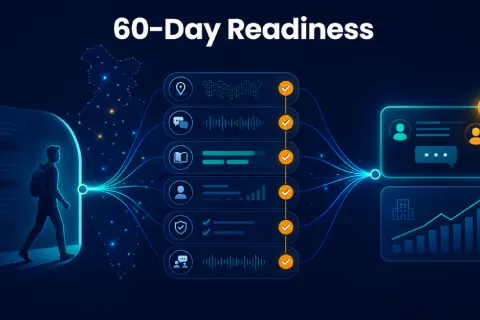

In 2026, your biggest competitor is not the vendor across the street. It is indecision. Research consistently shows that between 40% to 60% of all B2B deals end with no decision at all. In the automotive and BFSI sectors, buyers are currently operating under intense financial scrutiny. They are not simply looking for better features; they are actively searching for reasons to minimise risk and delay commitments. When frontline sales reps encounter friction regarding upfront costs or long-term ROI, and they lack a structured response, the momentum dies. The buyer goes silent, the pipeline clogs, and revenue leaks out of the system.
The financial stakes have rarely been higher. In the automotive sector, industry forecasts project a tightening market, with 2026 sales hovering around 15.8 to 16 million units as severe affordability pressures and high borrowing costs push buyers to scrutinise every purchase. BFSI decision-makers face similar macroeconomic headwinds, operating under strict mandates to justify every dollar spent. This environment creates two distinct layers of resistance. At the executive level, the decision-maker views your offering through the lens of financial and strategic risk, questioning ROI and upfront capital requirements. At the ground level, the end-user views your offering through the lens of operational friction, fearing implementation delays, steep learning curves, and workflow disruption. If a sales rep cannot satisfy both layers of scrutiny, the buyer defaults to the safety of the status quo.
The root cause of these stalled deals often traces directly back to capability gaps on the sales floor. Recent data indicates that 37% of deals stall simply because the salesperson fails to fully grasp and address the buyer's core challenges during the discovery and evaluation phases. Furthermore, 62% of buyers will shift or rescope their needs mid-process. When a buyer throws an objection about perceived risk or operational disruption, an unprepared rep will stumble. They resort to discounting or pushing product features rather than addressing the underlying psychological blocker. This lack of execution consistency across distributed geographies is what turns winnable deals into dead ends.
Sales organisations can no longer afford to let individual reps improvise their way through complex objections. When responses vary wildly from one region to the next, forecasting becomes impossible. You need a systematic approach to replicate the high-impact behaviours of your top performers. Standardising your objection handling bridges the gap between your go-to-market strategy and actual frontline execution. It transforms a scattered, reactive sales force into a synchronised unit capable of defending value, clarifying the true cost of inaction, and guiding the buyer safely through their hesitation.
This guide details the 14 most common objections your teams will face in the BFSI and automotive sectors today, paired with field-tested, structured rebuttals. By deploying these specific responses, Chief Revenue Officers and Sales Leaders can hardwire execution consistency into their teams. Whether delivered through on-the-fly enablement, AI role-plays, or real-time battlecards, these frameworks equip your frontline agents to handle buyer scrutiny confidently. They are designed to directly address the operational and financial anxieties of your prospects, bridging capability gaps and keeping deals moving forward at every stage of the 2026 buyer journey.
Objection 1: I already have a corporate health insurance policy.
Relying solely on a corporate health insurance policy is a high-risk strategy disguised as a safety net. When a prospect raises this objection, they view supplemental health insurance as a redundant expense. The tactical response requires shifting the conversation from basic coverage to mathematical risk mitigation. In 2026, India's medical inflation rate sits at approximately 14%, nearly triple the general inflation rate. This means the purchasing power of a static corporate policy is rapidly depreciating, exposing the prospect to severe out-of-pocket costs during a medical crisis.
The critical vulnerability lies in the standard limits of employer-sponsored plans. The average corporate health insurance policy in India provides a base cover between ₹1 Lakh and ₹5 Lakh. While this is sufficient for minor, routine hospitalisations, it completely fails against serious medical events. Advanced procedures, targeted oncology treatments, or complex cardiovascular surgeries in private Tier-1 hospitals routinely exceed ₹15 Lakh to ₹20 Lakh, with some major interventions pushing much higher. Once a medical bill breaches the corporate limit - often within the first few days of critical care - the financial burden transfers entirely to the patient, forcing them to liquidate personal savings or equity to fund the deficit.
Beyond coverage limits, corporate insurance is structurally flawed as a primary protection mechanism because it is contingent on active employment. A severe illness often necessitates a prolonged leave of absence or forces the individual out of the workforce entirely. The moment employment terminates, the corporate health cover evaporates. Attempting to purchase an individual retail health policy after a major diagnosis is a losing battle; insurers will either apply strict exclusions for the newly acquired pre-existing condition or reject the application outright. The prospect is left uninsurable when they are most vulnerable.
To overcome this objection, frontline sales teams must position a personal health policy - or a high-deductible super top-up - as a non-negotiable family protection asset. It is not an overlapping expense; it is a firewall for their personal wealth. A supplemental policy locks in their insurability while they are healthy, ensuring continuous coverage regardless of their employment status, job changes, or future corporate cost-cutting measures. It guarantees that a catastrophic health event does not trigger a secondary financial catastrophe.
Equip your sales agents to execute this pivot by asking a direct, scenario-based question: "If a medical emergency tomorrow requires a ₹15 Lakh intervention, how much of your personal savings will you need to liquidate after your corporate policy caps out?" This forces the prospect to transition from an abstract sense of security to calculating their immediate financial exposure. By confronting the mathematical gap between their current coverage and actual 2026 medical costs, agents can seamlessly transition the dialogue into structuring a robust, inflation-adjusted protection plan.
Objection 2: The competitor’s commercial vehicle is 15% cheaper upfront.
Fleet operators and procurement heads are heavily fixated on capital expenditure. When a competitor undercuts your commercial vehicle by 15% on the initial purchase price, that upfront discount looks incredibly attractive on an immediate balance sheet. Frontline sales agents often lose the deal right here, unable to defend their premium positioning because they remain stuck arguing unit cost rather than business impact.
The counter-strategy requires a decisive pivot from the sticker price to Total Cost of Ownership (TCO). Industry analysis shows that the initial purchase price of a commercial vehicle represents only 20% to 30% of its lifetime expense. The remaining 70% to 80% is consumed by fuel, routine maintenance, unplanned downtime, and administrative overhead. By allowing the buyer to focus purely on upfront cost, your reps are ignoring the very expenses that will dictate the fleet's profit margins for the next five to seven years.
A commercial vehicle is a working asset, and its value is measured in uptime and yield. If the competitor’s cheaper truck burns more fuel per trip, requires more frequent servicing, or spends three extra days in the workshop per quarter, that 15% upfront saving disappears rapidly. In the commercial sector, fuel alone frequently accounts for 40% to 50% of total operating expenses. A slight deficit in fuel efficiency, combined with inferior payload capacity or higher wear-and-tear, turns a seemingly cheap vehicle into a long-term financial drain.
To win these complex deals, sales leaders must equip their reps to reframe the math on the spot. Frontline teams need to shift the buyer’s perspective from the day of purchase to the full lifecycle of the vehicle. Using an interactive product illustrator or a digital TCO calculator, agents can input the buyer’s exact daily route lengths, payload requirements, and current fuel prices. This instantly visualises the true financial trajectory of the fleet based on the end user's daily reality.
Instead of defensively justifying the higher price, the rep proactively exposes the competitor’s hidden operational costs. The talk track must shift to a consultative approach:
"A 15% lower sticker price is a great short-term saving. But when we track this vehicle over the next 400,000 kilometres, fuel and maintenance will dictate the vast majority of your actual fleet expenses. Let's input your daily route data right now. I will show you how our higher payload yield and extended service intervals will completely offset that 15% difference within the first 18 months, protecting your operating margins for years to come."
This strategy effectively stops the race to the bottom. It elevates the sales agent from a simple order-taker to a strategic fleet advisor, mathematically proving that investing in reliability and efficiency today prevents severe margin erosion tomorrow.
Objection 3: The interest rate on this auto loan is higher than my pre-approved bank offer.
When a buyer presents a pre-approved bank offer at 7.5% against your dealership's slightly higher financing package, frontline agents face an immediate conversion risk. To the buyer, this is a simple math problem. To a high-performing sales agent, it is an opportunity to pivot the conversation from isolated interest rates to the total cost of ownership and execution speed. Competing solely on the rate commoditises the loan; selling the holistic financing package protects your Finance & Insurance margins.
The first countermeasure is the speed of disbursement. A pre-approved bank loan is a hunting license, not a cleared cheque. In 2026, executing a traditional bank's pre-approval still requires submitting final proforma invoices, completing specific hypothecation paperwork, and navigating back-office verification - often delaying vehicle delivery. Dealer finance is a point-of-sale execution system, with digital loan disbursals frequently completing in under 30 minutes. Agents must be trained to highlight this operational friction, showing buyers that dealer financing ensures instant disbursement and same-day delivery.
Next, agents must expose the hidden rigidity of traditional bank loans, specifically prepayment penalties. Many commercial bank loans look cheap on paper but enforce strict foreclosure rules. Lenders frequently charge a 3% to 5% penalty if the loan is closed or prepaid within the first 24 months. Furthermore, they often restrict part-payments to a maximum of 25% of the principal, strictly limiting it to once a year. By utilising an Interactive Product Illustrator, agents can visually map out these constraints. If a customer plans to upgrade their vehicle or close the loan early, the seemingly cheaper bank offer mathematically becomes the more expensive option.
The third phase of the rebuttal focuses on bundled asset protection. Dealership financing allows buyers to wrap zero-depreciation insurance, extended warranties, and maintenance packages into a single, manageable EMI. This preserves the buyer's liquid capital. Frontline teams should access Just-in-time Content and battlecards to present a side-by-side financial comparison. When buyers see that the integrated package offsets the nominal interest rate difference by removing heavy out-of-pocket expenses for insurance and maintenance, the rate objection dissolves.
For Sales Leaders and SVPs managing distributed geographies, the core challenge is execution consistency. Agents cannot improvise this complex financial analysis on the shop floor. By deploying AI Role-plays, managers can ensure every frontline representative practices this exact pivot until it becomes muscle memory. Shifting the narrative from a standalone interest rate to an integrated, flexible, and instant financial solution is how enterprise teams secure the deal and drive multi-fold business growth.
Objection 4: Market volatility is too high; I prefer keeping funds in fixed deposits.
Dissect the illusion of absolute safety in Fixed Deposits. The mathematical reality of long-term wealth erosion is undeniable. As of early 2026, top-tier bank FDs offer nominal yields between 6.5% and 7.5%, while the Reserve Bank of India projects consumer inflation to average 3.7%. On paper, this appears to be a net positive. However, once marginal tax brackets are applied to those interest earnings, the actual real return shrinks to roughly 1% - or crosses into negative territory during unforeseen inflationary spikes. Relying entirely on fixed deposits is not a strategy for risk avoidance; it is the guaranteed depreciation of purchasing power. The investor is silently losing money to the escalating costs of daily life.
To overcome this ingrained bias, frontline agents must systematically reframe the client's definition of risk. The conversation must pivot from short-term market volatility to long-term purchasing power preservation. Diversified portfolios - blending equities, bonds, and structured assets - are engineered specifically to outpace inflation, not to gamble on market highs. Historically, broad Indian equity indices have compounded at roughly 9% to 11% annually, effectively absorbing pricing shocks and generating real wealth. The strategic narrative shifts the perceived risk: short-term market fluctuations are standard operational mechanics, whereas the failure to match healthcare, education, and lifestyle inflation is the true systemic risk to the client's financial future.
This is where execution breaks down for most distributed sales teams, and where immediate enablement becomes critical. Frontline agents often lack the analytical tools to prove this mathematical reality on the fly. By deploying an Interactive Product Illustrator during the client meeting, the agent can input the client's exact corpus and instantly visualise the stark divergence between a post-tax FD trajectory and a balanced portfolio's compounded growth. This just-in-time data visualisation disrupts the client's emotional attachment to the FD, grounding the discussion in objective, personalised financial modelling rather than abstract market fears.
Sales Managers must ensure this rebuttal is standard operating procedure across all geographies. Using AI-driven Copilot systems and dynamic Objection Handling Battlecards, leaders can script the exact "Real Yield Pivot" for their teams. The protocol is straightforward: the agent validates the client's need for capital protection, allocates a small percentage to FDs strictly for emergency liquidity, and positions the diversified mutual fund or structured product as the mandatory inflation-adjusted core. This prevents agents from debating market timing and forces the discussion toward long-term wealth survival.
By embedding this specific capability into Learning Journeys and AI Role-plays, Chief Revenue Officers can replicate this high-impact advisory behaviour across thousands of agents. It closes the capability gap and transforms order-takers into strategic wealth consultants. The frontline team stops losing deals to institutional inertia and starts converting higher-ticket, diversified portfolios by proving that beating inflation is the only true form of financial security.
Objection 5: We have a 10-year relationship with our current OEM dealer; switching is too risky.
When a buyer claims that switching from a decade-long OEM dealer relationship is "too risky," they are leaning on the sunk cost fallacy to avoid operational friction. However, in 2026, the global market has fundamentally shifted. Supply chain volatility and stringent regulatory frameworks have made single-supplier reliance a massive liability. For instance, in the BFSI sector, the enforcement of frameworks like the Digital Operational Resilience Act (DORA) explicitly mandates the mitigation of vendor concentration risk, and industry data shows that 82% of outsourced critical functions suffer from severe vendor lock-in. In the automotive sector, 70% of suppliers are actively enhancing their supply chain strategies to protect against geopolitical tension and economic volatility. The actual risk is not switching; it is remaining entirely dependent on a single legacy provider.
To overcome this deeply entrenched defence, frontline sales teams must execute a precise conversational pivot from "replacement" to "resilience." Using Sharpsell.ai’s Objection Handling and Battlecards, reps are prompted to immediately validate the existing relationship rather than attack it. By acknowledging the trust built over ten years, the rep lowers the buyer's defences. The battlecard then guides the rep to introduce a low-risk pilot program, explicitly framing the engagement as a business continuity strategy. The buyer is no longer being asked to sever ties with their legacy dealer; they are being invited to run an isolated, parallel process to stress-test an alternative supplier.
This approach requires reps to back up their claims with localised, hard data. Through Sharpsell.ai’s Just-in-time Content, frontline agents instantly access industry-specific proof points during the live conversation. For automotive buyers, reps can pull up case studies showing how single points of failure at legacy OEM dealers have bottlenecked production lines. For BFSI clients, they can deploy whitepapers demonstrating how vendor diversification directly aligns with modern compliance standards. The rep uses this curated content to prove that testing a secondary supplier for superior after-sales support is not a risk, but a necessary operational safeguard.
Executing this manoeuvre flawlessly across distributed geographies is where Sales Leaders see the highest impact. Pitching a pilot as a business continuity play requires nuance and confidence. With Sharpsell.ai’s Learning Journeys and AI Role-plays, Sales Managers can drill their agents on this exact scenario before they step into the field. Reps practice validating the legacy relationship, transitioning to the pilot pitch, and handling the inevitable pushback in a simulated environment.
When a frontline team masters this playbook, they stop losing deals to legacy lock-in. They systematically convert a hard objection into a strategic, capped-scope trial. The buyer gets to road-test the execution and after-sales support infrastructure without jeopardising their core operations, and the sales organisation secures a critical foothold to expand the account and drive long-term revenue growth.
Objection 6: The premium for this term plan is much higher than that of online aggregators.
Online aggregators compete entirely on the lowest visible unit cost. They achieve these lower premiums by stripping away the advisory layer and pushing the entire burden of medical and financial disclosure onto the customer. But term insurance is not a standard retail commodity; it is a conditional legal contract. When a customer buys a policy through an automated portal, they must interpret complex medical questionnaires on their own. A simple misunderstanding about family medical history, past outpatient treatments, or lifestyle habits is easily mischecked. Down the line, this innocent mistake is classified as non-disclosure, which remains a primary trigger for claim repudiation. The cheaper online premium is effectively a do-it-yourself discount where the buyer absorbs all the underwriting risk.
The real cost of a policy is realised only at the moment of truth: the claim settlement. In 2026, data from the Insurance Regulatory and Development Authority of India (IRDAI) shows that top-tier insurers consistently maintain Claim Settlement Ratios exceeding 99%. Yet, a high settlement ratio does not guarantee a smooth claim experience. For aggregator-bought policies, the burden of execution falls completely on the nominee. During a period of grief, a spouse is handed a generic email address, a customer support toll-free number, and a login portal. They are left alone to gather medical records, coordinate with hospital administration, and chase up claim statuses through call centre queues. The premium difference in an agent-assisted policy pays for a dedicated human advocate who takes over this administrative nightmare and expedites the payout.
This hands-on advisory model shines brightest in complex or high-stakes use cases. Take the example of a 40-year-old business owner with a complicated tax structure and a minor history of hypertension. An automated aggregator simply issues a standard policy, often without matching the coverage to the exact financial liabilities of the business. An expert advisor conducts thorough frontline underwriting. They structure the policy with the correct Married Women’s Property (MWP) Act protections, ensure ironclad medical disclosure to prevent future disputes, and map out the exact claim procedure. If a crisis occurs, the advisor is already familiar with the family, the finances, and the medical history, ensuring the claim is airtight before it even reaches the processing desk.
Frontline sales teams must confidently own this premium gap rather than apologising for it. Reposition the price difference not as a higher unit cost, but as a lifetime retainer for legal and administrative advocacy. When a prospect points to a cheaper quote on an aggregator website, agents must immediately pivot the conversation to the end-user reality. The winning rebuttal lies in asking a direct question: "When your family actually needs this money, do you want them waiting on hold with an automated call centre, or do you want them calling my direct line so I can handle the paperwork?" This instantly shifts the battleground from an unwinnable spreadsheet price comparison to a concrete discussion about claim reliability and family security.
Objection 7: Your SME loan disbursement process takes too long.
When an SME owner protests that your loan disbursement process is too slow, they are benchmarking your timeline against the 48-hour digital lending cycles dominated by modern NBFCs. The immediate instinct of a frontline sales agent is to apologise or make empty promises about expediting the paperwork. This undermines the institution’s credibility. In the fast-paced 2026 credit market, the delay is not a bureaucratic failure; it is a byproduct of rigorous underwriting and compliance checks designed to protect both the financial institution and the borrower’s long-term operational stability.
The strategy is to shift the narrative from administrative delay to a partnership in risk mitigation. Sales managers must coach their distributed teams to explain that rapid, purely algorithm-driven approvals often rely on superficial data points, which can lead to misaligned credit structures or sudden covenant breaches down the road. By conducting thorough initial due diligence - deeply analysing digital cash flows, verifying cross-channel GST data, and pressure-testing regulatory compliance - the institution eliminates future roadblocks. The client must understand that doing the heavy lifting now prevents frozen credit lines or sudden capital restrictions when their business scales or faces market volatility.
This reframe is highly effective when a frontline agent is negotiating with an SME scaling operations in capital-intensive sectors like automotive components or consumer durables. The client urgently needs working capital to meet supplier demands. Using Sharpsell.ai’s Objection Handling & Battlecards, the agent pulls up a customised response framework on the fly. Instead of retreating, the agent articulates, "Our underwriting takes longer because we are structuring a working capital facility that directly scales with your supply chain, rather than issuing a quick, rigid loan that gets flagged during your next audit." The focus immediately moves from transaction speed to structural integrity.
Execution consistency requires the agent to replace vague reassurances with highly specific, actionable timelines. Leveraging Just-in-time Content via the platform, the agent maps out exactly what the underwriting process looks like. They outline the documentation milestones, the risk assessment window, and the exact date for final working capital access. This transparent, step-by-step roadmap transforms the friction of a rigorous disbursement process into a showcase of institutional reliability, securing the client's trust and positioning the sales representative as a strategic financial partner.
Objection 8: I am concerned about the resale value of this EV model.
Frontline sales agents know the exact moment a buyer hesitates. The customer looks at the sticker price and immediately calculates the drop in value the second the tyres leave the lot. For electric vehicles, this fear is rooted in the early days of battery degradation and unpredictable trade-in values. Today, that financial risk is entirely manageable. The 2026 secondary market is supported by concrete battery health standards and aggressive manufacturer protections. Handling this objection requires shifting the buyer's focus from historical depreciation myths to modern financial predictability.
The most effective way to dismantle this concern is with hard data. As of 2026, the industry standard battery warranty is 8 years or 100,000 miles, featuring a strict 70% capacity retention guarantee. Market leaders like Hyundai, Kia, and Rivian push this even further, offering up to 10-year or 175,000-mile protection. At the same time, the EV secondary market has matured. With off-lease EVs now making up a significant portion of used vehicle inventory, remarketers rely on standardised battery condition reports to evaluate assets. This transparency means a used EV's value is tied directly to verified battery health rather than arbitrary depreciation curves.
To execute this on the floor, sales teams need a structured response. Use this battlecard to neutralise the objection:
Battlecard: The Depreciation Shield • Validate the Baseline: Acknowledge that while older EVs faced uncertain resale markets, 2026 models are evaluated on certified battery health metrics, not just age and mileage. • Highlight the Capacity Guarantee: Walk the buyer through the 8-year/100,000-mile standard. Explain that the most expensive component of the vehicle is legally protected against premature failure or excessive range loss. • Pivot to Guaranteed Buyback: Introduce the financing backstop. Detail the guaranteed buyback program or specialised EV lease structure. This places a hard contractual floor on the vehicle’s future value, transferring the depreciation risk from the buyer back to the financial institution.
This framework is highly effective for analytical retail buyers and corporate fleet managers focused on the total cost of ownership. When a customer begins stress-testing the long-term financial viability of the purchase, frontline agents can deploy this exact logic. By linking the manufacturer’s battery warranty to the dealership’s guaranteed buyback terms, the agent eliminates the guesswork. The buyer is no longer speculating on secondary market trends; they are investing in a contractually protected asset. This turns a pricing objection into a direct demonstration of value and security.
Objection 9: The processing fees and hidden charges drive up the effective interest rate.
When a prospect objects to processing fees and hidden charges, they are not asking for a discount; they are testing your credibility. In 2026, retail and MSME borrowers are highly cautious of initial low-rate offers masked by inflated documentation fees, sudden convenience charges, or post-disbursement premium spikes. Frontline sales agents must immediately abandon defensive posturing and pivot to radical transparency. Instead of downplaying the administrative costs, the agent should place the exact, itemised financial structure squarely on the table to establish immediate trust.
The sharpest execution of this rebuttal involves weaponising the RBI-mandated Key Fact Statement (KFS). Rather than treating the KFS as a backend compliance hurdle, high-performing agents use it as a primary sales advantage. By walking the buyer step-by-step through the All-Inclusive Annual Percentage Rate (APR), the agent completely neutralises the fear of the unknown. For example, in a standard automotive loan scenario, showing the prospect a 1% processing fee, definitely capped at ₹9,000, alongside a flat, non-refundable documentation charge of ₹650, proves that the upfront costs are rigid and regulated. The buyer sees exactly how standard flat fees lock in their financial commitment and prevent unexpected effective interest rate hikes later in the tenure.
This strategy is particularly effective for distributed BFSI and automotive sales teams, where branch-level agents historically struggle to explain the mathematical difference between a nominal interest rate and the effective APR. Sales leaders can solve this execution gap by equipping their teams with interactive product illustrators that instantly break down the total cost of ownership on the fly. When a frontline agent can pull up a visual, side-by-side comparison on their device, contrasting a competitor’s deceptively low nominal rate - which hides heavy backend penalties - against their own transparent fee structure, the conversation changes entirely.
Breaking down the loan to the last rupee shifts the dynamic from a hostile negotiation to an expert, advisory consultation. When an agent confidently explains specific foreclosure charges - such as a 6% penalty within the first year that drops to 3% after 24 months - and outlines exact part-payment conditions before the prospect even asks, the buyer stops bracing for hidden traps. Enforcing this systematic transparency across thousands of distributed agents ensures that every representative can confidently defend the effective interest rate, turning a common deal-breaker into a definitive, trust-building closing mechanism.
Objection 10: The maintenance schedule for this fleet interrupts our daily delivery operations.
Traditional fleet maintenance frameworks treat servicing as a necessary operational pause, pulling revenue-generating vehicles off the road and compromising strict delivery SLAs. This is a critical friction point for logistics directors, given that industry data from Element Fleet Management indicates vehicle downtime costs fleets between $448 and $760 per truck per day in lost productivity, driver wages, and missed delivery penalties. The rebuttal here must reframe your maintenance package from a scheduling roadblock into an active uptime multiplier by aligning maintenance execution with the customer's exact operational rhythms.
Address the disruption concern directly by introducing flexible, zero-friction servicing protocols. Modern fleet agreements include on-site mobile maintenance units that arrive at the fleet terminal or distribution centre fully equipped with advanced diagnostic tools and critical parts inventories. By servicing vehicles on-site, fleet managers eliminate the secondary costs and delays of towing or driving units to an off-site garage, avoiding driver idle time and coordination headaches. You bring the shop to the lot, transforming hours of logistical dead time into immediate, localised action.
Connect this flexibility directly to the realities of driver schedules and Hours-of-Service regulations. Position off-hours servicing as a core strategic advantage. When vehicles are serviced overnight, during weekends, or explicitly during a driver’s mandatory rest period, maintenance becomes completely invisible to the delivery operation. Emphasise that your maintenance program guarantees specific turnaround times tailored to these operational windows. If a logistics firm runs a 6:00 AM to 6:00 PM delivery cycle, the maintenance SLA ensures the vehicle is diagnosed, serviced, and handed back by 5:00 AM, ensuring zero overlap with revenue-generating hours.
To solidify the operational efficiency win, introduce the predictive technology layered into your maintenance packages. Detail how advanced telematics and IoT sensors continuously monitor vehicle health, allowing your team to predict and schedule maintenance before a catastrophic failure occurs. This shifts the fleet from a reactive, emergency-repair model - which guarantees massive disruptions - to a proactive model. Predictive data allows you to bundle preventative checks, such as brake inspections and fluid top-offs, into the same off-hours service window.
Ultimately, the argument must shift the buyer’s perspective from the cost of maintenance to the cost of unplanned downtime. By integrating on-site execution, off-hours scheduling, and predictive telematics, your maintenance schedule does not interrupt their daily delivery operations; it aggressively protects them. You are no longer selling a service schedule; you are selling guaranteed fleet utilisation, strict adherence to delivery SLAs, and a structurally lower total cost of ownership.
Objection 11: Your claims settlement ratio looks lower than the top three insurers.
When a prospect points out that your Claim Settlement Ratio (CSR) trails behind the top three insurers, untrained reps immediately go on the defensive. They either apologise for the metric or attempt to sell around the number. Elite frontline teams take a different approach. They know that raw CSR is a blended, surface-level metric that lacks operational nuance. To win this objection, you must teach your reps to deconstruct the data and separate high-volume retail policies from complex commercial claims.
The math behind the ratio tells a specific story. In 2026, regulatory reports merge straightforward retail health and motor claims with high-value corporate and commercial liabilities. A high volume of standard retail claims is processed quickly, but complex commercial claims routinely require prolonged legal, medical, or financial investigations. If an insurer handles a substantial portfolio of commercial risk, those mandatory, time-intensive investigations will mathematically lower the company-wide settlement percentage. Reps must learn to redirect the conversation from a blended company-wide number to the exact category the prospect is purchasing.
When a customer buys a standard retail policy - like individual health coverage or personal motor insurance - the commercial underwriting disputes skewing the overall CSR do not impact their daily reality. Your agents need to address this disconnect directly. Teach them to acknowledge the public number, isolate the commercial data, and immediately highlight your brand's specific execution capability for retail claim velocity.
Once the data is contextualised, reps must reinforce your brand’s fast-track settlement process for standard claims. This is where the conversation shifts from defending a statistic to proving reliability. Agents should detail how your adjudication system processes standard retail claims without friction. By focusing on tangible use cases - such as the mandated sub-three-hour cashless approvals under current IRDAI guidelines or automated motor claim processing without manual surveyor delays - the rep proves that your retail settlement speed is highly competitive.
Equipping a distributed workforce with this level of analytical pushback requires strict execution consistency. This is exactly where Sharpsell.ai supports your sales enablement strategy. Through dynamic Objection Handling & Battlecards, frontline agents do not have to memorise complex regulatory data. The moment the CSR objection surfaces, the platform provides just-in-time content, giving the rep immediate access to the exact retail versus commercial breakdown and localised settlement timelines.
To build this muscle memory, Sales Leaders can deploy Sharpsell.ai’s Learning Journeys and AI Role-plays. Managers can assign specific simulations where reps practice deconstructing the CSR metric until the delivery is sharp and confident. By turning a complex data objection into a targeted conversation about fast-tracked retail settlements, your team controls the narrative and drives the deal forward.
Objection 12: The lock-in period for this investment restricts my liquidity.
When a prospect raises concerns about the mandatory lock-in period restricting their liquidity, frontline agents must immediately reframe this perceived constraint as a primary structural benefit. A lock-in period is not a penalty; it is a built-in behavioural defence mechanism. Retail investors are historically prone to panic selling during temporary market corrections. The Insurance Regulatory and Development Authority of India (IRDAI) mandates a five-year lock-in for Unit Linked Insurance Plans (ULIPs) specifically to force investment discipline, ensuring the portfolio survives short-term volatility to achieve true long-term compounding.
To address the actual fear of being cash-poor during an emergency, agents must pivot to the specific liquidity levers available within the policy framework. The first lever is the partial withdrawal clause. Once the initial lock-in period concludes, policyholders are not required to surrender the entire policy to access cash. They can execute partial withdrawals - typically up to 20% of the total fund value in a single policy year. This feature allows the client to handle major planned expenses, like a child’s higher education or a home renovation, without dismantling their core wealth-building engine or forfeiting their life cover.
For true, immediate emergencies where liquidity is required, or when the client wants to avoid touching their market-linked returns, the loan-against-policy option is the strongest rebuttal. Clients can secure a loan for up to 80% to 90% of the policy’s acquired surrender value. The technical specifications of this option make it highly advantageous compared to traditional personal loans. The average interest rate typically hovers around 9% to 9.5% per annum, calculated on a reducing balance basis, and borrowers have the flexibility to pay only the interest component while the principal is adjusted at maturity.
Crucially, taking a loan against a life insurance policy requires zero credit score checks and involves minimal paperwork, with disbursals often processed within 24 to 48 hours. The policy simply acts as collateral. This presents a vital use case for business owners or self-employed professionals who frequently face sudden working capital requirements. Rather than liquidating their equity portfolios at a loss during a market dip, they pledge their insurance policy. They secure immediate cash flow while their underlying asset remains fully invested and continues to compound.
The execution strategy for the sales professional is to shift the client’s perspective from having their capital trapped to having their capital protected from impulsive decisions, yet fully accessible for genuine emergencies. By quantifying exactly how partial withdrawals and low-interest policy loans work in practice, agents dismantle the liquidity objection with factual, mathematical solutions. This approach validates the client’s need for emergency funds while preserving the integrity of the long-term sale.
Objection 13: We are delaying the fleet upgrade until next year's budget cycle.
Delaying a fleet upgrade until the next budget cycle is a cash-flow calculation error disguised as fiscal responsibility. Buyers raising this objection operate under the assumption that deferring a capital expenditure equates to immediate financial savings. In reality, they are simply shifting the financial burden from their capital budget directly onto their operating expenses. The strategic response requires automotive sales teams to pivot the conversation away from the initial acquisition price and focus entirely on the escalating Cost of Inaction (COI) associated with keeping an ageing fleet on the road.
The daily reality of operating older commercial vehicles aggressively drains current-year profitability. Industry data reveals that ageing trucks experience a steep decline in reliability, pushing unplanned downtime costs to an average of $448 to $760 per vehicle, per day. Furthermore, newer commercial vehicles consistently deliver 10% to 15% better fuel efficiency compared to legacy models. By postponing the upgrade by even 12 months, the buyer is actively choosing to absorb inflated fuel costs, elevated emergency repair labour, and the lost revenue of out-of-service vehicles. This directly bleeds the very bottom line the buyer is attempting to protect.
To definitively dismantle this objection, frontline agents must construct a stark, data-backed financial comparison. The agent must contrast the predictable, structured monthly cost of financing or leasing a new fleet against the volatile, compounding monthly drain of holding onto the old one. Unplanned reactive maintenance on older assets costs up to four times more than scheduled preventative upkeep. When combined with the daily fuel efficiency gap and inflated parts pricing, the immediate operational savings generated by a new fleet frequently offset, or entirely neutralise, the monthly acquisition cost of the upgrade.
This approach is highly effective for B2B automotive sales teams targeting enterprise fleet managers and procurement heads, where Total Cost of Ownership (TCO) dictates every decision. Sales Leaders must equip their reps with localised maintenance data, real-time fuel metrics, and dynamic TCO calculators to execute this play in the field. By quantifying the immediate cash-flow bleed of maintaining ageing assets, frontline agents reframe the upgrade from a deferred expense into an urgent financial rescue. This proves to the buyer that waiting for next year's budget is the most expensive decision they can make today.
Objection 14: I need to discuss this policy with my CA before deciding.
When a prospect says, "I need to discuss this policy with my CA before deciding," they are not necessarily pushing back on your product. They are managing their internal risk. In the Indian BFSI and automotive sectors, Chartered Accountants are the ultimate gatekeepers for capital allocation, tax planning, and compliance. Fighting this objection creates immediate friction. The strategic move is to validate the need for consensus while taking complete control of the narrative that the CA will eventually see.
Research shows that a vast majority of deals stall in the mid-to-late stages primarily due to a lack of multi-threaded consensus. The "CA review" is a notorious black hole where high-value propositions go to die. The reason is simple: your prospect is not a trained sales agent. When they attempt to explain a complex insurance policy or a fleet acquisition strategy to their CA, they strip away the strategic value and reduce your solution to a simple expense line item. The CA, trained to minimise outflows and ensure regulatory compliance, will naturally view it through a lens of cost rather than long-term utility or verified ROI.
To maintain deal momentum, you must equip your prospect with the right ammunition. Relying on them to defend your value proposition is a losing strategy. Instead, frontline agents must provide a concrete, easily digestible asset that speaks directly to the CA’s priorities: tax efficiency, compliance, and clear financial mechanics.
This is where Sharpsell.ai’s PitchWiz and Just-in-time Content capabilities become critical deal-savers. When the objection is raised, the agent uses the platform to instantly generate a customised, co-branded executive summary. This document bypasses the marketing fluff and immediately highlights the exact tax codes, depreciation benefits, and compliance structures the CA is looking for.
Simultaneously, the agent relies on Objection Handling Battlecards to deliver a flawless, on-the-fly rebuttal. The execution sounds like this: "I completely agree. Your CA must review the financial mechanics to ensure optimal tax efficiency. To save them time, I have just generated a one-page financial summary breaking down the exact compliance and ROI metrics for your specific use case. Let’s review it together quickly before you send it over."
By providing this executive summary, you accomplish three things. First, you validate the prospect's caution and build trust. Second, you ensure your value proposition is not diluted or misrepresented behind closed doors. Third, you transition the CA from a potential deal-blocker into a silent champion who sees a compliant, financially sound decision. The deal stays active, the agent retains control of the narrative, and the buyer feels secure in their decision-making process.
summary that speaks directly to the CA's financial concerns while keeping the deal moving forward.
Final Strategic Conclusion
Success in BFSI and Automotive sales is determined by the speed and precision of a salesperson’s response. In these high-stakes sectors, an objection is rarely a "no"; it is usually a request for more information or a signal of low confidence. The 14 rebuttals outlined above serve as the foundation for turning sceptical prospects into committed customers by addressing their core anxieties around risk, cost, and utility.
The strategic path forward requires moving beyond reactive selling. High-performing teams do not rely on the individual wit of a few star performers. Instead, they democratize excellence by standardising winning logic across the entire distributed workforce. The goal is to transform every frontline agent into a subject matter expert who can navigate complex regulatory queries or technical product comparisons without hesitation.
To maintain a competitive edge in 2026, sales leaders must shift their focus from passive training to active execution. Memorising scripts is no longer sufficient for the modern buyer. Organisations need a structured sales execution system that delivers these rebuttals at the exact moment they are needed. By utilising AI-powered battlecards and real-time objection handling tools, you ensure that your team remains composed and persuasive during every interaction.
The final recommendation is clear: Institutionalise your sales playbooks. Do not leave the quality of your customer interactions to chance. Implement a platform like Sharpsell.ai to automate lead activation and provide just-in-time content to your field teams. When your agents have the right words and data at their fingertips, objections stop being hurdles and start being the bridge to a closed deal. Consistent execution is the only way to drive multi-fold growth in today’s demanding market.
What’s a Rich Text element?
The rich text element allows you to create and format headings, paragraphs, blockquotes, images, and video all in one place instead of having to add and format them individually. Just double-click and easily create content.
Static and dynamic content editing
A rich text element can be used with static or dynamic content. For static content, just drop it into any page and begin editing. For dynamic content, add a rich text field to any collection and then connect a rich text element to that field in the settings panel. Voila!
How to customize formatting for each rich text
Headings, paragraphs, blockquotes, figures, images, and figure captions can all be styled after a class is added to the rich text element using the "When inside of" nested selector system.
zdxfhgfg
- sdnslk,xdv
- SDlknjsdv
- SDvlknj
- sdgdf v