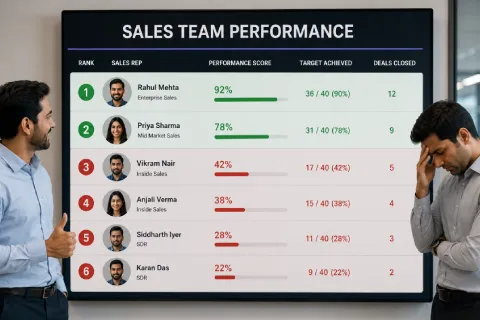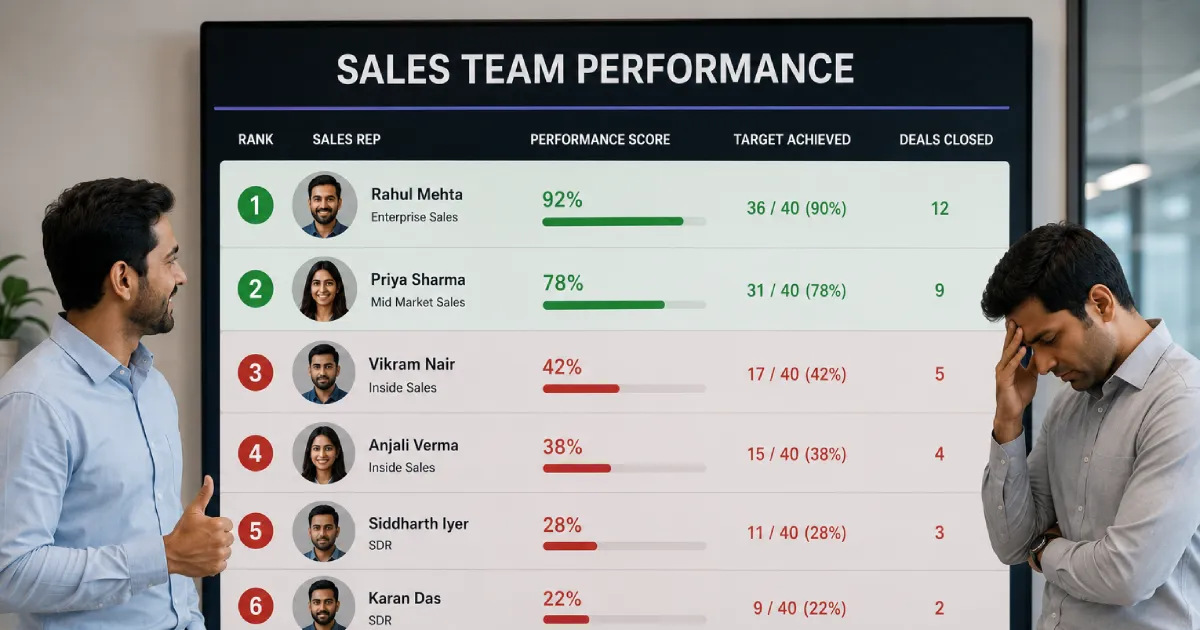

In large, distributed sales forces, especially across insurance and banking, the performance gap is rarely about a lack of effort; it is an execution gap. Most organizations find that a small 10% cohort of "star" performers consistently carries the bulk of the revenue target, while the remaining 90% struggle to replicate the same conversion quality or lead conversion rates. This disparity creates a fragile revenue model that relies on individual talent rather than a repeatable, institutionalized process.
Traditional training methods often fail to close this gap because they focus on static knowledge rather than real-time application. In the field, a rep doesn't need a 40-page product manual; they need to know exactly how to counter a specific competitor's interest rate or explain a complex policy feature during a high-stakes conversation. When the middle 60% of your sales force lacks this instant access to the "best-practice" behaviors of your top performers, your cost of acquisition rises and your market share stagnates.
Turning your entire sales force into a high-performing engine requires moving beyond simple enablement to true execution management. By codifying the specific behaviors, objection handles, and pitch structures used by your top 10% and embedding them into the daily workflow of every rep, you remove the guesswork from the sales process. This blueprint focuses on shifting the performance curve, ensuring that every lead is handled with the same precision and expertise as if your best seller were in the room.
What is the core philosophy behind the 10% Blueprint for sales execution?

The 10% Blueprint for sales execution operates on the principle of marginal gains applied to the "Last Mile" of the sales process. In large, distributed teams, specifically within sectors like insurance, banking, and automotive, sales leaders often make the mistake of attempting to overhaul the entire sales methodology at once. This leads to cognitive overload and execution fatigue. The 10% Blueprint shifts the focus away from total transformation and toward the optimization of the 10% of activities that historically drive 90% of revenue outcomes.
The core philosophy rests on the belief that a salesperson does not need to be 100% better than the competition to win; they only need a 10% edge in key execution areas to dominate the market. This edge is usually found in three specific pillars: speed to lead, message consistency, and objection mastery. By isolating these high-leverage moments, organizations can move the "middle 60%" of their sales force closer to the performance levels of the top 10%. In 2026, where consumer attention is the scarcest resource, this precision in execution is the only sustainable competitive advantage.
Execution at scale fails because of "behavioral drift." As strategies move from headquarters to the frontline agents in regional offices, the original intent is diluted. The 10% Blueprint solves this by institutionalizing winning behaviors through a unified system. It assumes that if you can improve the quality of the first customer interaction by 10% and reduce the lead response time by 10%, the compound effect on the final conversion rate is exponential, not linear. It turns sales from an art form practiced by a few into a repeatable science executed by the many.
To implement the 10% Blueprint effectively, sales leaders must focus on these actionable areas:
- Audit the "Golden Hour": Identify the exact timeframe where lead conversion is highest. For most distributed teams, responding within the first 5 minutes increases conversion odds by over 400%. The blueprint mandates a 10% reduction in current response latency every quarter.
- Standardize the "First Five": The first five minutes of a customer conversation dictate the trust level. Provide reps with modular, AI-supported talking points that allow for local nuances and accents while maintaining core brand compliance.
- Automate Content Context: Stop forcing reps to search for brochures. Ensure the relevant case study or product comparison video is pushed to the rep based on the lead's specific profile or segment (e.g., a HNI client vs. a first-time insurance buyer).
- Deploy Micro-Feedback Loops: Instead of monthly reviews, use AI-powered roleplays (like PitchWiz) to provide 2-minute feedback sessions daily. Improving a rep's pitch by 10% every week leads to total mastery within a single quarter.
- Visualize the Execution Gap: Use heatmaps to identify where the "drift" is happening. If 90% of your team is skipping the "needs analysis" phase, that is the 10% activity you must fix to see a massive jump in deal size.
The philosophy also addresses the reality of high churn in frontline sales. When a system is built around a complex 100-step process, recruits take months to become productive. The 10% Blueprint simplifies the onboarding by focusing the recruit only on the 10% of tasks that lead to their first check. This reduces early-stage friction and boosts retention by providing the rep with an early sense of achievement.
Pro Tip: Stop measuring "Activity" and start measuring "Execution Accuracy." A rep making 100 low-quality calls is less valuable than a rep making 10 calls that strictly follow the 10% Blueprint’s high-leverage triggers. Use your sales execution platform to score the quality of the interaction, not just the volume of the logs.
Why does the performance gap persist in large distributed sales teams?

The persistence of the performance gap in large, distributed sales teams is rarely a result of poor hiring or a lack of talent. Instead, it is a structural failure rooted in the "Execution Gap”, the space between what a salesperson is taught in a classroom and what they actually say during a customer interaction. In sectors like insurance, banking, and automotive, this gap widens because the frontline is often geographically dispersed, making it impossible for managers to maintain a consistent standard of quality across every conversation.
Traditional training models rely on periodic workshops or static LMS modules. However, knowledge retention drops by nearly 80% within a week if the information is not applied immediately. In 2026, the complexity of financial products and consumer regulations means that a rep who is 20% less informed than a top performer doesn't just sell less; they often fail to build the trust necessary to close any deal at all. This creates a "Power Law" distribution where the top 10% of the team generates the vast majority of revenue, while the rest struggle with basic objection handling and product positioning.
Another primary driver is "Information Friction." Distributed teams often lack a unified source of truth that is accessible at the "moment of truth", the actual customer meeting. When a prospect asks a specific question about a policy rider or a competitor's pricing, the rep often has to navigate through cluttered WhatsApp groups, outdated emails, or buried cloud folders. This delay kills momentum. Top performers succeed because they have internalized this data over years, but the "middle 60%" of the workforce remains trapped in a cycle of inefficiency because the organization hasn't democratized that expertise.
Managerial bandwidth is the third pillar of this problem. In a distributed setup, a single manager might oversee 15 to 20 reps. It is physically impossible for them to join every call or visit every dealership to provide coaching. Without visibility into the actual "input" metrics, the quality of the pitch, the tone of voice, and the accuracy of the information shared, managers are forced to coach based on "output" metrics like monthly sales targets. Coaching based on lagging indicators is like a sports coach only looking at the final score rather than the players' form during the game. It tells the rep they failed, but it doesn't tell them how to fix it.
To bridge this gap, organizations must shift from a "Training First" mindset to an "Execution First" mindset:
- Move from Periodic to Just-in-Time Learning: Replace long-form training with "Sales Helpkits" that provide 30-second product explainers, personalized customer videos, and instant competitor battlecards exactly when the rep is preparing for a meeting.
- Standardize the "Perfect Pitch": Use AI-powered roleplays and voice-based practice tools. This allows reps to fail in a safe environment rather than in front of a high-value prospect. Ensure every rep passes a "fluency check" before they are cleared to sell a new product.
- Automate Content Personalization: Remove the burden of content creation from the salesperson. Provide tools that allow them to generate personalized, co-branded collateral (like quotes or product comparisons) with two clicks. This ensures the brand message stays consistent regardless of the rep's experience level.
- Implement Execution Heatmaps: Instead of just tracking sales numbers, track "Execution Data." Which reps are using the latest sales scripts? Who is struggling with objection handling? Use these insights to direct coaching efforts where they will have the most impact on revenue.
- Digitize Managerial Coaching: Use automated coaching queues that highlight specific gaps in a rep’s performance. This allows managers to provide feedback on specific conversations without needing to be physically present at every site.
Pro Tip: Stop treating your CRM as a sales enablement tool. CRMs are for management reporting. To close the performance gap, you need a "System of Execution" that sits in the rep's pocket and tells them what to say, what to show, and what to do next during the actual sales process. Focus on the "Input" (the conversation), and the "Output" (the revenue) will naturally follow.
How can AI capture and distribute tribal knowledge from high-performing sellers?

High-performing sellers often possess a "gut feel" for closing deals that rarely makes its way into official training manuals. This tribal knowledge- the nuanced ways they handle a specific objection from a high-net-worth individual or how they pivot when a competitor is mentioned- is usually lost when those sellers leave or move to different roles. To capture this, AI acts as a digital shadow, observing the successful behaviors that lead to conversions. Instead of asking top performers to manually document their secrets, which they rarely have time for, AI-native systems capture raw data from actual sales interactions, voice-based practice sessions, and successful pitches to identify the specific language patterns and strategies that work.
By utilizing voice-to-insight technology, AI analyzes successful pitches within tools like PitchWiz to find the common threads. The focus has shifted from simple transcription to intent mapping. When a high-performing seller in the insurance or banking sector successfully navigates a complex regulatory objection, the AI flags that specific segment of the conversation. It doesn't just record it; it categorizes it as a "Winning Response" and links it to the specific product and customer persona. This creates a living repository of field-tested wisdom that is grounded in reality rather than theoretical sales training.
Distribution of this knowledge is where the value is realized for the broader distributed team. Static handbooks are replaced by an AI Sales Helpkit that surfaces these high-performing insights at the exact moment a rep needs them. For instance, if a frontline agent is about to meet a customer who previously expressed interest in a competitor’s health plan, the AI Copilot can push a 30-second video of a top performer explaining exactly how to counter that specific competitor’s latest offering. This just-in-time delivery ensures that the "tribal knowledge" isn't buried in a database but is actively used to drive execution during live customer interactions.
For large organizations in industries like pharmaceuticals or consumer durables, this systematic capture solves the problem of "performance variance" across different regions. AI can identify if a seller in a Tier 2 city has found a unique way to explain product value that resonates with local demographics. Once captured, this insight can be instantly distributed to thousands of other reps operating in similar markets. This transforms the collective intelligence of the organization into a competitive advantage, ensuring that every rep, regardless of their tenure, can perform with the proficiency of a veteran.
Actionable steps to implement this:
- Implement AI-powered roleplay tools where top performers record their best pitches for specific scenarios. Use these as "Gold Standards" for the rest of the team to emulate.
- Integrate a Sales Helpkit that allows reps to search for real-world peer solutions rather than just corporate PDFs. Ensure these are tagged by industry, persona, and deal stage.
- Use heatmaps within your Manager Activity Centre to identify which "high-performing " behaviors are actually being adopted by the rest of the team and which ones are being ignored.
- Create a "Viral Feedback Loop" where successful field stories are captured via voice notes, transcribed by AI, and converted into structured FAQs within minutes.
- Incorporate localized language and accent support in your AI tools to ensure tribal knowledge is captured and distributed accurately across diverse geographic regions.
Pro Tip: Don't just reward the "closing" of a deal; reward the "contribution of knowledge." Use your AI platform to track which reps' practice videos or recorded insights are being viewed most by their peers, and gamify the sharing of these best practices to build a culture of collective winning.
Do AI-powered roleplays actually reduce sales rep ramp-up time?
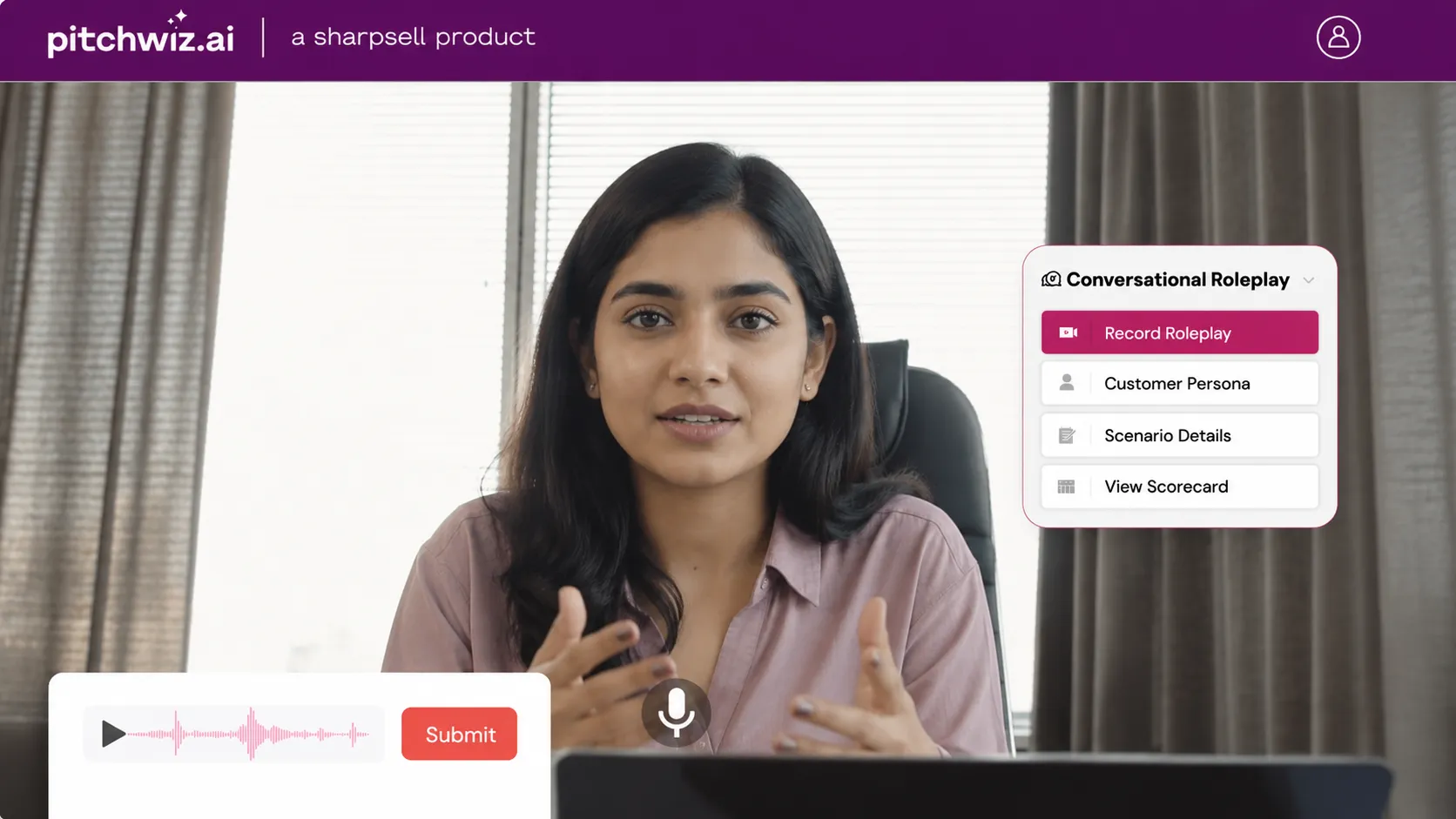
Traditional sales onboarding often suffers from a "proficiency gap" where reps know the product features but freeze when faced with a real customer. In industries like insurance or banking, where products are complex and trust is the primary currency, this gap leads to high churn and slow time-to-revenue. AI-powered roleplays bridge this gap by transitioning training from passive listening to active performance. Instead of waiting for a manager’s availability, a new hire can practice a discovery call or a difficult objection ten times in a single hour. This high-frequency repetition builds muscle memory, which is the core driver of reduced ramp-up time.
The primary reason AI roleplays work is the immediacy of the feedback loop. In a standard setup, a rep might wait days for a manager to review a recorded call or sit for a mock session. By then, the nuances of the conversation are forgotten. AI platforms like PitchWiz provide instant scoring on parameters like tone, confidence, product accuracy, and handling of specific objections. The benchmark for "field readiness" has moved from completing a certification to achieving a specific proficiency score in AI-simulated high-stakes scenarios. This data-driven approach ensures that no rep is sent to speak with a high-value lead until they have demonstrated competence in a safe, simulated environment.
For large, distributed teams in sectors like automotive or pharmaceuticals, the challenge is consistency. A manager in one region might be a lenient coach, while another is overly critical. AI roleplays standardize the evaluation criteria across the entire organization. Every rep is judged against the same "Gold Standard" pitch. This eliminates the variability in training quality that usually plagues large-scale operations. When every rep receives the same high-quality coaching via AI, the entire cohort reaches peak performance faster, often reducing the traditional three-month ramp period to under six weeks.
The psychological safety of AI roleplays also plays a significant role. New hires, particularly in high-pressure environments like financial services, are often hesitant to practice in front of peers or superiors for fear of judgment. An AI partner provides a non-judgmental space to fail, stutter, and refine their delivery. This psychological safety encourages more practice sessions. We see that reps who use AI roleplays engage in 5x more practice attempts than those relying on traditional methods. This volume of practice directly correlates with a faster transition from "trainee" to "consistent producer."
Actionable steps for implementing AI roleplays:
- Map Scenarios to Real-World Friction: Identify the top five objections your field teams face, such as "the premium is too high" or "I need to talk to my spouse", and build specific AI roleplay modules for these.
- Set Mandatory Proficiency Benchmarks: Do not allow reps to move to live lead assignments until they have cleared the AI roleplay with a score of 85% or higher across three consecutive attempts.
- Leverage Regional Language Capabilities: For teams operating across diverse geographies, ensure the AI roleplay supports local languages and accents to reflect the actual customer demographic the rep will face.
- Integrate Feedback into Manager Dashboards: Use the data from AI sessions to show managers exactly where a rep is struggling, be it closing techniques or product knowledge, so they can provide surgical coaching instead of generic advice.
- Gamify the Learning Path: Create leaderboards based on roleplay scores to drive healthy competition and increase the frequency of practice among the new cohort.
Pro Tip: To make roleplays hyper-realistic, feed the AI "winning" transcripts from your top 10% of performers. This trains the AI to recognize and reward the specific linguistic patterns and emotional cues that actually result in closed deals within your specific industry.
How does real-time execution support prevent lead leakage in high-pressure sectors?

In high-stakes industries like insurance, banking, or automotive, lead leakage is rarely a result of a lack of effort; it is a symptom of cognitive overload. When a field agent or a distributed sales rep receives a high-intent lead, the window of tactical opportunity is measured in minutes. Real-time execution support prevents leakage by automating the "what next" for the salesperson. Instead of the rep deciding which brochure to send or how to answer a specific compliance question, the system pushes the exact asset or response required based on the lead's profile. This removes the friction that leads to procrastination, the primary driver of lead abandonment in the field.
Frontline reps in sectors like pharmaceuticals or consumer durables often struggle with the sheer volume of product updates and competitor shifts. Leakage occurs when a rep cannot answer a prospect’s query confidently, leading the prospect to seek clarity from a competitor. Real-time support systems act as a digital Sales Helpkit, providing instant access to product FAQs and competitor comparisons during the conversation. By arming the rep with localized, accurate information at the moment of truth, the system ensures the lead stays within the brand’s ecosystem rather than falling through the cracks of rep uncertainty.
A common point of failure in distributed teams is the inconsistency of the sales pitch. One rep might be a top performer, while ten others miss key value propositions, causing leads to go cold despite high traffic. AI-powered activity management solves this by guiding the rep through a structured conversation flow. By providing real-time prompts and voice-based practice tools, organizations ensure that every lead, regardless of which rep it is assigned to, receives a high-quality, standardized experience. This consistency prevents the "silent leakage" where leads are technically followed up on but are lost due to poor engagement quality.
Lead leakage often happens in the "dark spots" of the sales cycle—the time between the first call and the second meeting. Real-time execution platforms provide managers with execution heatmaps and coaching queues. When a lead stalls or a rep fails to execute a specific follow-up action, the system flags it immediately. This allows for proactive intervention rather than a post-mortem analysis of why a monthly target was missed. In 2026, waiting for a weekly report to identify lost leads is no longer a viable strategy; real-time visibility turns lead management from a reactive task into a proactive discipline.
Actionables for Sales and L&D Leaders:
✓ Implement automated content triggers that send relevant product videos or personalized summaries to the prospect immediately after a call ends.
✓ Use AI-driven activity prompts to nudge reps on specific "next best actions" based on the age and status of the lead within the CRM.
✓ Centralize all sales collateral, FAQs, calculators, and comparison sheets, into a single, mobile-first interface that works offline for field teams.
✓ Monitor "Time to First Action" as a primary KPI, ensuring that every lead is engaged within a 5-minute window of assignment to maintain momentum.
✓ Deploy AI roleplay modules to certify reps on new product launches before they are allowed to handle live leads, reducing the risk of "practicing" on real prospects.
Finally, lead leakage is often a data entry problem. When reps find it difficult to update systems, they delay the task, and data decays. Real-time support integrates the execution and the reporting. When a rep uses a sales tool to share a document or record a pitch, the activity is automatically captured. This ensures that the lead's status is always current, preventing prospects from being "lost" simply because they weren't updated in a clunky legacy system.
Pro Tip: Do not just track if a lead was called; track the "Content Resonance." Use your execution system to see which specific brochures or videos the prospect engaged with after the interaction. If a prospect spends more time on a "Competitor Comparison" video than a "Pricing" sheet, the system should nudge the rep to focus the next conversation on value-differentiation rather than discounts. This tactical pivot is what stops warm leads from leaking to competitors.
Why is traditional manager-led coaching failing to scale in 2026?

Traditional manager-led coaching is failing in 2026 because it relies on a "sampling" methodology that no longer fits the scale of modern distributed sales teams. In industries like insurance, banking, and automotive, a single manager often oversees 15 to 20 frontline agents. Mathematically, if a manager spends 30 minutes coaching each rep per week, they have already lost 10 hours of their week before accounting for any operational work, reporting, or deal intervention. This creates a bottleneck where coaching becomes a "check-the-box" activity rather than a performance driver.
The lack of objective ground truth is another critical failure point. Traditional coaching is often based on "ride-alongs" or the manager’s subjective memory of a call. This leads to feedback that is biased, inconsistent, and frequently contested by the sales rep. When a manager says, "I think you need to build better rapport," it is an opinion. Today, reps expect data-backed insights. Without a system that records and analyzes every interaction, coaching remains a guessing game based on the 2% of conversations a manager actually hears.
Furthermore, the "feedback lag" in traditional models is too high. If a rep makes a mistake in a product pitch on Monday, but the manager doesn’t review that performance until the following Friday, the learning opportunity is lost. The rep has already repeated the mistake in twenty other meetings, turning a one-time error into a bad habit. Traditional coaching is reactive, whereas the current market demands real-time course correction.
The "Hero Manager" syndrome also limits scalability. Most managers are promoted because they were high-performing individual contributors, not because they are skilled educators. Expecting every manager to naturally possess the ability to diagnose performance gaps and deliver constructive feedback across a diverse team is unrealistic. Without a standardized execution framework, the quality of coaching varies wildly from one branch or territory to another, leading to inconsistent customer experiences and uneven revenue growth.
Actionable Steps to Solve the Coaching Bottleneck:
✓ Shift to Asynchronous Coaching: Instead of scheduling 1:1 sessions for every feedback point, use voice-based practice tools and AI-driven roleplays. Reps can practice their pitches and receive instant, automated feedback on their tone, keywords, and objection handling before they ever speak to a customer.
✓ Implement Execution Heatmaps: Move away from individual call reviews and look at "execution heatmaps" across the entire team. Identify if the entire team is struggling with a specific product feature or a new competitor's objection. This allows managers to coach the "cohort" rather than repeating the same advice 20 times individually.
✓ Prioritize the "Middle 60%": Stop spending all coaching time on the bottom performers (who may never scale) or the top performers (who don't need it). Focus manager interventions on the middle 60% of the team, where a 5% improvement in execution leads to the highest revenue impact.
✓ Use Objective Interaction Data: Replace "I think" with "The data shows." Use platforms that automatically flag missing compliance statements or missed upsell opportunities in every conversation. This turns the manager into a strategist who solves problems rather than a monitor who just finds them.
✓ Standardize the Coaching Rubric: Provide managers with a clear, digitized checklist of what "good" looks like for every specific product. This ensures that a sales rep in Mumbai receives the same quality of guidance as a rep in Delhi.
Pro Tip for Practitioners:
Move from "Review Coaching" to "Pre-play Coaching." Instead of spending 100% of your time reviewing what went wrong in past meetings, spend 30% of your time using AI simulations to "pre-play" upcoming high-stakes conversations. Use automated roleplays to ensure the rep is prepared for the specific objections relevant to that customer profile before the meeting starts. This shifts the manager's role from a post-mortem examiner to a high-performance trainer.
How do personalized customer conversations drive higher premiums in insurance and banking?

Personalization in insurance and banking is often misunderstood as a marketing tactic, but in a high-stakes sales environment, it is a clinical tool for risk assessment and value alignment. When a sales representative engages in a personalized conversation, they move away from the "product-push" model toward a consultative framework. In these sectors, customers are not buying a commodity; they are purchasing a hedge against uncertainty or a vehicle for wealth preservation. Trust is the primary currency. When an advisor demonstrates a deep understanding of a client’s specific life stage, localized challenges, and financial trajectory, the perceived risk of the transaction decreases. This shift in perception allows the advisor to recommend more comprehensive coverage or sophisticated financial instruments, which naturally command higher premiums.
Generic sales pitches trigger price sensitivity. When every life insurance policy or wealth management plan sounds the same, the customer defaults to the lowest price. Personalized conversations break this cycle by shifting the focus to "value-density." For instance, in the Indian insurance market in 2026, a generic pitch for a term plan might result in a minimum-sum assured sale. However, a conversation that integrates a customer’s specific liabilities, such as a home loan or child’s international education goals, changes the math. The customer is no longer looking at the monthly premium cost; they are looking at the potential deficit in their family’s future. By visualizing these gaps through personalized videos or data-driven comparisons, the sales rep justifies a higher premium that actually solves the customer's problem.
In banking and wealth management, personalization drives premiums by identifying "silent" needs. A distributed sales team equipped with real-time customer insights can pivot a standard savings conversation into a discussion about tax-efficient investment wrappers or high-yield legacy planning. This requires the rep to have immediate access to localized content and competitor comparisons. When a rep can say, "Based on your current portfolio in this specific region, here is why this specific premium-tier plan outperforms the standard option," the conversion rate for high-value products increases. This is where execution becomes a competitive advantage; the ability to deliver the right insight at the exact moment of the customer’s hesitation determines the final ticket size.
To drive higher premiums through personalized conversations, practitioners should focus on these actionable strategies:
✓ Audit the Discovery Phase: Move beyond demographic data. Train teams to uncover "emotional triggers", such as a recent promotion, a new addition to the family, or an upcoming retirement, and link these directly to the benefits of a higher-tier plan.
✓ Utilize Visual Storytelling: Use personalized video tools to send a post-meeting summary that visualizes the "Protection Gap." Seeing a personalized chart that shows their current coverage versus their actual need is more persuasive than a 20-page PDF brochure.
✓ Contextual Competitor Benchmarking: Instead of generic "us vs. them" sheets, provide reps with specific talking points that compare your high-premium offerings against the specific products the customer is currently considering. Highlight the long-term cost of "under-insuring."
✓ Localized Language and Dialect Nuance: In diverse markets, trust is built through familiarity. Ensure that sales enablement tools provide scripts and content in the customer’s preferred local language to ensure the nuances of complex financial products are fully understood.
✓ Implement Execution Heatmaps: Sales managers should monitor which personalized content pieces are leading to higher-value conversions. If a specific "Retirement Calculator" interaction consistently leads to 20% higher premiums, that behavior should be scaled across the entire distributed team.
Pro Tip: Stop selling the "Plan" and start selling the "Exclusion Gap." Most customers believe they are "covered enough." Use your sales tool to show them exactly what is not covered in a basic plan. By focusing the conversation on the specific risks they are currently self-insuring (often unknowingly), you create a logical path to a higher-premium, comprehensive solution. This "Gap Analysis" approach reframes the higher cost as a strategic investment rather than an additional expense.
What are the primary metrics for measuring sales execution quality over activity?

Measuring the success of a sales team solely through activity volume, such as the number of dials made or emails sent, is a legacy approach that often masks systemic inefficiencies. In 2026, performing organizations have shifted their focus toward execution quality. Activity tells you a rep is busy; execution quality tells you if they are actually moving the needle toward a revenue outcome. When managing large, distributed teams in sectors like insurance or banking, the objective is to ensure that every interaction adheres to a high standard of professional competency and strategic intent.
One of the most critical metrics for execution quality is Playbook Adherence. This measures how consistently a salesperson follows the prescribed sales process and utilizes the correct tools at the right stages. For example, are they using the specific competitor comparison modules or personalized product videos designed for the discovery phase? High activity with low playbook adherence results in brand dilution and missed opportunities. By tracking the usage of specific sales enablement assets during customer interactions, you can determine if your frontline is actually delivering the enterprise’s best value proposition or simply "winging it."
Another vital metric is the Discovery-to-Solution Alignment. In industries like pharmaceuticals or consumer durables, the quality of execution is defined by how well a rep uncovers customer pain points before pitching a product. Instead of tracking call duration, you should measure "Question Density" and the "Talk-to-Listen Ratio." A rep who dominates the conversation is usually performing at a lower execution quality than one who asks high-value questions that prompt the prospect to reveal intent. AI-driven sentiment analysis can now quantify whether a rep addressed specific objections or if they glossed over customer concerns to reach a quota.
The Lead-to-Meaningful-Conversation (LMC) rate is a superior metric compared to simple lead response times. While speed to lead remains important, the quality of that first touch determines the trajectory of the entire deal. Execution quality is measured by the rep's ability to transition a cold or warm lead into a structured discovery session. If your team is hitting their call volume targets but their LMC rate is low, it indicates a failure in the opening pitch or a lack of localized context. This is particularly relevant for Indian enterprise teams where language nuances and regional preferences dictate the success of the initial engagement.
Finally, you must track Pipeline Velocity by Stage rather than just overall sales cycle length. Execution quality manifests as the ability to move a prospect through specific friction points. If a large portion of your leads stall after the initial demo or product walkthrough, the execution of the "value justification" stage is likely the bottleneck. Analyzing the conversion rates between these specific micro-stages allows managers to pinpoint exactly where reps need better training, more relevant content, or improved coaching interventions.
Actionable metrics to implement:
1. Effective Conversation Rate: Stop measuring total dials. Measure how many calls resulted in a scheduled next step or a successful objection-handling event.
2. Content Resonance Score: Track which sales assets (FAQs, videos, comparisons) are actually opened and engaged with by the prospect. This indicates the rep's ability to provide relevant information.
3. Execution Heatmaps: Use data to identify which regions or teams are deviating from the sales playbook. This allows for targeted coaching instead of generic, team-wide training.
4. Mock-to-Market Readiness: Before a rep goes live, use AI-powered roleplays to score their pitch delivery. Only those who meet a specific quality threshold should be funneled high-value leads.
5. Lead Integrity Score: Measure the depth of data captured by a rep in the CRM during the first two interactions. High execution quality results in rich, actionable customer profiles.
Pro Tip: Shift your weekly reviews from "How many calls did you make?" to "Which specific stage of the playbook did you struggle to execute this week?" Focus your coaching on the "Middle 60%" of your sales force. Moving this group by just 5% in execution quality generates a significantly higher ROI than trying to push your top 5% or fix your bottom 5%.
Can AI help frontline reps handle complex product objections instantly?

Frontline sales reps in industries like insurance, banking, and pharmaceuticals often fail not because they lack effort, but because they lack immediate access to high-stakes information. When a customer raises a complex objection, such as questioning the specific tax implications of a wealth management product or comparing a car's engine performance against a rival brand’s latest model, the rep has a window of about ten seconds to provide a credible answer. If they stumble, trust evaporates. AI solves this by transforming a rep’s mobile device into a real-time "Sales Helpkit" that processes the query and surfaces the exact talk track needed to keep the conversation moving.
The benchmark for sales execution is no longer just "knowing the product" but "retrieving the solution." AI-native systems index thousands of product FAQs, compliance documents, and competitor battlecards, making them searchable via natural language. Instead of a rep scrolling through a 50-page PDF manual while a customer waits, they can type or speak a query into their activity management tool and receive a concise, bite-sized response designed for verbal delivery. This ensures that even a junior agent with three weeks of experience can handle objections with the nuance of a ten-year veteran.
To implement this effectively, organizations should follow these actionable steps:
- Digitize Objection Maps: Move beyond static training decks. Create a dynamic library of "if-then" scenarios based on actual field data from your top 10% of performers. Use AI to categorize these by product line and customer persona.
- Deploy AI Roleplays: Use tools like PitchWiz to let reps practice these complex objections before they face a customer. AI roleplays provide instant feedback on tone, sentiment, and factual accuracy, building the muscle memory required for instant responses.
- Integrate Competitive Battlecards: AI should automatically surface comparisons when a competitor's name is mentioned. This prevents reps from being blindsided by a customer who has done more research than they have.
- Monitor Execution Heatmaps: Managers must use activity centers to see which objections are currently "hot" in the market. If 40% of your insurance reps are struggling with objections regarding a specific premium hike, you can push a localized, AI-verified talk track to the entire team instantly.
The capability of AI to assist in real-time extends to personalized content generation. If a customer in the pharmaceutical sector asks about drug-to-drug interactions, the AI can instantly generate a personalized video or a validated infographic that the rep can share on WhatsApp or email during the meeting. This reinforces the verbal answer with visual proof, significantly increasing the probability of a close.
By unifying lead management and training into a single execution system, the AI learns which responses actually lead to conversions. It’s a closed-loop system where the AI gets smarter based on successful field outcomes, continuously refining the "perfect" response for every complex objection.
Pro Tip: Stop treating objection handling as a memory test. Configure your AI Sales Helpkit to prioritize "Impact Statements" over "Technical Features." When a customer objects to price in a consumer durables context, the AI should prompt the rep with a value-based ROI calculator or a comparison of total cost of ownership over five years, rather than just a list of specs.
How will the 10% Blueprint reshape sales team structures by the end of 2026?
The 10% Blueprint shifts the focus from managing headcount to codifying excellence. By the end of 2026, sales organizations in sectors like Insurance and Banking will no longer structure their teams around a "bell curve" of performance. Instead, they will use the 10% Blueprint to identify the specific high-impact behaviors of their top decile and force-multiply them across the entire distributed workforce. This fundamentally changes the sales structure from a pyramid of varying skill levels into a flattened, high-execution engine where the "middle 60%" performs with the same precision as the top 10%.
The most significant structural change will be the thinning of middle-management layers traditionally dedicated to manual tracking and "check-in" meetings. In 2026, the Manager Activity Centre becomes the hub of the sales organization, rather than chasing reps for updates, managers will use execution heatmaps to see where leads are stalling in real-time. This allows a single manager to oversee larger, more geographically dispersed teams without a drop in quality. The manager’s role moves from being a "report collector" to a "high-performance coach" who only intervenes when the AI flags a specific execution gap in a customer conversation or pitch.
Frontline roles will transition into "Augmented Execution Specialists." In industries like Pharmaceuticals or Consumer Durables, where product complexity is high, reps will no longer be expected to memorize thousands of data points. The structure of the team will favor those who can navigate AI-powered Sales Helpkits and personalized video tools during live interactions. This reduces the time-to-productivity for new hires, a critical factor in industries with traditionally high churn. By 2026, the "ramp-up period" will be a relic of the past; new reps will be structured into active selling roles within days, supported by AI-driven roleplays and voice-based practice sessions that simulate real-world objections.
Lead management will also drive a structural divide between "Inbound Response Units" and "Strategic Execution Teams." The 10% Blueprint dictates that 90% of lead qualification and initial nurturing be handled by automated Lead Execution Systems. This leaves the human sales team to focus strictly on the final 10% of the journey—the high-stakes closing and relationship building. Consequently, sales structures will become leaner but more specialized, with a heavy emphasis on "just-in-time" learning enablement rather than once-a-quarter training workshops.
Actionables for Sales and L&D Leaders:
- Codify the "Winner’s Script": Identify the top 10% of your performers in the field. Use AI to analyze their successful pitches and objections handling. Turn these insights into a mandatory "Execution Playbook" for the rest of the team.
- Deploy Execution Heatmaps: Move away from lagging indicators like "Revenue Booked." Implement real-time dashboards that track leading indicators such as "Pitch Accuracy" and "Content Utilization" during customer calls.
- Shift to Micro-Enablement: Replace day-long training sessions with 2-minute "Helpkit" modules that reps can access seconds before a meeting. Structure your L&D team to produce these bite-sized assets based on real-time field feedback.
- Automate Roleplays: Use AI-powered voice practice tools (like PitchWiz) to ensure every rep has practiced the current month’s specific campaign script at least 20 times before they speak to a customer.
Pro Tip: Stop hiring for "industry experience" and start hiring for "coachability and tech fluency." By 2026, your Sales Execution System will provide industry knowledge; you need a team that can execute the system’s prompts with high emotional intelligence and speed.
Closing the performance gap across a distributed sales force is not a recruitment challenge; it is an execution challenge. Top performers succeed because they intuitively manage leads, handle objections, and personalize their pitches. For the remaining 90% of your team, these behaviors must be embedded into their daily workflow through a unified system. When you standardize high-performance habits, you stop relying on a few "star players" and start building a predictable revenue engine.
The reality of industries like insurance, banking, and automotive demands immediate access to accurate information. If a rep cannot answer a complex product query or handle a competitive objection on the spot, the lead is lost. Moving your middle performers toward the top 10% requires moving beyond static training videos and into real-time AI activity management that guides every customer conversation as it happens.
Sales leadership is defined by visibility and replication. By using execution heatmaps and AI-powered coaching queues, managers can identify exactly where a rep is struggling and intervene with the right product FAQs or practice sessions before it impacts the monthly target. This systematic approach turns tribal knowledge into a scalable competitive advantage that works for every rep, regardless of their location or tenure.
Ready to turn your top-tier sales tactics into a standard operating procedure for your entire team? Book a Sharpsell demo today to see how our Sales Execution System can unify your lead management, training, and customer conversations into one platform.
What’s a Rich Text element?
The rich text element allows you to create and format headings, paragraphs, blockquotes, images, and video all in one place instead of having to add and format them individually. Just double-click and easily create content.
Static and dynamic content editing
A rich text element can be used with static or dynamic content. For static content, just drop it into any page and begin editing. For dynamic content, add a rich text field to any collection and then connect a rich text element to that field in the settings panel. Voila!
How to customize formatting for each rich text
Headings, paragraphs, blockquotes, figures, images, and figure captions can all be styled after a class is added to the rich text element using the "When inside of" nested selector system.
zdxfhgfg
- sdnslk,xdv
- SDlknjsdv
- SDvlknj
- sdgdf v