
How Auto Retail Teams Can Personalize Vehicle Finance and Value Conversations

The automotive retail industry has undergone a significant transformation over the past decade. Today's customers are more informed, more connected, and more financially aware than ever before.

How Auto Retail Teams Can Personalize Vehicle Finance and Value Conversations

The automotive retail industry has undergone a significant transformation over the past decade. Today's customers are more informed, more connected, and more financially aware than ever before. Before stepping into a dealership, many have already compared vehicle models, watched reviews, explored financing options, calculated EMIs, and read customer experiences online. By the time they meet a sales consultant, they are not looking for basic product information—they are looking for guidance that helps them make the right buying decision.

This shift has fundamentally changed the role of dealership sales teams.

A successful vehicle sale is no longer driven solely by product specifications or discounts. Customers want to understand how a vehicle fits their lifestyle, business requirements, and financial situation. They expect sales consultants to explain financing options clearly, justify the long-term value of the vehicle, and recommend solutions based on their individual needs.

For dealerships, this presents both an opportunity and a challenge.

The opportunity lies in delivering highly personalised buying experiences that build trust and increase conversion rates.

The challenge is ensuring that every sales consultant can confidently conduct these conversations across multiple vehicle models, financing schemes, promotional offers, and customer profiles.

This is particularly relevant in India, where financing plays a central role in vehicle purchases. Whether someone is buying their first hatchback, upgrading to an SUV, investing in a luxury sedan, or purchasing a fleet of commercial vehicles, the discussion rarely revolves around the vehicle alone. Financing options, monthly affordability, ownership costs, resale value, maintenance expenses, warranty coverage, and long-term value have become equally important parts of the buying journey.

As customer expectations evolve, dealership conversations must evolve with them.

Instead of focusing primarily on price negotiations, sales teams need to help customers understand value.

For passenger vehicle buyers, value often means comfort, safety, technology, convenience, fuel efficiency, and flexible financing.

For commercial vehicle buyers, value is measured differently. Businesses evaluate fuel economy, payload capacity, uptime, maintenance costs, financing structures, operating expenses, and total cost of ownership (TCO). Their purchase decisions are based less on emotion and more on long-term profitability.

Although both customer groups are buying vehicles, the conversations that influence their decisions are fundamentally different.

Understanding these differences is essential for building high-performing automotive sales teams.

Why Automotive Buying Has Changed

Buying a vehicle was once a relatively straightforward process. Customers visited a dealership, explored available models, negotiated the price, and completed the purchase. The dealership was often the customer's primary source of information.

That buying journey looks very different today.

Customers now spend weeks researching online before entering a showroom. They compare specifications, watch video reviews, calculate loan eligibility, browse financing options, and evaluate competing brands across multiple platforms.

Many customers already know the features of competing vehicles before speaking with a salesperson.

This means dealerships no longer compete only on product.

They compete on experience. The quality of the sales conversation has become a major differentiator.

Customers expect consultants to understand their requirements, answer detailed questions, explain financial implications clearly, and recommend solutions that feel personalised rather than scripted.

A family purchasing their first car may prioritise affordability, safety ratings, maintenance costs, and financing flexibility.

A young professional may focus on connected technologies, premium features, and EMI options that fit their monthly budget.

A fleet operator, on the other hand, may care far less about aesthetics and far more about operating costs, service intervals, fuel efficiency, resale value, and business profitability.

These differences require sales teams to adapt every conversation rather than delivering the same product pitch to every customer.

Vehicle Finance Has Become Part of the Sales Conversation

One of the biggest changes in automotive retail is the growing importance of vehicle finance.

For many customers, purchasing decisions are no longer based solely on the vehicle's ex-showroom price. Instead, they evaluate monthly affordability, down payment requirements, loan tenure, interest rates, exchange benefits, maintenance packages, insurance costs, extended warranties, and ownership expenses before making a decision.

In other words, customers increasingly buy a monthly payment rather than a vehicle price.

This has significantly expanded the role of dealership sales consultants.

Today's sales representatives are expected to explain financing options with the same confidence that they explain engine performance or safety features.

A customer considering two similar SUVs may ultimately choose the one with the financing structure that better fits their monthly budget.

Another customer may initially believe a premium model is unaffordable until the salesperson demonstrates how exchange benefits, lower interest rates, and extended loan tenure reduce the monthly EMI.

Similarly, a commercial vehicle buyer may reject the lowest-priced truck if another option delivers better fuel efficiency and lower maintenance costs over five years.

These are value conversations, not price conversations. The ability to personalise them directly influences buying decisions.

Why Personalisation Matters More Than Ever

Modern customers expect recommendations that reflect their unique circumstances.

They no longer respond well to generic product demonstrations or standard financing presentations.

Instead, they expect sales consultants to ask thoughtful questions before recommending solutions.

Questions such as:

  • What will the vehicle primarily be used for?
  • How many kilometres do you typically drive each month?
  • Are you upgrading from an existing vehicle?
  • Would you prefer lower monthly EMIs or a shorter loan tenure?
  • Is long-term maintenance cost an important consideration?
  • Are you purchasing for personal use or business operations?

The answers to these questions fundamentally change the conversation.

For example, two customers may be interested in the same SUV. One customer is purchasing it as a family vehicle and prioritises comfort, safety, and flexible financing. The other travels extensively for work and is more interested in fuel efficiency, reliability, and resale value. Although the product is identical, the value proposition should be completely different.

The same principle applies to commercial vehicle sales. A logistics company managing hundreds of deliveries every day evaluates vehicles differently from an independent transporter purchasing their first truck. One focuses on fleet productivity. The other focuses on financing affordability.

Personalisation helps sales consultants recommend solutions that are genuinely relevant rather than relying on generic product pitches.

Passenger and Commercial Vehicle Buyers Think Differently

One of the biggest mistakes dealerships make is assuming every vehicle sale follows the same buying process.

In reality, passenger vehicle and commercial vehicle customers make purchasing decisions based on very different priorities.

Passenger Vehicle Buyers

Passenger vehicle purchases are often influenced by a combination of emotional and practical factors.

Customers consider aspects such as:

  • Safety features
  • Design and styling
  • Comfort
  • Technology
  • Brand reputation
  • Fuel efficiency
  • Financing options
  • Monthly affordability
  • Resale value
  • Ownership experience

While rational evaluation certainly plays a role, emotional factors frequently influence the final decision.

A family may choose a vehicle because they feel it is safer for their children. A young buyer may value connected features that complement their lifestyle. Another customer may upgrade simply because they aspire to own a premium brand.

Finance conversations are therefore centred around making the desired vehicle feel accessible without compromising financial comfort.

Commercial Vehicle Buyers

Commercial vehicle purchases are fundamentally business decisions.

Fleet owners, logistics operators, transport companies, and commercial buyers evaluate every purchase based on its financial impact over several years.

Their questions are different.

Instead of asking, "How comfortable is the cabin?" they ask:

  • What is the fuel efficiency under actual operating conditions?
  • How much downtime can we expect?
  • What are the annual maintenance costs?
  • How quickly will the vehicle generate returns?
  • What financing options improve cash flow?
  • What is the expected resale value?
  • What is the total cost of ownership?

For these customers, every feature must translate into measurable business value. A better engine is valuable because it reduces fuel consumption. Predictive maintenance is valuable because it reduces downtime. Advanced telematics are valuable because they improve fleet utilisation. The conversation shifts from product features to business outcomes. Understanding this distinction is essential for dealership sales teams.

The Challenge for Automotive Sales Teams

Despite changing customer expectations, many dealership conversations continue to focus on specifications, discounts, and promotional offers.

Customers often hear lengthy explanations about horsepower, touchscreen sizes, or limited-period discounts before anyone asks how they intend to use the vehicle or what financial considerations matter most to them.

This creates two challenges.

First, sales consultants may struggle to connect product features with customer priorities.

Second, conversations frequently become discount-driven far earlier than necessary.

When value is not clearly established, price naturally becomes the centre of the discussion. Customers begin comparing discounts instead of comparing long-term benefits. Margins become harder to protect. Premium variants become more difficult to sell. Finance options are introduced too late in the buying journey instead of being positioned as tools that improve affordability and customer choice.

Leading dealerships are beginning to shift away from this approach.

Rather than leading with discounts, they focus on understanding customer needs, demonstrating long-term value, and personalising finance conversations from the very beginning. This allows customers to evaluate vehicles based on ownership experience and business value, not simply on the lowest upfront price.

For both passenger and commercial vehicle sales, this shift represents one of the biggest opportunities to improve customer engagement, increase conversions, and build stronger long-term relationships.

Personalising Finance Conversations for Passenger Vehicle Buyers

For most passenger vehicle buyers, purchasing a car is one of the biggest financial decisions they will make after buying a home. While customers may initially visit a dealership to explore a particular model, their final decision is often influenced by how well the vehicle fits their financial situation rather than its ex-showroom price alone.

This is why finance conversations have become just as important as product conversations.

Today's customers want to understand what they can comfortably afford, how different financing options affect their monthly expenses, and whether upgrading to a higher variant makes financial sense. They are looking for guidance rather than a sales pitch.

For dealership sales consultants, this represents an opportunity to shift the conversation from price to value.

Instead of asking, "Which model are you interested in?" the conversation should begin with understanding the customer's lifestyle, budget, ownership goals, and financing preferences. The more relevant the recommendation, the more likely the customer is to view the dealership as a trusted advisor rather than just another seller.

Every Customer Has Different Financial Priorities

No two customers walk into a showroom with the same expectations.

A first-time buyer purchasing their first hatchback has very different concerns from a customer upgrading to a premium SUV. Similarly, a young working professional may focus on affordable monthly EMIs, while an experienced buyer may prioritise resale value, long-term ownership costs, or premium features.

This is why finance conversations should never follow a single script.

For example, consider three customers visiting the same dealership to explore the same vehicle.

The first customer is a young professional purchasing their first car. They have a fixed monthly budget and are primarily concerned about EMI affordability. Rather than focusing on technical specifications, the conversation should revolve around flexible loan tenure, down payment options, exchange offers, and ownership costs.

The second customer is a growing family upgrading from a smaller vehicle. Safety features, cabin space, fuel efficiency, maintenance packages, and long-term reliability are likely to be more important than achieving the lowest monthly payment. Finance discussions should demonstrate how different repayment structures allow them to comfortably upgrade without significantly increasing their monthly expenses.

The third customer is purchasing a second vehicle for personal convenience. Their priorities may include premium features, connected technology, faster delivery, and overall ownership experience. In this case, the discussion should focus on value-added services such as extended warranties, service packages, insurance benefits, and financing solutions that enhance convenience.

Although all three customers may ultimately purchase the same vehicle, the sales conversation, and particularly the finance discussion, should be completely different.

Customers Think in EMIs, Not Just Vehicle Prices

One of the biggest changes in automotive retail is the way customers evaluate affordability.

While ex-showroom pricing remains important, many buyers now make purchasing decisions based on monthly payments rather than the total cost of the vehicle.

A customer comparing two vehicles priced ₹2 lakh apart may initially assume that the higher variant is beyond their budget. However, when the difference is explained as a relatively small increase in monthly EMI, the premium option often becomes far more attractive.

This is where personalised finance conversations become powerful.

Instead of discussing only the vehicle's price, sales consultants can demonstrate how financing structures influence affordability.

For example, adjusting the loan tenure, increasing the down payment slightly, or incorporating exchange benefits can significantly reduce the perceived financial gap between vehicle variants.

When customers understand the financial implications clearly, they are able to make more informed decisions based on value rather than assumptions.

The objective is not to encourage customers to spend more. It is to help them understand all available options so they can choose the vehicle that best meets both their needs and their budget.

Finance Should Support the Value Conversation

One common mistake in automotive retail is treating finance as a separate discussion that happens only after the customer has selected a vehicle.

In reality, finance should support the value conversation from the very beginning.

Imagine a customer interested in a mid-range SUV. If the salesperson focuses only on price, the customer may immediately begin negotiating discounts.

However, if the discussion explores financing flexibility alongside vehicle benefits, the customer starts evaluating affordability differently.

Instead of asking, "Can I get a better price?" they begin asking, "What would my monthly payment look like if I chose the higher variant?" or "How would the EMI change if I added the extended warranty package?" The conversation gradually shifts away from reducing price and toward maximising value. This approach benefits both customers and dealerships.

Customers receive solutions that align with their financial goals, while dealerships improve premium variant adoption, increase attachment rates for value-added services, and reduce unnecessary discounting.

Why Product Features Alone No Longer Differentiate Dealerships

Most customers today have already researched vehicle specifications before visiting a showroom.

  • They know the engine capacity.
  • They have watched online reviews.
  • They have compared safety ratings.
  • They have read expert opinions.

In many cases, customers are already familiar with the product before meeting a salesperson. This changes the role of dealership sales consultants. Their responsibility is no longer limited to explaining features. Instead, they must help customers understand what those features mean in the context of everyday ownership.

For example, instead of simply stating that a vehicle includes Advanced Driver Assistance Systems (ADAS), a consultant should explain how those features improve safety during long highway journeys or reduce driver fatigue in heavy traffic.

Similarly, rather than mentioning a connected car platform, they should explain how remote diagnostics, navigation updates, and vehicle tracking simplify ownership over several years.

When these explanations are combined with personalised finance discussions, customers begin evaluating long-term ownership value rather than comparing specifications alone.

The Challenge of Maintaining Consistency Across Dealerships
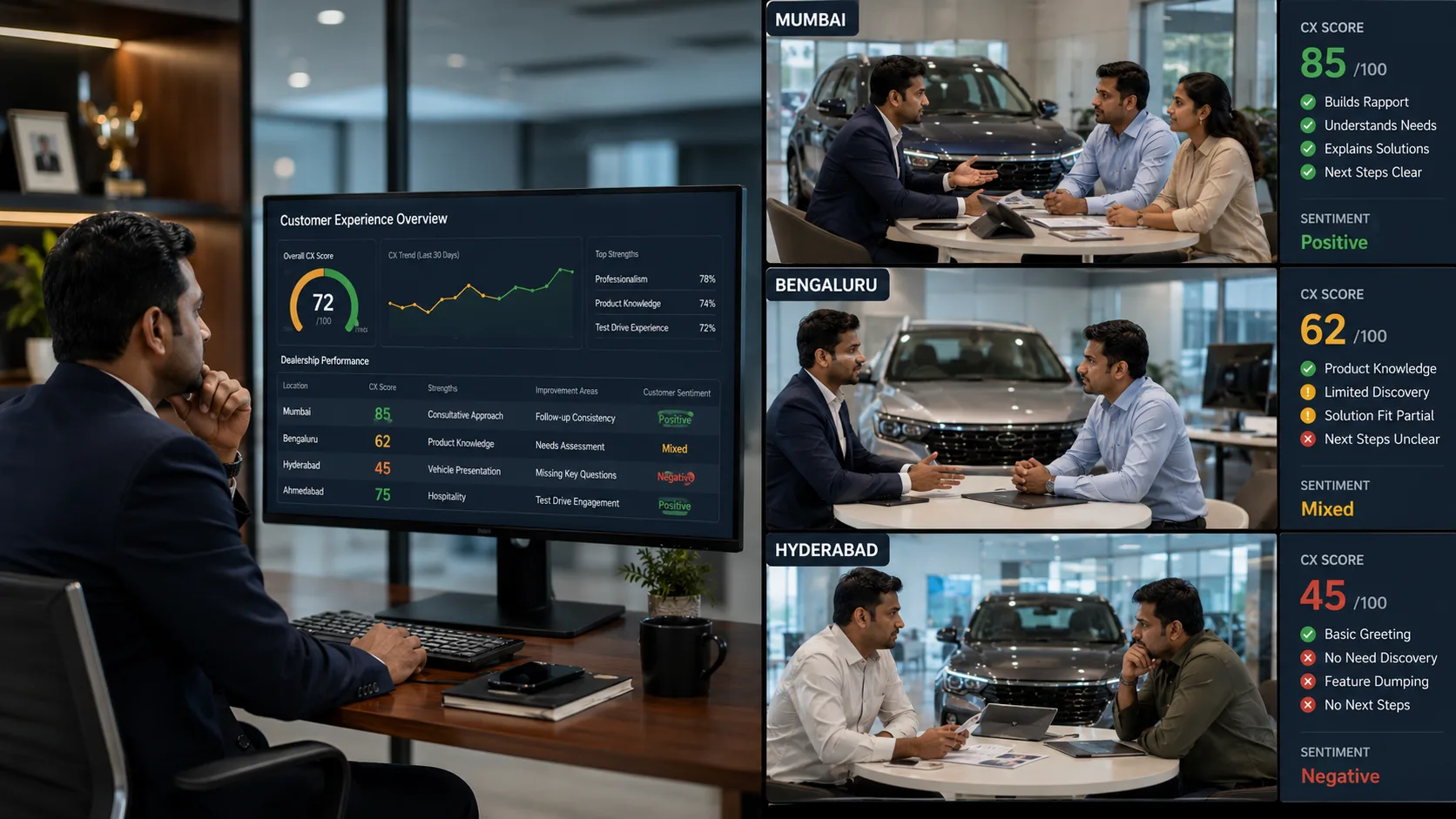
Large automotive brands often operate through extensive dealer networks spread across multiple cities and states. Each dealership may employ dozens of sales consultants with varying levels of product knowledge, selling experience, and financial understanding.

While experienced consultants naturally personalise conversations based on customer needs, newer representatives often rely on generic presentations or memorised product pitches. This creates inconsistent customer experiences.

A customer visiting one dealership may receive an excellent explanation of financing options, ownership costs, and upgrade benefits. Another customer visiting a different location may receive only basic product information followed by immediate discount discussions. Such inconsistencies affect not only conversion rates but also overall brand perception.

Maintaining consistent, high-quality conversations across an entire dealer network requires more than periodic product training.

It requires structured guidance that helps every consultant ask the right questions, recommend relevant financing solutions, explain value effectively, and adapt conversations to different customer profiles.

Helping Sales Consultants Ask Better Questions

Personalisation begins with understanding the customer.

Unfortunately, many dealership conversations still start with product recommendations before sufficient information has been gathered.

A better approach is to encourage consultants to begin with discovery.

Questions such as these help create a more relevant conversation:

  • Is this your first vehicle or are you upgrading?
  • How do you primarily use your vehicle—daily commuting, family travel, or long-distance driving?
  • Approximately how many kilometres do you drive each month?
  • Are you planning to finance your purchase?
  • Do you already own a vehicle that you would like to exchange?
  • Which matters more to you: lower monthly EMIs or completing the loan sooner?
  • Are there specific ownership costs that concern you?

These questions help consultants understand not only what the customer wants to buy, but also why they want to buy it.

That understanding allows them to recommend the right vehicle, the most suitable financing option, and the most relevant ownership benefits.

The conversation becomes consultative rather than transactional.

Equipping Sales Teams with the Right Guidance

Even experienced consultants can struggle to remember every finance scheme, promotional campaign, product update, and feature comparison across multiple vehicle models.

As dealerships expand their portfolios and financing options become more sophisticated, the amount of information sales teams must retain continues to grow.

Providing structured guidance during customer conversations helps reduce this complexity.

Instead of relying entirely on memory, consultants can access updated finance schemes, product comparisons, ownership benefits, promotional offers, and customer success stories at the moment they need them. This enables them to explain financing with greater confidence, maintain consistency across the dealership network, and focus on understanding customer needs rather than searching for information.

For passenger vehicle dealerships, this approach creates a significant competitive advantage. Customers receive personalised recommendations, finance conversations become more meaningful, premium variants become easier to position, and the discussion naturally shifts from negotiating discounts to understanding long-term ownership value.

As customer expectations continue to evolve, dealerships that combine consultative selling with personalised finance guidance will be better positioned to deliver exceptional buying experiences while improving both customer satisfaction and business performance.

Personalising Value Conversations for Commercial Vehicle Buyers

While passenger vehicle purchases are often influenced by lifestyle, comfort, and personal aspirations, commercial vehicle purchases are fundamentally business decisions. Every investment is evaluated based on its ability to generate revenue, reduce operating costs, and improve business efficiency. For fleet owners, logistics companies, transport operators, and small business owners, purchasing a commercial vehicle is less about owning an asset and more about investing in profitability.

This changes the role of the dealership sales consultant entirely.

Unlike passenger vehicle sales, where customers may be influenced by design, technology, or brand perception, commercial vehicle buyers expect sales representatives to understand their business. They want practical recommendations supported by numbers, operational insights, and long-term financial value.

Unfortunately, many dealership conversations still begin and end with discounts.

A buyer asks for the price.

The salesperson offers a discount.

The customer negotiates further.

Eventually, the conversation becomes centred entirely around reducing the upfront purchase cost.

While discounts may help close individual deals, they rarely communicate why one vehicle delivers better long-term value than another. More importantly, they can reduce margins while overlooking opportunities to demonstrate how the right vehicle contributes to lower operating costs and higher profitability over its lifetime.

The most successful commercial vehicle sales teams approach these conversations differently. Instead of leading with price, they focus on value.

Commercial Vehicle Buyers Think Beyond the Purchase Price

The purchase price of a truck, bus, or light commercial vehicle is only one part of the customer's investment.

Fleet owners evaluate every vehicle based on the total cost of operating it over several years. Fuel expenses, maintenance costs, service intervals, tyre life, financing, resale value, downtime, payload capacity, and driver productivity all influence the final buying decision.

For example, imagine two trucks with a price difference of ₹2 lakh. At first glance, the lower-priced vehicle appears to be the better deal. However, if the higher-priced vehicle delivers better fuel efficiency, requires fewer maintenance visits, experiences less downtime, and offers stronger resale value, the overall ownership cost may actually be significantly lower over five years.

For business owners, these long-term savings often matter far more than the initial purchase price. This is why commercial vehicle conversations should focus on ownership economics rather than simply discussing discounts.

Helping customers understand this difference builds credibility and positions the salesperson as a business advisor instead of someone whose only objective is to negotiate on price.

Total Cost of Ownership Changes the Conversation
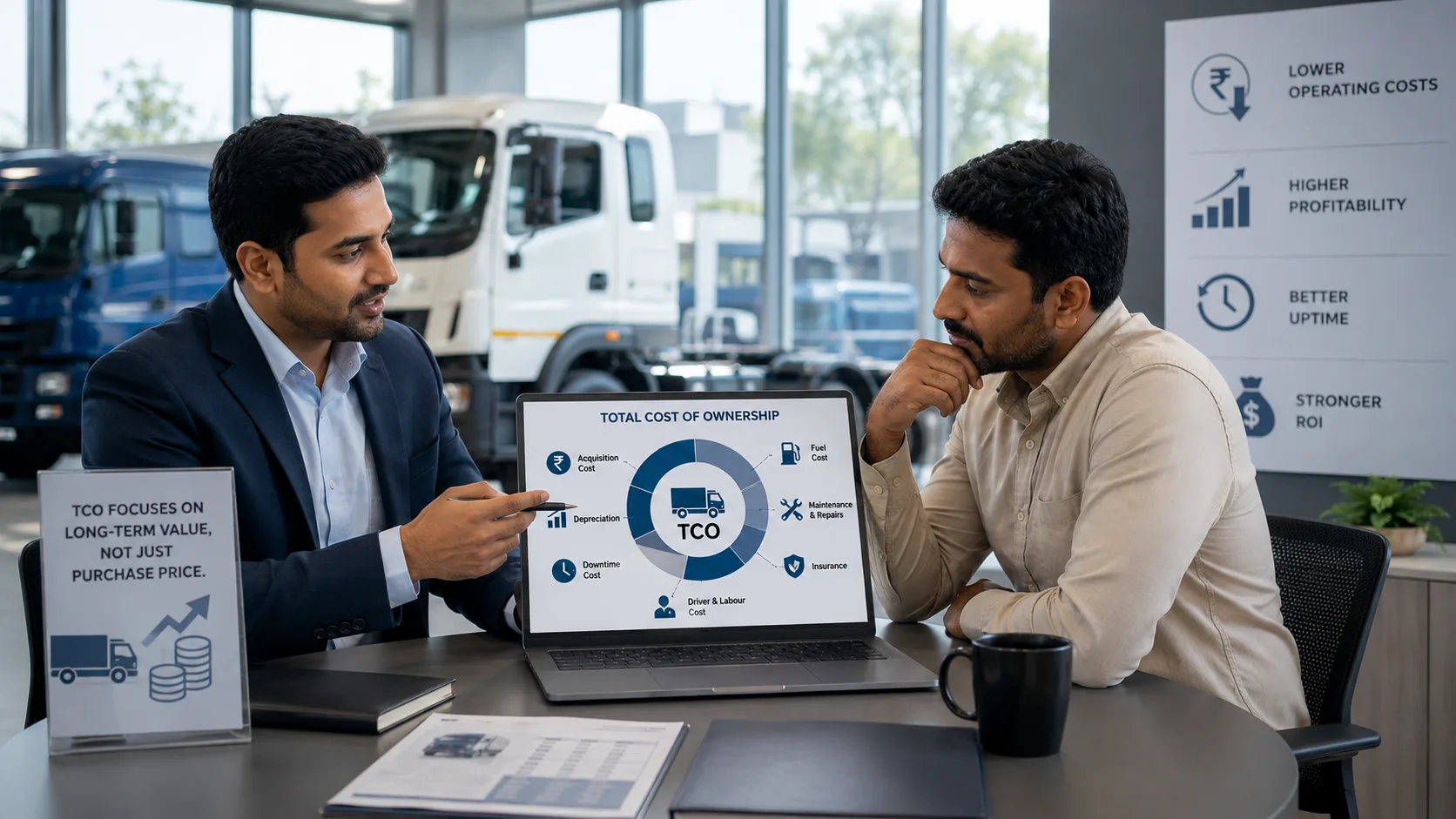
One of the most effective ways to shift discussions from discounts to value is by introducing the concept of Total Cost of Ownership (TCO).

Rather than evaluating vehicles solely on acquisition cost, TCO considers every expense associated with owning and operating the vehicle throughout its lifecycle.

These include:

  • Fuel consumption
  • Maintenance and servicing costs
  • Spare parts expenses
  • Vehicle uptime
  • Insurance
  • Financing costs
  • Residual or resale value
  • Driver productivity
  • Operating efficiency

When these factors are presented together, customers gain a much clearer understanding of the vehicle's long-term financial impact.

For instance, a logistics company operating vehicles over long distances may discover that a truck with better fuel efficiency saves several lakhs in fuel costs over five years. Those savings could easily outweigh a slightly higher purchase price.

Similarly, reduced maintenance requirements may keep vehicles on the road longer, generating additional revenue while lowering workshop expenses.

These conversations help customers evaluate vehicles based on business outcomes rather than short-term pricing.

Every Feature Should Be Connected to a Business Benefit

Commercial vehicle buyers are generally less interested in product features unless those features directly improve business performance.

Simply stating that a truck has a more powerful engine or an upgraded transmission is unlikely to influence purchasing decisions on its own.

Instead, sales consultants should explain why those features matter.

For example:

  • A fuel-efficient engine reduces operating expenses across every kilometre travelled.
  • An improved suspension system minimises wear and tear while protecting cargo during transportation.
  • Telematics enable fleet managers to monitor vehicle utilisation, optimise routes, and reduce idle time.
  • Predictive maintenance systems help identify issues before they lead to costly breakdowns, improving vehicle uptime.
  • A higher payload capacity allows businesses to transport more goods in fewer trips, increasing profitability.

When product features are translated into measurable business outcomes, customers begin viewing the vehicle as an investment rather than an expense. This approach naturally shifts conversations away from discounts because buyers understand the long-term value being delivered.

Different Commercial Buyers Have Different Priorities

Commercial vehicle customers are far from homogeneous.

A fleet operator managing hundreds of vehicles has different priorities from a first-time entrepreneur purchasing a single truck. Likewise, a construction company, a logistics provider, and a municipal transport organisation all evaluate vehicles through different operational lenses.

This makes personalisation just as important in commercial vehicle sales as it is in passenger vehicle retail.

Consider these examples.

  • A fleet manager responsible for a nationwide logistics network may prioritise fuel economy, predictive maintenance, uptime, and telematics because even small improvements can generate substantial savings across hundreds of vehicles.
  • A small business owner purchasing their first commercial vehicle may be more concerned about financing options, EMI affordability, maintenance costs, and after-sales support because cash flow has a direct impact on their business.
  • A construction contractor may place greater emphasis on payload capacity, durability, and service availability in remote locations.
  • A tourism operator purchasing passenger buses may focus on passenger comfort, safety, driver ergonomics, and operating efficiency.

Although these buyers may purchase similar vehicles, the conversations that influence their decisions should be completely different. Understanding customer priorities allows sales consultants to recommend solutions that are relevant rather than generic

Why Discount-Led Selling Limits Business Growth

Price negotiations are a natural part of commercial vehicle sales, but leading with discounts often creates unnecessary challenges for dealerships.

When discounts become the primary sales strategy, product differentiation becomes difficult. Customers begin comparing only purchase prices instead of evaluating ownership value. Sales consultants feel pressured to negotiate earlier in the buying journey. Profit margins become increasingly difficult to protect. Premium models and value-added services become harder to position because customers remain focused on the initial transaction rather than long-term returns. More importantly, discount-led selling reduces opportunities to build consultative relationships.

Business owners are looking for partners who understand their operational challenges, not just suppliers offering the lowest price. By shifting conversations toward productivity, lifecycle value, and business outcomes, dealerships can demonstrate expertise that extends beyond pricing discussions, and creates stronger customer relationships while supporting healthier margins.

Equipping Sales Teams to Have Better Business Conversations

Discussing Total Cost of Ownership, financing structures, lifecycle value, and return on investment requires a different level of preparation than explaining product specifications.

Sales consultants need access to accurate information, practical business examples, financing options, feature-benefit comparisons, and tools that help simplify complex calculations.

This is where structured sales guidance becomes particularly valuable.

For example, TCO calculators allow consultants to compare long-term operating costs based on customer-specific inputs such as annual mileage, fuel prices, maintenance schedules, financing terms, and expected ownership duration. Instead of making broad claims about savings, representatives can demonstrate measurable financial outcomes using data that is relevant to the customer's business.

Similarly, guided sales conversations help consultants consistently connect technical specifications with operational benefits. Rather than simply stating that a vehicle includes advanced telematics, they can explain how route optimisation improves fuel efficiency, how driver behaviour monitoring reduces operating costs, or how predictive maintenance increases fleet availability.

These conversations are significantly more persuasive because they address the customer's business objectives rather than focusing solely on product features.

Consistency Across Dealer Networks Matters

Commercial vehicle manufacturers often operate through large dealer networks that serve customers across multiple industries and regions.

While experienced consultants naturally develop consultative selling skills over time, newer representatives may rely heavily on brochures, feature lists, or price negotiations because they lack confidence in discussing broader business value.

This creates inconsistent customer experiences. One dealership may confidently explain lifecycle savings using structured value conversations. Another may immediately respond to pricing requests with discounts. As a result, the same product may be positioned very differently depending on which dealership the customer visits.

Maintaining consistency requires more than product knowledge. Sales teams need ongoing learning, practical business scenarios, guided selling frameworks, and easy access to tools that help them personalise conversations for different customer segments.

When every consultant understands how to connect product features with measurable business outcomes, value selling becomes a repeatable process rather than an individual skill.

Moving from Selling Vehicles to Solving Business Problems

The most successful commercial vehicle dealerships recognise that customers are not simply buying trucks or buses—they are investing in the future performance of their business.

  • A transport operator wants to improve fleet profitability.
  • A distributor wants to reduce delivery costs.
  • A contractor wants to maximise equipment utilisation.
  • A logistics company wants to increase uptime while lowering maintenance expenses.

Vehicles are simply the means to achieve those objectives. Sales conversations should reflect that reality.

Rather than asking, "Which model would you like to buy?", consultants should ask questions that uncover operational priorities.

What type of goods do you transport?

How many kilometres do your vehicles typically cover each month?

What is your biggest operating expense today?

Are you looking to improve fuel efficiency, reduce downtime, or increase payload capacity?

How long do you usually retain your vehicles before replacing them?

These questions shift the conversation from product selection to business problem-solving. Customers feel understood because recommendations are based on their operational needs rather than generic product pitches.

For dealerships, this approach creates stronger differentiation, improves customer trust, and reduces dependence on discount-led selling.

As commercial vehicle buyers become increasingly focused on lifecycle value and operational efficiency, dealerships that combine consultative selling with structured value conversations will be better positioned to build long-term customer relationships while improving sales performance.

Bringing Personalised Sales Conversations to Scale with Digital Sales Execution

Creating personalised finance and value conversations is relatively straightforward when a dealership has a small, highly experienced sales team. The real challenge begins when an automotive brand operates across hundreds of dealerships, thousands of sales consultants, multiple vehicle categories, and constantly evolving financing programmes.

Every month, new offers are introduced, interest rates change, promotional campaigns are updated, vehicle variants are refreshed, and financing partners launch revised schemes. At the same time, dealerships continue onboarding new sales consultants while experienced employees move between dealerships or take on new roles.

Keeping every salesperson updated, and ensuring every customer receives the same high-quality buying experience, becomes increasingly difficult.

This is why many automotive brands are shifting their focus from simply training sales teams to enabling consistent sales execution.

The objective is no longer just to ensure that sales consultants know the product. It is to ensure they can confidently deliver the right conversation, recommend the right finance solution, and communicate the right value proposition at the right moment.

Why Product Training Alone Is No Longer Enough

Most automotive manufacturers invest significantly in training their dealer networks. Sales consultants attend classroom sessions, complete e-learning modules, participate in product launches, and receive detailed product brochures before new vehicles reach the showroom.

While these programmes build product knowledge, they often leave one important question unanswered:

Can every consultant confidently apply that knowledge during a live customer conversation?

Knowing that a vehicle offers advanced safety technology is different from explaining how those features protect a family during long-distance travel.

Understanding loan structures is different from helping a customer compare two financing options based on monthly affordability.

Knowing that a truck delivers better fuel efficiency is different from demonstrating how that translates into lower operating costs over five years.

This is where many dealerships experience a gap between learning and execution.

Sales consultants understand the information but struggle to deliver it consistently under real selling conditions.

Bridging this gap requires continuous guidance rather than one-time training.

Supporting Passenger Vehicle Sales Teams with Smarter Sales Conversations

Passenger vehicle buyers expect highly personalised interactions.

One customer may need help understanding EMI options for their first car, while another wants to compare ownership costs between two premium SUVs. A third may already know the product they want but require reassurance about exchange benefits, maintenance packages, or extended warranty plans.

For sales consultants, remembering every finance scheme, promotional offer, feature comparison, and customer success story across multiple vehicle models can be challenging.

Digital sales execution simplifies these conversations by making relevant information easily accessible during the customer interaction.

Instead of searching through brochures or switching between multiple applications, consultants can quickly access updated product information, financing options, feature comparisons, sales presentations, and customer-focused content within a single workflow.

This allows them to spend less time searching for information and more time understanding customer needs.

It also improves consistency across dealership networks because every consultant works with the latest approved messaging and sales content.

Enabling Better Commercial Vehicle Sales

Commercial vehicle conversations require an even greater level of business understanding.

Fleet owners expect sales consultants to discuss operating costs, financing structures, payload efficiency, service intervals, maintenance planning, and long-term profitability with confidence.

These conversations often involve calculations, comparisons, and business scenarios rather than simple product demonstrations.

For example, a logistics company evaluating two trucks wants to understand which option delivers better financial performance over several years—not simply which vehicle has the lower purchase price.

Tools such as Total Cost of Ownership (TCO) calculators become particularly valuable in these situations because they allow consultants to demonstrate measurable business value instead of relying on generic claims.

Rather than saying, "This truck is more fuel efficient," the consultant can show how improved fuel economy, lower maintenance requirements, and higher resale value contribute to lower operating costs over the vehicle's lifecycle.

This transforms the conversation.

Instead of negotiating around discounts, customers begin evaluating long-term return on investment.

For dealerships, this creates stronger differentiation while helping protect margins.

Learning Should Be Continuous, Not Occasional

Automotive retail is constantly evolving.

New vehicle launches happen throughout the year.

Finance partners revise schemes regularly.

Government regulations change.

Customer preferences evolve.

Competitors introduce new technologies and promotional offers.

A sales consultant who completed product training six months ago may already be working with outdated information.

This is why continuous learning has become essential.

Rather than relying solely on periodic classroom sessions, leading automotive brands are creating learning ecosystems where dealership teams can continuously refresh their knowledge through short, engaging learning experiences.

Microlearning modules help consultants quickly understand new product features without attending lengthy workshops.

Short sales videos demonstrate how experienced consultants position premium variants or explain financing effectively.

Interactive product updates allow dealership teams to stay informed without disrupting daily operations.

Because learning is available on demand, consultants remain prepared even as products and customer expectations evolve.

Helping Sales Consultants Learn from High-Performing Peers

One of the most effective ways to improve sales performance is by sharing successful selling practices across the dealer network.

Every organisation has consultants who consistently explain finance options clearly, handle objections confidently, and convert more customers into buyers. Traditionally, this expertise remains localised.

Only colleagues working in the same dealership benefit from observing these high-performing salespeople.

Digital learning changes that. Short sales videos, practical demonstrations, and real customer scenarios allow successful selling techniques to be shared across the entire organisation.

  • A consultant in Mumbai can learn how another consultant in Bengaluru positions premium finance packages.
  • A salesperson in Delhi can observe effective ways of explaining connected vehicle features.
  • A dealership in Jaipur can adopt customer engagement techniques that have already proven successful elsewhere.

Instead of relying solely on classroom instruction, organisations create a culture of peer learning where best practices spread much faster.

Guiding Every Conversation Without Making It Feel Scripted

One concern dealerships often have about digital sales tools is that they may make conversations sound robotic or overly scripted.

In reality, effective sales guidance works very differently. The objective is not to tell consultants exactly what to say. It is to ensure they have the right information available when they need it.

For example, if a customer expresses concern about affordability, the consultant can immediately access updated financing options, EMI comparisons, exchange programmes, and ownership cost information. If another customer asks about safety features, relevant demonstrations, comparison charts, and product videos are readily available.

Commercial vehicle consultants can quickly access TCO calculators, feature-benefit comparisons, operating cost examples, and financing structures that support value-based selling.

The conversation remains natural because consultants adapt the information to each customer's situation rather than following a fixed script.

Creating Consistency Across Dealer Networks

Consistency is one of the biggest challenges facing automotive brands.

Customers expect the same quality of advice whether they visit a metropolitan showroom or a dealership in a Tier 2 or Tier 3 city. However, maintaining this consistency across hundreds of locations is difficult. Different dealerships may interpret finance schemes differently. Some consultants may focus heavily on discounts and others may overlook important ownership benefits or confidently explain premium features, while newer consultants avoid discussing them altogether.

Digital sales execution helps reduce these variations by giving every consultant access to the same approved product information, sales journeys, finance updates, comparison tools, and customer engagement resources.

This ensures that while conversations remain personalised, the brand message stays consistent.

Customers receive accurate information regardless of where they engage with the dealership.

Building a Connected Sales Ecosystem

The most successful automotive brands are moving beyond standalone training programmes and isolated sales tools. Instead, they are building connected ecosystems that support dealership teams throughout the entire sales journey.

Learning platforms help consultants stay updated on new products, finance schemes, and selling techniques. 

Interactive sales playbooks provide structured guidance during customer conversations.

AI-powered sales assistance surfaces relevant content, finance options, and product information at the right moment.

Video-based learning enables consultants to learn from successful peers and quickly understand new product launches.

Customer engagement tools help dealerships maintain communication after showroom visits through personalised follow-ups, ensuring that conversations continue beyond the initial interaction.

When these capabilities work together, dealerships create a more connected sales experience where learning, selling, and customer engagement reinforce one another rather than operating independently.

For passenger vehicle dealerships, this means consultants can confidently personalise finance conversations, explain premium features more effectively, and improve customer confidence throughout the buying journey.

For commercial vehicle dealerships, it enables sales teams to shift discussions from discounts to long-term business value using structured tools such as TCO calculators, feature-benefit selling frameworks, and consultative sales guidance

  • The “New Normal” for Pharma Sales post the lockdown
  • Why organizations look for Sales Enablement
  • How Sales Enablement is different from traditional LMS or CRM
  • The industry best practices for Sales Enablement
  • Implementation challenges and how to overcome them
  • Ensuring higher adoption

Aman Vasishth

Aman Vasishth is a B2B marketing leader who simplifies complex products through storytelling-driven strategy. He has led brand, growth, and content initiatives across fintech and F&B, building scalable marketing systems that drive measurable business impact.

How Auto Retail Teams Can Personalize Vehicle Finance and Value Conversations

How Auto Retail Teams Can Personalize Vehicle Finance and Value Conversations

The automotive retail industry has undergone a significant transformation over the past decade. Today's customers are more informed, more connected, and more financially aware than ever before.
Aman Vasishth
January 7, 2026

The automotive retail industry has undergone a significant transformation over the past decade. Today's customers are more informed, more connected, and more financially aware than ever before. Before stepping into a dealership, many have already compared vehicle models, watched reviews, explored financing options, calculated EMIs, and read customer experiences online. By the time they meet a sales consultant, they are not looking for basic product information—they are looking for guidance that helps them make the right buying decision.

This shift has fundamentally changed the role of dealership sales teams.

A successful vehicle sale is no longer driven solely by product specifications or discounts. Customers want to understand how a vehicle fits their lifestyle, business requirements, and financial situation. They expect sales consultants to explain financing options clearly, justify the long-term value of the vehicle, and recommend solutions based on their individual needs.

For dealerships, this presents both an opportunity and a challenge.

The opportunity lies in delivering highly personalised buying experiences that build trust and increase conversion rates.

The challenge is ensuring that every sales consultant can confidently conduct these conversations across multiple vehicle models, financing schemes, promotional offers, and customer profiles.

This is particularly relevant in India, where financing plays a central role in vehicle purchases. Whether someone is buying their first hatchback, upgrading to an SUV, investing in a luxury sedan, or purchasing a fleet of commercial vehicles, the discussion rarely revolves around the vehicle alone. Financing options, monthly affordability, ownership costs, resale value, maintenance expenses, warranty coverage, and long-term value have become equally important parts of the buying journey.

As customer expectations evolve, dealership conversations must evolve with them.

Instead of focusing primarily on price negotiations, sales teams need to help customers understand value.

For passenger vehicle buyers, value often means comfort, safety, technology, convenience, fuel efficiency, and flexible financing.

For commercial vehicle buyers, value is measured differently. Businesses evaluate fuel economy, payload capacity, uptime, maintenance costs, financing structures, operating expenses, and total cost of ownership (TCO). Their purchase decisions are based less on emotion and more on long-term profitability.

Although both customer groups are buying vehicles, the conversations that influence their decisions are fundamentally different.

Understanding these differences is essential for building high-performing automotive sales teams.

Why Automotive Buying Has Changed

Buying a vehicle was once a relatively straightforward process. Customers visited a dealership, explored available models, negotiated the price, and completed the purchase. The dealership was often the customer's primary source of information.

That buying journey looks very different today.

Customers now spend weeks researching online before entering a showroom. They compare specifications, watch video reviews, calculate loan eligibility, browse financing options, and evaluate competing brands across multiple platforms.

Many customers already know the features of competing vehicles before speaking with a salesperson.

This means dealerships no longer compete only on product.

They compete on experience. The quality of the sales conversation has become a major differentiator.

Customers expect consultants to understand their requirements, answer detailed questions, explain financial implications clearly, and recommend solutions that feel personalised rather than scripted.

A family purchasing their first car may prioritise affordability, safety ratings, maintenance costs, and financing flexibility.

A young professional may focus on connected technologies, premium features, and EMI options that fit their monthly budget.

A fleet operator, on the other hand, may care far less about aesthetics and far more about operating costs, service intervals, fuel efficiency, resale value, and business profitability.

These differences require sales teams to adapt every conversation rather than delivering the same product pitch to every customer.

Vehicle Finance Has Become Part of the Sales Conversation

One of the biggest changes in automotive retail is the growing importance of vehicle finance.

For many customers, purchasing decisions are no longer based solely on the vehicle's ex-showroom price. Instead, they evaluate monthly affordability, down payment requirements, loan tenure, interest rates, exchange benefits, maintenance packages, insurance costs, extended warranties, and ownership expenses before making a decision.

In other words, customers increasingly buy a monthly payment rather than a vehicle price.

This has significantly expanded the role of dealership sales consultants.

Today's sales representatives are expected to explain financing options with the same confidence that they explain engine performance or safety features.

A customer considering two similar SUVs may ultimately choose the one with the financing structure that better fits their monthly budget.

Another customer may initially believe a premium model is unaffordable until the salesperson demonstrates how exchange benefits, lower interest rates, and extended loan tenure reduce the monthly EMI.

Similarly, a commercial vehicle buyer may reject the lowest-priced truck if another option delivers better fuel efficiency and lower maintenance costs over five years.

These are value conversations, not price conversations. The ability to personalise them directly influences buying decisions.

Why Personalisation Matters More Than Ever

Modern customers expect recommendations that reflect their unique circumstances.

They no longer respond well to generic product demonstrations or standard financing presentations.

Instead, they expect sales consultants to ask thoughtful questions before recommending solutions.

Questions such as:

  • What will the vehicle primarily be used for?
  • How many kilometres do you typically drive each month?
  • Are you upgrading from an existing vehicle?
  • Would you prefer lower monthly EMIs or a shorter loan tenure?
  • Is long-term maintenance cost an important consideration?
  • Are you purchasing for personal use or business operations?

The answers to these questions fundamentally change the conversation.

For example, two customers may be interested in the same SUV. One customer is purchasing it as a family vehicle and prioritises comfort, safety, and flexible financing. The other travels extensively for work and is more interested in fuel efficiency, reliability, and resale value. Although the product is identical, the value proposition should be completely different.

The same principle applies to commercial vehicle sales. A logistics company managing hundreds of deliveries every day evaluates vehicles differently from an independent transporter purchasing their first truck. One focuses on fleet productivity. The other focuses on financing affordability.

Personalisation helps sales consultants recommend solutions that are genuinely relevant rather than relying on generic product pitches.

Passenger and Commercial Vehicle Buyers Think Differently

One of the biggest mistakes dealerships make is assuming every vehicle sale follows the same buying process.

In reality, passenger vehicle and commercial vehicle customers make purchasing decisions based on very different priorities.

Passenger Vehicle Buyers

Passenger vehicle purchases are often influenced by a combination of emotional and practical factors.

Customers consider aspects such as:

  • Safety features
  • Design and styling
  • Comfort
  • Technology
  • Brand reputation
  • Fuel efficiency
  • Financing options
  • Monthly affordability
  • Resale value
  • Ownership experience

While rational evaluation certainly plays a role, emotional factors frequently influence the final decision.

A family may choose a vehicle because they feel it is safer for their children. A young buyer may value connected features that complement their lifestyle. Another customer may upgrade simply because they aspire to own a premium brand.

Finance conversations are therefore centred around making the desired vehicle feel accessible without compromising financial comfort.

Commercial Vehicle Buyers

Commercial vehicle purchases are fundamentally business decisions.

Fleet owners, logistics operators, transport companies, and commercial buyers evaluate every purchase based on its financial impact over several years.

Their questions are different.

Instead of asking, "How comfortable is the cabin?" they ask:

  • What is the fuel efficiency under actual operating conditions?
  • How much downtime can we expect?
  • What are the annual maintenance costs?
  • How quickly will the vehicle generate returns?
  • What financing options improve cash flow?
  • What is the expected resale value?
  • What is the total cost of ownership?

For these customers, every feature must translate into measurable business value. A better engine is valuable because it reduces fuel consumption. Predictive maintenance is valuable because it reduces downtime. Advanced telematics are valuable because they improve fleet utilisation. The conversation shifts from product features to business outcomes. Understanding this distinction is essential for dealership sales teams.

The Challenge for Automotive Sales Teams

Despite changing customer expectations, many dealership conversations continue to focus on specifications, discounts, and promotional offers.

Customers often hear lengthy explanations about horsepower, touchscreen sizes, or limited-period discounts before anyone asks how they intend to use the vehicle or what financial considerations matter most to them.

This creates two challenges.

First, sales consultants may struggle to connect product features with customer priorities.

Second, conversations frequently become discount-driven far earlier than necessary.

When value is not clearly established, price naturally becomes the centre of the discussion. Customers begin comparing discounts instead of comparing long-term benefits. Margins become harder to protect. Premium variants become more difficult to sell. Finance options are introduced too late in the buying journey instead of being positioned as tools that improve affordability and customer choice.

Leading dealerships are beginning to shift away from this approach.

Rather than leading with discounts, they focus on understanding customer needs, demonstrating long-term value, and personalising finance conversations from the very beginning. This allows customers to evaluate vehicles based on ownership experience and business value, not simply on the lowest upfront price.

For both passenger and commercial vehicle sales, this shift represents one of the biggest opportunities to improve customer engagement, increase conversions, and build stronger long-term relationships.

Personalising Finance Conversations for Passenger Vehicle Buyers

For most passenger vehicle buyers, purchasing a car is one of the biggest financial decisions they will make after buying a home. While customers may initially visit a dealership to explore a particular model, their final decision is often influenced by how well the vehicle fits their financial situation rather than its ex-showroom price alone.

This is why finance conversations have become just as important as product conversations.

Today's customers want to understand what they can comfortably afford, how different financing options affect their monthly expenses, and whether upgrading to a higher variant makes financial sense. They are looking for guidance rather than a sales pitch.

For dealership sales consultants, this represents an opportunity to shift the conversation from price to value.

Instead of asking, "Which model are you interested in?" the conversation should begin with understanding the customer's lifestyle, budget, ownership goals, and financing preferences. The more relevant the recommendation, the more likely the customer is to view the dealership as a trusted advisor rather than just another seller.

Every Customer Has Different Financial Priorities

No two customers walk into a showroom with the same expectations.

A first-time buyer purchasing their first hatchback has very different concerns from a customer upgrading to a premium SUV. Similarly, a young working professional may focus on affordable monthly EMIs, while an experienced buyer may prioritise resale value, long-term ownership costs, or premium features.

This is why finance conversations should never follow a single script.

For example, consider three customers visiting the same dealership to explore the same vehicle.

The first customer is a young professional purchasing their first car. They have a fixed monthly budget and are primarily concerned about EMI affordability. Rather than focusing on technical specifications, the conversation should revolve around flexible loan tenure, down payment options, exchange offers, and ownership costs.

The second customer is a growing family upgrading from a smaller vehicle. Safety features, cabin space, fuel efficiency, maintenance packages, and long-term reliability are likely to be more important than achieving the lowest monthly payment. Finance discussions should demonstrate how different repayment structures allow them to comfortably upgrade without significantly increasing their monthly expenses.

The third customer is purchasing a second vehicle for personal convenience. Their priorities may include premium features, connected technology, faster delivery, and overall ownership experience. In this case, the discussion should focus on value-added services such as extended warranties, service packages, insurance benefits, and financing solutions that enhance convenience.

Although all three customers may ultimately purchase the same vehicle, the sales conversation, and particularly the finance discussion, should be completely different.

Customers Think in EMIs, Not Just Vehicle Prices

One of the biggest changes in automotive retail is the way customers evaluate affordability.

While ex-showroom pricing remains important, many buyers now make purchasing decisions based on monthly payments rather than the total cost of the vehicle.

A customer comparing two vehicles priced ₹2 lakh apart may initially assume that the higher variant is beyond their budget. However, when the difference is explained as a relatively small increase in monthly EMI, the premium option often becomes far more attractive.

This is where personalised finance conversations become powerful.

Instead of discussing only the vehicle's price, sales consultants can demonstrate how financing structures influence affordability.

For example, adjusting the loan tenure, increasing the down payment slightly, or incorporating exchange benefits can significantly reduce the perceived financial gap between vehicle variants.

When customers understand the financial implications clearly, they are able to make more informed decisions based on value rather than assumptions.

The objective is not to encourage customers to spend more. It is to help them understand all available options so they can choose the vehicle that best meets both their needs and their budget.

Finance Should Support the Value Conversation

One common mistake in automotive retail is treating finance as a separate discussion that happens only after the customer has selected a vehicle.

In reality, finance should support the value conversation from the very beginning.

Imagine a customer interested in a mid-range SUV. If the salesperson focuses only on price, the customer may immediately begin negotiating discounts.

However, if the discussion explores financing flexibility alongside vehicle benefits, the customer starts evaluating affordability differently.

Instead of asking, "Can I get a better price?" they begin asking, "What would my monthly payment look like if I chose the higher variant?" or "How would the EMI change if I added the extended warranty package?" The conversation gradually shifts away from reducing price and toward maximising value. This approach benefits both customers and dealerships.

Customers receive solutions that align with their financial goals, while dealerships improve premium variant adoption, increase attachment rates for value-added services, and reduce unnecessary discounting.

Why Product Features Alone No Longer Differentiate Dealerships

Most customers today have already researched vehicle specifications before visiting a showroom.

  • They know the engine capacity.
  • They have watched online reviews.
  • They have compared safety ratings.
  • They have read expert opinions.

In many cases, customers are already familiar with the product before meeting a salesperson. This changes the role of dealership sales consultants. Their responsibility is no longer limited to explaining features. Instead, they must help customers understand what those features mean in the context of everyday ownership.

For example, instead of simply stating that a vehicle includes Advanced Driver Assistance Systems (ADAS), a consultant should explain how those features improve safety during long highway journeys or reduce driver fatigue in heavy traffic.

Similarly, rather than mentioning a connected car platform, they should explain how remote diagnostics, navigation updates, and vehicle tracking simplify ownership over several years.

When these explanations are combined with personalised finance discussions, customers begin evaluating long-term ownership value rather than comparing specifications alone.

The Challenge of Maintaining Consistency Across Dealerships

Large automotive brands often operate through extensive dealer networks spread across multiple cities and states. Each dealership may employ dozens of sales consultants with varying levels of product knowledge, selling experience, and financial understanding.

While experienced consultants naturally personalise conversations based on customer needs, newer representatives often rely on generic presentations or memorised product pitches. This creates inconsistent customer experiences.

A customer visiting one dealership may receive an excellent explanation of financing options, ownership costs, and upgrade benefits. Another customer visiting a different location may receive only basic product information followed by immediate discount discussions. Such inconsistencies affect not only conversion rates but also overall brand perception.

Maintaining consistent, high-quality conversations across an entire dealer network requires more than periodic product training.

It requires structured guidance that helps every consultant ask the right questions, recommend relevant financing solutions, explain value effectively, and adapt conversations to different customer profiles.

Helping Sales Consultants Ask Better Questions

Personalisation begins with understanding the customer.

Unfortunately, many dealership conversations still start with product recommendations before sufficient information has been gathered.

A better approach is to encourage consultants to begin with discovery.

Questions such as these help create a more relevant conversation:

  • Is this your first vehicle or are you upgrading?
  • How do you primarily use your vehicle—daily commuting, family travel, or long-distance driving?
  • Approximately how many kilometres do you drive each month?
  • Are you planning to finance your purchase?
  • Do you already own a vehicle that you would like to exchange?
  • Which matters more to you: lower monthly EMIs or completing the loan sooner?
  • Are there specific ownership costs that concern you?

These questions help consultants understand not only what the customer wants to buy, but also why they want to buy it.

That understanding allows them to recommend the right vehicle, the most suitable financing option, and the most relevant ownership benefits.

The conversation becomes consultative rather than transactional.

Equipping Sales Teams with the Right Guidance

Even experienced consultants can struggle to remember every finance scheme, promotional campaign, product update, and feature comparison across multiple vehicle models.

As dealerships expand their portfolios and financing options become more sophisticated, the amount of information sales teams must retain continues to grow.

Providing structured guidance during customer conversations helps reduce this complexity.

Instead of relying entirely on memory, consultants can access updated finance schemes, product comparisons, ownership benefits, promotional offers, and customer success stories at the moment they need them. This enables them to explain financing with greater confidence, maintain consistency across the dealership network, and focus on understanding customer needs rather than searching for information.

For passenger vehicle dealerships, this approach creates a significant competitive advantage. Customers receive personalised recommendations, finance conversations become more meaningful, premium variants become easier to position, and the discussion naturally shifts from negotiating discounts to understanding long-term ownership value.

As customer expectations continue to evolve, dealerships that combine consultative selling with personalised finance guidance will be better positioned to deliver exceptional buying experiences while improving both customer satisfaction and business performance.

Personalising Value Conversations for Commercial Vehicle Buyers

While passenger vehicle purchases are often influenced by lifestyle, comfort, and personal aspirations, commercial vehicle purchases are fundamentally business decisions. Every investment is evaluated based on its ability to generate revenue, reduce operating costs, and improve business efficiency. For fleet owners, logistics companies, transport operators, and small business owners, purchasing a commercial vehicle is less about owning an asset and more about investing in profitability.

This changes the role of the dealership sales consultant entirely.

Unlike passenger vehicle sales, where customers may be influenced by design, technology, or brand perception, commercial vehicle buyers expect sales representatives to understand their business. They want practical recommendations supported by numbers, operational insights, and long-term financial value.

Unfortunately, many dealership conversations still begin and end with discounts.

A buyer asks for the price.

The salesperson offers a discount.

The customer negotiates further.

Eventually, the conversation becomes centred entirely around reducing the upfront purchase cost.

While discounts may help close individual deals, they rarely communicate why one vehicle delivers better long-term value than another. More importantly, they can reduce margins while overlooking opportunities to demonstrate how the right vehicle contributes to lower operating costs and higher profitability over its lifetime.

The most successful commercial vehicle sales teams approach these conversations differently. Instead of leading with price, they focus on value.

Commercial Vehicle Buyers Think Beyond the Purchase Price

The purchase price of a truck, bus, or light commercial vehicle is only one part of the customer's investment.

Fleet owners evaluate every vehicle based on the total cost of operating it over several years. Fuel expenses, maintenance costs, service intervals, tyre life, financing, resale value, downtime, payload capacity, and driver productivity all influence the final buying decision.

For example, imagine two trucks with a price difference of ₹2 lakh. At first glance, the lower-priced vehicle appears to be the better deal. However, if the higher-priced vehicle delivers better fuel efficiency, requires fewer maintenance visits, experiences less downtime, and offers stronger resale value, the overall ownership cost may actually be significantly lower over five years.

For business owners, these long-term savings often matter far more than the initial purchase price. This is why commercial vehicle conversations should focus on ownership economics rather than simply discussing discounts.

Helping customers understand this difference builds credibility and positions the salesperson as a business advisor instead of someone whose only objective is to negotiate on price.

Total Cost of Ownership Changes the Conversation

One of the most effective ways to shift discussions from discounts to value is by introducing the concept of Total Cost of Ownership (TCO).

Rather than evaluating vehicles solely on acquisition cost, TCO considers every expense associated with owning and operating the vehicle throughout its lifecycle.

These include:

  • Fuel consumption
  • Maintenance and servicing costs
  • Spare parts expenses
  • Vehicle uptime
  • Insurance
  • Financing costs
  • Residual or resale value
  • Driver productivity
  • Operating efficiency

When these factors are presented together, customers gain a much clearer understanding of the vehicle's long-term financial impact.

For instance, a logistics company operating vehicles over long distances may discover that a truck with better fuel efficiency saves several lakhs in fuel costs over five years. Those savings could easily outweigh a slightly higher purchase price.

Similarly, reduced maintenance requirements may keep vehicles on the road longer, generating additional revenue while lowering workshop expenses.

These conversations help customers evaluate vehicles based on business outcomes rather than short-term pricing.

Every Feature Should Be Connected to a Business Benefit

Commercial vehicle buyers are generally less interested in product features unless those features directly improve business performance.

Simply stating that a truck has a more powerful engine or an upgraded transmission is unlikely to influence purchasing decisions on its own.

Instead, sales consultants should explain why those features matter.

For example:

  • A fuel-efficient engine reduces operating expenses across every kilometre travelled.
  • An improved suspension system minimises wear and tear while protecting cargo during transportation.
  • Telematics enable fleet managers to monitor vehicle utilisation, optimise routes, and reduce idle time.
  • Predictive maintenance systems help identify issues before they lead to costly breakdowns, improving vehicle uptime.
  • A higher payload capacity allows businesses to transport more goods in fewer trips, increasing profitability.

When product features are translated into measurable business outcomes, customers begin viewing the vehicle as an investment rather than an expense. This approach naturally shifts conversations away from discounts because buyers understand the long-term value being delivered.

Different Commercial Buyers Have Different Priorities

Commercial vehicle customers are far from homogeneous.

A fleet operator managing hundreds of vehicles has different priorities from a first-time entrepreneur purchasing a single truck. Likewise, a construction company, a logistics provider, and a municipal transport organisation all evaluate vehicles through different operational lenses.

This makes personalisation just as important in commercial vehicle sales as it is in passenger vehicle retail.

Consider these examples.

  • A fleet manager responsible for a nationwide logistics network may prioritise fuel economy, predictive maintenance, uptime, and telematics because even small improvements can generate substantial savings across hundreds of vehicles.
  • A small business owner purchasing their first commercial vehicle may be more concerned about financing options, EMI affordability, maintenance costs, and after-sales support because cash flow has a direct impact on their business.
  • A construction contractor may place greater emphasis on payload capacity, durability, and service availability in remote locations.
  • A tourism operator purchasing passenger buses may focus on passenger comfort, safety, driver ergonomics, and operating efficiency.

Although these buyers may purchase similar vehicles, the conversations that influence their decisions should be completely different. Understanding customer priorities allows sales consultants to recommend solutions that are relevant rather than generic

Why Discount-Led Selling Limits Business Growth

Price negotiations are a natural part of commercial vehicle sales, but leading with discounts often creates unnecessary challenges for dealerships.

When discounts become the primary sales strategy, product differentiation becomes difficult. Customers begin comparing only purchase prices instead of evaluating ownership value. Sales consultants feel pressured to negotiate earlier in the buying journey. Profit margins become increasingly difficult to protect. Premium models and value-added services become harder to position because customers remain focused on the initial transaction rather than long-term returns. More importantly, discount-led selling reduces opportunities to build consultative relationships.

Business owners are looking for partners who understand their operational challenges, not just suppliers offering the lowest price. By shifting conversations toward productivity, lifecycle value, and business outcomes, dealerships can demonstrate expertise that extends beyond pricing discussions, and creates stronger customer relationships while supporting healthier margins.

Equipping Sales Teams to Have Better Business Conversations

Discussing Total Cost of Ownership, financing structures, lifecycle value, and return on investment requires a different level of preparation than explaining product specifications.

Sales consultants need access to accurate information, practical business examples, financing options, feature-benefit comparisons, and tools that help simplify complex calculations.

This is where structured sales guidance becomes particularly valuable.

For example, TCO calculators allow consultants to compare long-term operating costs based on customer-specific inputs such as annual mileage, fuel prices, maintenance schedules, financing terms, and expected ownership duration. Instead of making broad claims about savings, representatives can demonstrate measurable financial outcomes using data that is relevant to the customer's business.

Similarly, guided sales conversations help consultants consistently connect technical specifications with operational benefits. Rather than simply stating that a vehicle includes advanced telematics, they can explain how route optimisation improves fuel efficiency, how driver behaviour monitoring reduces operating costs, or how predictive maintenance increases fleet availability.

These conversations are significantly more persuasive because they address the customer's business objectives rather than focusing solely on product features.

Consistency Across Dealer Networks Matters

Commercial vehicle manufacturers often operate through large dealer networks that serve customers across multiple industries and regions.

While experienced consultants naturally develop consultative selling skills over time, newer representatives may rely heavily on brochures, feature lists, or price negotiations because they lack confidence in discussing broader business value.

This creates inconsistent customer experiences. One dealership may confidently explain lifecycle savings using structured value conversations. Another may immediately respond to pricing requests with discounts. As a result, the same product may be positioned very differently depending on which dealership the customer visits.

Maintaining consistency requires more than product knowledge. Sales teams need ongoing learning, practical business scenarios, guided selling frameworks, and easy access to tools that help them personalise conversations for different customer segments.

When every consultant understands how to connect product features with measurable business outcomes, value selling becomes a repeatable process rather than an individual skill.

Moving from Selling Vehicles to Solving Business Problems

The most successful commercial vehicle dealerships recognise that customers are not simply buying trucks or buses—they are investing in the future performance of their business.

  • A transport operator wants to improve fleet profitability.
  • A distributor wants to reduce delivery costs.
  • A contractor wants to maximise equipment utilisation.
  • A logistics company wants to increase uptime while lowering maintenance expenses.

Vehicles are simply the means to achieve those objectives. Sales conversations should reflect that reality.

Rather than asking, "Which model would you like to buy?", consultants should ask questions that uncover operational priorities.

What type of goods do you transport?

How many kilometres do your vehicles typically cover each month?

What is your biggest operating expense today?

Are you looking to improve fuel efficiency, reduce downtime, or increase payload capacity?

How long do you usually retain your vehicles before replacing them?

These questions shift the conversation from product selection to business problem-solving. Customers feel understood because recommendations are based on their operational needs rather than generic product pitches.

For dealerships, this approach creates stronger differentiation, improves customer trust, and reduces dependence on discount-led selling.

As commercial vehicle buyers become increasingly focused on lifecycle value and operational efficiency, dealerships that combine consultative selling with structured value conversations will be better positioned to build long-term customer relationships while improving sales performance.

Bringing Personalised Sales Conversations to Scale with Digital Sales Execution

Creating personalised finance and value conversations is relatively straightforward when a dealership has a small, highly experienced sales team. The real challenge begins when an automotive brand operates across hundreds of dealerships, thousands of sales consultants, multiple vehicle categories, and constantly evolving financing programmes.

Every month, new offers are introduced, interest rates change, promotional campaigns are updated, vehicle variants are refreshed, and financing partners launch revised schemes. At the same time, dealerships continue onboarding new sales consultants while experienced employees move between dealerships or take on new roles.

Keeping every salesperson updated, and ensuring every customer receives the same high-quality buying experience, becomes increasingly difficult.

This is why many automotive brands are shifting their focus from simply training sales teams to enabling consistent sales execution.

The objective is no longer just to ensure that sales consultants know the product. It is to ensure they can confidently deliver the right conversation, recommend the right finance solution, and communicate the right value proposition at the right moment.

Why Product Training Alone Is No Longer Enough

Most automotive manufacturers invest significantly in training their dealer networks. Sales consultants attend classroom sessions, complete e-learning modules, participate in product launches, and receive detailed product brochures before new vehicles reach the showroom.

While these programmes build product knowledge, they often leave one important question unanswered:

Can every consultant confidently apply that knowledge during a live customer conversation?

Knowing that a vehicle offers advanced safety technology is different from explaining how those features protect a family during long-distance travel.

Understanding loan structures is different from helping a customer compare two financing options based on monthly affordability.

Knowing that a truck delivers better fuel efficiency is different from demonstrating how that translates into lower operating costs over five years.

This is where many dealerships experience a gap between learning and execution.

Sales consultants understand the information but struggle to deliver it consistently under real selling conditions.

Bridging this gap requires continuous guidance rather than one-time training.

Supporting Passenger Vehicle Sales Teams with Smarter Sales Conversations

Passenger vehicle buyers expect highly personalised interactions.

One customer may need help understanding EMI options for their first car, while another wants to compare ownership costs between two premium SUVs. A third may already know the product they want but require reassurance about exchange benefits, maintenance packages, or extended warranty plans.

For sales consultants, remembering every finance scheme, promotional offer, feature comparison, and customer success story across multiple vehicle models can be challenging.

Digital sales execution simplifies these conversations by making relevant information easily accessible during the customer interaction.

Instead of searching through brochures or switching between multiple applications, consultants can quickly access updated product information, financing options, feature comparisons, sales presentations, and customer-focused content within a single workflow.

This allows them to spend less time searching for information and more time understanding customer needs.

It also improves consistency across dealership networks because every consultant works with the latest approved messaging and sales content.

Enabling Better Commercial Vehicle Sales

Commercial vehicle conversations require an even greater level of business understanding.

Fleet owners expect sales consultants to discuss operating costs, financing structures, payload efficiency, service intervals, maintenance planning, and long-term profitability with confidence.

These conversations often involve calculations, comparisons, and business scenarios rather than simple product demonstrations.

For example, a logistics company evaluating two trucks wants to understand which option delivers better financial performance over several years—not simply which vehicle has the lower purchase price.

Tools such as Total Cost of Ownership (TCO) calculators become particularly valuable in these situations because they allow consultants to demonstrate measurable business value instead of relying on generic claims.

Rather than saying, "This truck is more fuel efficient," the consultant can show how improved fuel economy, lower maintenance requirements, and higher resale value contribute to lower operating costs over the vehicle's lifecycle.

This transforms the conversation.

Instead of negotiating around discounts, customers begin evaluating long-term return on investment.

For dealerships, this creates stronger differentiation while helping protect margins.

Learning Should Be Continuous, Not Occasional

Automotive retail is constantly evolving.

New vehicle launches happen throughout the year.

Finance partners revise schemes regularly.

Government regulations change.

Customer preferences evolve.

Competitors introduce new technologies and promotional offers.

A sales consultant who completed product training six months ago may already be working with outdated information.

This is why continuous learning has become essential.

Rather than relying solely on periodic classroom sessions, leading automotive brands are creating learning ecosystems where dealership teams can continuously refresh their knowledge through short, engaging learning experiences.

Microlearning modules help consultants quickly understand new product features without attending lengthy workshops.

Short sales videos demonstrate how experienced consultants position premium variants or explain financing effectively.

Interactive product updates allow dealership teams to stay informed without disrupting daily operations.

Because learning is available on demand, consultants remain prepared even as products and customer expectations evolve.

Helping Sales Consultants Learn from High-Performing Peers

One of the most effective ways to improve sales performance is by sharing successful selling practices across the dealer network.

Every organisation has consultants who consistently explain finance options clearly, handle objections confidently, and convert more customers into buyers. Traditionally, this expertise remains localised.

Only colleagues working in the same dealership benefit from observing these high-performing salespeople.

Digital learning changes that. Short sales videos, practical demonstrations, and real customer scenarios allow successful selling techniques to be shared across the entire organisation.

  • A consultant in Mumbai can learn how another consultant in Bengaluru positions premium finance packages.
  • A salesperson in Delhi can observe effective ways of explaining connected vehicle features.
  • A dealership in Jaipur can adopt customer engagement techniques that have already proven successful elsewhere.

Instead of relying solely on classroom instruction, organisations create a culture of peer learning where best practices spread much faster.

Guiding Every Conversation Without Making It Feel Scripted

One concern dealerships often have about digital sales tools is that they may make conversations sound robotic or overly scripted.

In reality, effective sales guidance works very differently. The objective is not to tell consultants exactly what to say. It is to ensure they have the right information available when they need it.

For example, if a customer expresses concern about affordability, the consultant can immediately access updated financing options, EMI comparisons, exchange programmes, and ownership cost information. If another customer asks about safety features, relevant demonstrations, comparison charts, and product videos are readily available.

Commercial vehicle consultants can quickly access TCO calculators, feature-benefit comparisons, operating cost examples, and financing structures that support value-based selling.

The conversation remains natural because consultants adapt the information to each customer's situation rather than following a fixed script.

Creating Consistency Across Dealer Networks

Consistency is one of the biggest challenges facing automotive brands.

Customers expect the same quality of advice whether they visit a metropolitan showroom or a dealership in a Tier 2 or Tier 3 city. However, maintaining this consistency across hundreds of locations is difficult. Different dealerships may interpret finance schemes differently. Some consultants may focus heavily on discounts and others may overlook important ownership benefits or confidently explain premium features, while newer consultants avoid discussing them altogether.

Digital sales execution helps reduce these variations by giving every consultant access to the same approved product information, sales journeys, finance updates, comparison tools, and customer engagement resources.

This ensures that while conversations remain personalised, the brand message stays consistent.

Customers receive accurate information regardless of where they engage with the dealership.

Building a Connected Sales Ecosystem

The most successful automotive brands are moving beyond standalone training programmes and isolated sales tools. Instead, they are building connected ecosystems that support dealership teams throughout the entire sales journey.

Learning platforms help consultants stay updated on new products, finance schemes, and selling techniques. 

Interactive sales playbooks provide structured guidance during customer conversations.

AI-powered sales assistance surfaces relevant content, finance options, and product information at the right moment.

Video-based learning enables consultants to learn from successful peers and quickly understand new product launches.

Customer engagement tools help dealerships maintain communication after showroom visits through personalised follow-ups, ensuring that conversations continue beyond the initial interaction.

When these capabilities work together, dealerships create a more connected sales experience where learning, selling, and customer engagement reinforce one another rather than operating independently.

For passenger vehicle dealerships, this means consultants can confidently personalise finance conversations, explain premium features more effectively, and improve customer confidence throughout the buying journey.

For commercial vehicle dealerships, it enables sales teams to shift discussions from discounts to long-term business value using structured tools such as TCO calculators, feature-benefit selling frameworks, and consultative sales guidance

What’s a Rich Text element?

The rich text element allows you to create and format headings, paragraphs, blockquotes, images, and video all in one place instead of having to add and format them individually. Just double-click and easily create content.

Static and dynamic content editing

A rich text element can be used with static or dynamic content. For static content, just drop it into any page and begin editing. For dynamic content, add a rich text field to any collection and then connect a rich text element to that field in the settings panel. Voila!

How to customize formatting for each rich text

Headings, paragraphs, blockquotes, figures, images, and figure captions can all be styled after a class is added to the rich text element using the "When inside of" nested selector system.

zdxfhgfg

  1. sdnslk,xdv
  2. SDlknjsdv
  3. SDvlknj
  • sdgdf v

How Auto Retail Teams Can Personalize Vehicle Finance and Value Conversations

July 24, 2026
8 min.
Aman Vasishth
Aman Vasishth

The automotive retail industry has undergone a significant transformation over the past decade. Today's customers are more informed, more connected, and more financially aware than ever before. Before stepping into a dealership, many have already compared vehicle models, watched reviews, explored financing options, calculated EMIs, and read customer experiences online. By the time they meet a sales consultant, they are not looking for basic product information—they are looking for guidance that helps them make the right buying decision.

This shift has fundamentally changed the role of dealership sales teams.

A successful vehicle sale is no longer driven solely by product specifications or discounts. Customers want to understand how a vehicle fits their lifestyle, business requirements, and financial situation. They expect sales consultants to explain financing options clearly, justify the long-term value of the vehicle, and recommend solutions based on their individual needs.

For dealerships, this presents both an opportunity and a challenge.

The opportunity lies in delivering highly personalised buying experiences that build trust and increase conversion rates.

The challenge is ensuring that every sales consultant can confidently conduct these conversations across multiple vehicle models, financing schemes, promotional offers, and customer profiles.

This is particularly relevant in India, where financing plays a central role in vehicle purchases. Whether someone is buying their first hatchback, upgrading to an SUV, investing in a luxury sedan, or purchasing a fleet of commercial vehicles, the discussion rarely revolves around the vehicle alone. Financing options, monthly affordability, ownership costs, resale value, maintenance expenses, warranty coverage, and long-term value have become equally important parts of the buying journey.

As customer expectations evolve, dealership conversations must evolve with them.

Instead of focusing primarily on price negotiations, sales teams need to help customers understand value.

For passenger vehicle buyers, value often means comfort, safety, technology, convenience, fuel efficiency, and flexible financing.

For commercial vehicle buyers, value is measured differently. Businesses evaluate fuel economy, payload capacity, uptime, maintenance costs, financing structures, operating expenses, and total cost of ownership (TCO). Their purchase decisions are based less on emotion and more on long-term profitability.

Although both customer groups are buying vehicles, the conversations that influence their decisions are fundamentally different.

Understanding these differences is essential for building high-performing automotive sales teams.

Why Automotive Buying Has Changed

Buying a vehicle was once a relatively straightforward process. Customers visited a dealership, explored available models, negotiated the price, and completed the purchase. The dealership was often the customer's primary source of information.

That buying journey looks very different today.

Customers now spend weeks researching online before entering a showroom. They compare specifications, watch video reviews, calculate loan eligibility, browse financing options, and evaluate competing brands across multiple platforms.

Many customers already know the features of competing vehicles before speaking with a salesperson.

This means dealerships no longer compete only on product.

They compete on experience. The quality of the sales conversation has become a major differentiator.

Customers expect consultants to understand their requirements, answer detailed questions, explain financial implications clearly, and recommend solutions that feel personalised rather than scripted.

A family purchasing their first car may prioritise affordability, safety ratings, maintenance costs, and financing flexibility.

A young professional may focus on connected technologies, premium features, and EMI options that fit their monthly budget.

A fleet operator, on the other hand, may care far less about aesthetics and far more about operating costs, service intervals, fuel efficiency, resale value, and business profitability.

These differences require sales teams to adapt every conversation rather than delivering the same product pitch to every customer.

Vehicle Finance Has Become Part of the Sales Conversation

One of the biggest changes in automotive retail is the growing importance of vehicle finance.

For many customers, purchasing decisions are no longer based solely on the vehicle's ex-showroom price. Instead, they evaluate monthly affordability, down payment requirements, loan tenure, interest rates, exchange benefits, maintenance packages, insurance costs, extended warranties, and ownership expenses before making a decision.

In other words, customers increasingly buy a monthly payment rather than a vehicle price.

This has significantly expanded the role of dealership sales consultants.

Today's sales representatives are expected to explain financing options with the same confidence that they explain engine performance or safety features.

A customer considering two similar SUVs may ultimately choose the one with the financing structure that better fits their monthly budget.

Another customer may initially believe a premium model is unaffordable until the salesperson demonstrates how exchange benefits, lower interest rates, and extended loan tenure reduce the monthly EMI.

Similarly, a commercial vehicle buyer may reject the lowest-priced truck if another option delivers better fuel efficiency and lower maintenance costs over five years.

These are value conversations, not price conversations. The ability to personalise them directly influences buying decisions.

Why Personalisation Matters More Than Ever

Modern customers expect recommendations that reflect their unique circumstances.

They no longer respond well to generic product demonstrations or standard financing presentations.

Instead, they expect sales consultants to ask thoughtful questions before recommending solutions.

Questions such as:

  • What will the vehicle primarily be used for?
  • How many kilometres do you typically drive each month?
  • Are you upgrading from an existing vehicle?
  • Would you prefer lower monthly EMIs or a shorter loan tenure?
  • Is long-term maintenance cost an important consideration?
  • Are you purchasing for personal use or business operations?

The answers to these questions fundamentally change the conversation.

For example, two customers may be interested in the same SUV. One customer is purchasing it as a family vehicle and prioritises comfort, safety, and flexible financing. The other travels extensively for work and is more interested in fuel efficiency, reliability, and resale value. Although the product is identical, the value proposition should be completely different.

The same principle applies to commercial vehicle sales. A logistics company managing hundreds of deliveries every day evaluates vehicles differently from an independent transporter purchasing their first truck. One focuses on fleet productivity. The other focuses on financing affordability.

Personalisation helps sales consultants recommend solutions that are genuinely relevant rather than relying on generic product pitches.

Passenger and Commercial Vehicle Buyers Think Differently

One of the biggest mistakes dealerships make is assuming every vehicle sale follows the same buying process.

In reality, passenger vehicle and commercial vehicle customers make purchasing decisions based on very different priorities.

Passenger Vehicle Buyers

Passenger vehicle purchases are often influenced by a combination of emotional and practical factors.

Customers consider aspects such as:

  • Safety features
  • Design and styling
  • Comfort
  • Technology
  • Brand reputation
  • Fuel efficiency
  • Financing options
  • Monthly affordability
  • Resale value
  • Ownership experience

While rational evaluation certainly plays a role, emotional factors frequently influence the final decision.

A family may choose a vehicle because they feel it is safer for their children. A young buyer may value connected features that complement their lifestyle. Another customer may upgrade simply because they aspire to own a premium brand.

Finance conversations are therefore centred around making the desired vehicle feel accessible without compromising financial comfort.

Commercial Vehicle Buyers

Commercial vehicle purchases are fundamentally business decisions.

Fleet owners, logistics operators, transport companies, and commercial buyers evaluate every purchase based on its financial impact over several years.

Their questions are different.

Instead of asking, "How comfortable is the cabin?" they ask:

  • What is the fuel efficiency under actual operating conditions?
  • How much downtime can we expect?
  • What are the annual maintenance costs?
  • How quickly will the vehicle generate returns?
  • What financing options improve cash flow?
  • What is the expected resale value?
  • What is the total cost of ownership?

For these customers, every feature must translate into measurable business value. A better engine is valuable because it reduces fuel consumption. Predictive maintenance is valuable because it reduces downtime. Advanced telematics are valuable because they improve fleet utilisation. The conversation shifts from product features to business outcomes. Understanding this distinction is essential for dealership sales teams.

The Challenge for Automotive Sales Teams

Despite changing customer expectations, many dealership conversations continue to focus on specifications, discounts, and promotional offers.

Customers often hear lengthy explanations about horsepower, touchscreen sizes, or limited-period discounts before anyone asks how they intend to use the vehicle or what financial considerations matter most to them.

This creates two challenges.

First, sales consultants may struggle to connect product features with customer priorities.

Second, conversations frequently become discount-driven far earlier than necessary.

When value is not clearly established, price naturally becomes the centre of the discussion. Customers begin comparing discounts instead of comparing long-term benefits. Margins become harder to protect. Premium variants become more difficult to sell. Finance options are introduced too late in the buying journey instead of being positioned as tools that improve affordability and customer choice.

Leading dealerships are beginning to shift away from this approach.

Rather than leading with discounts, they focus on understanding customer needs, demonstrating long-term value, and personalising finance conversations from the very beginning. This allows customers to evaluate vehicles based on ownership experience and business value, not simply on the lowest upfront price.

For both passenger and commercial vehicle sales, this shift represents one of the biggest opportunities to improve customer engagement, increase conversions, and build stronger long-term relationships.

Personalising Finance Conversations for Passenger Vehicle Buyers

For most passenger vehicle buyers, purchasing a car is one of the biggest financial decisions they will make after buying a home. While customers may initially visit a dealership to explore a particular model, their final decision is often influenced by how well the vehicle fits their financial situation rather than its ex-showroom price alone.

This is why finance conversations have become just as important as product conversations.

Today's customers want to understand what they can comfortably afford, how different financing options affect their monthly expenses, and whether upgrading to a higher variant makes financial sense. They are looking for guidance rather than a sales pitch.

For dealership sales consultants, this represents an opportunity to shift the conversation from price to value.

Instead of asking, "Which model are you interested in?" the conversation should begin with understanding the customer's lifestyle, budget, ownership goals, and financing preferences. The more relevant the recommendation, the more likely the customer is to view the dealership as a trusted advisor rather than just another seller.

Every Customer Has Different Financial Priorities

No two customers walk into a showroom with the same expectations.

A first-time buyer purchasing their first hatchback has very different concerns from a customer upgrading to a premium SUV. Similarly, a young working professional may focus on affordable monthly EMIs, while an experienced buyer may prioritise resale value, long-term ownership costs, or premium features.

This is why finance conversations should never follow a single script.

For example, consider three customers visiting the same dealership to explore the same vehicle.

The first customer is a young professional purchasing their first car. They have a fixed monthly budget and are primarily concerned about EMI affordability. Rather than focusing on technical specifications, the conversation should revolve around flexible loan tenure, down payment options, exchange offers, and ownership costs.

The second customer is a growing family upgrading from a smaller vehicle. Safety features, cabin space, fuel efficiency, maintenance packages, and long-term reliability are likely to be more important than achieving the lowest monthly payment. Finance discussions should demonstrate how different repayment structures allow them to comfortably upgrade without significantly increasing their monthly expenses.

The third customer is purchasing a second vehicle for personal convenience. Their priorities may include premium features, connected technology, faster delivery, and overall ownership experience. In this case, the discussion should focus on value-added services such as extended warranties, service packages, insurance benefits, and financing solutions that enhance convenience.

Although all three customers may ultimately purchase the same vehicle, the sales conversation, and particularly the finance discussion, should be completely different.

Customers Think in EMIs, Not Just Vehicle Prices

One of the biggest changes in automotive retail is the way customers evaluate affordability.

While ex-showroom pricing remains important, many buyers now make purchasing decisions based on monthly payments rather than the total cost of the vehicle.

A customer comparing two vehicles priced ₹2 lakh apart may initially assume that the higher variant is beyond their budget. However, when the difference is explained as a relatively small increase in monthly EMI, the premium option often becomes far more attractive.

This is where personalised finance conversations become powerful.

Instead of discussing only the vehicle's price, sales consultants can demonstrate how financing structures influence affordability.

For example, adjusting the loan tenure, increasing the down payment slightly, or incorporating exchange benefits can significantly reduce the perceived financial gap between vehicle variants.

When customers understand the financial implications clearly, they are able to make more informed decisions based on value rather than assumptions.

The objective is not to encourage customers to spend more. It is to help them understand all available options so they can choose the vehicle that best meets both their needs and their budget.

Finance Should Support the Value Conversation

One common mistake in automotive retail is treating finance as a separate discussion that happens only after the customer has selected a vehicle.

In reality, finance should support the value conversation from the very beginning.

Imagine a customer interested in a mid-range SUV. If the salesperson focuses only on price, the customer may immediately begin negotiating discounts.

However, if the discussion explores financing flexibility alongside vehicle benefits, the customer starts evaluating affordability differently.

Instead of asking, "Can I get a better price?" they begin asking, "What would my monthly payment look like if I chose the higher variant?" or "How would the EMI change if I added the extended warranty package?" The conversation gradually shifts away from reducing price and toward maximising value. This approach benefits both customers and dealerships.

Customers receive solutions that align with their financial goals, while dealerships improve premium variant adoption, increase attachment rates for value-added services, and reduce unnecessary discounting.

Why Product Features Alone No Longer Differentiate Dealerships

Most customers today have already researched vehicle specifications before visiting a showroom.

  • They know the engine capacity.
  • They have watched online reviews.
  • They have compared safety ratings.
  • They have read expert opinions.

In many cases, customers are already familiar with the product before meeting a salesperson. This changes the role of dealership sales consultants. Their responsibility is no longer limited to explaining features. Instead, they must help customers understand what those features mean in the context of everyday ownership.

For example, instead of simply stating that a vehicle includes Advanced Driver Assistance Systems (ADAS), a consultant should explain how those features improve safety during long highway journeys or reduce driver fatigue in heavy traffic.

Similarly, rather than mentioning a connected car platform, they should explain how remote diagnostics, navigation updates, and vehicle tracking simplify ownership over several years.

When these explanations are combined with personalised finance discussions, customers begin evaluating long-term ownership value rather than comparing specifications alone.

The Challenge of Maintaining Consistency Across Dealerships

Large automotive brands often operate through extensive dealer networks spread across multiple cities and states. Each dealership may employ dozens of sales consultants with varying levels of product knowledge, selling experience, and financial understanding.

While experienced consultants naturally personalise conversations based on customer needs, newer representatives often rely on generic presentations or memorised product pitches. This creates inconsistent customer experiences.

A customer visiting one dealership may receive an excellent explanation of financing options, ownership costs, and upgrade benefits. Another customer visiting a different location may receive only basic product information followed by immediate discount discussions. Such inconsistencies affect not only conversion rates but also overall brand perception.

Maintaining consistent, high-quality conversations across an entire dealer network requires more than periodic product training.

It requires structured guidance that helps every consultant ask the right questions, recommend relevant financing solutions, explain value effectively, and adapt conversations to different customer profiles.

Helping Sales Consultants Ask Better Questions

Personalisation begins with understanding the customer.

Unfortunately, many dealership conversations still start with product recommendations before sufficient information has been gathered.

A better approach is to encourage consultants to begin with discovery.

Questions such as these help create a more relevant conversation:

  • Is this your first vehicle or are you upgrading?
  • How do you primarily use your vehicle—daily commuting, family travel, or long-distance driving?
  • Approximately how many kilometres do you drive each month?
  • Are you planning to finance your purchase?
  • Do you already own a vehicle that you would like to exchange?
  • Which matters more to you: lower monthly EMIs or completing the loan sooner?
  • Are there specific ownership costs that concern you?

These questions help consultants understand not only what the customer wants to buy, but also why they want to buy it.

That understanding allows them to recommend the right vehicle, the most suitable financing option, and the most relevant ownership benefits.

The conversation becomes consultative rather than transactional.

Equipping Sales Teams with the Right Guidance

Even experienced consultants can struggle to remember every finance scheme, promotional campaign, product update, and feature comparison across multiple vehicle models.

As dealerships expand their portfolios and financing options become more sophisticated, the amount of information sales teams must retain continues to grow.

Providing structured guidance during customer conversations helps reduce this complexity.

Instead of relying entirely on memory, consultants can access updated finance schemes, product comparisons, ownership benefits, promotional offers, and customer success stories at the moment they need them. This enables them to explain financing with greater confidence, maintain consistency across the dealership network, and focus on understanding customer needs rather than searching for information.

For passenger vehicle dealerships, this approach creates a significant competitive advantage. Customers receive personalised recommendations, finance conversations become more meaningful, premium variants become easier to position, and the discussion naturally shifts from negotiating discounts to understanding long-term ownership value.

As customer expectations continue to evolve, dealerships that combine consultative selling with personalised finance guidance will be better positioned to deliver exceptional buying experiences while improving both customer satisfaction and business performance.

Personalising Value Conversations for Commercial Vehicle Buyers

While passenger vehicle purchases are often influenced by lifestyle, comfort, and personal aspirations, commercial vehicle purchases are fundamentally business decisions. Every investment is evaluated based on its ability to generate revenue, reduce operating costs, and improve business efficiency. For fleet owners, logistics companies, transport operators, and small business owners, purchasing a commercial vehicle is less about owning an asset and more about investing in profitability.

This changes the role of the dealership sales consultant entirely.

Unlike passenger vehicle sales, where customers may be influenced by design, technology, or brand perception, commercial vehicle buyers expect sales representatives to understand their business. They want practical recommendations supported by numbers, operational insights, and long-term financial value.

Unfortunately, many dealership conversations still begin and end with discounts.

A buyer asks for the price.

The salesperson offers a discount.

The customer negotiates further.

Eventually, the conversation becomes centred entirely around reducing the upfront purchase cost.

While discounts may help close individual deals, they rarely communicate why one vehicle delivers better long-term value than another. More importantly, they can reduce margins while overlooking opportunities to demonstrate how the right vehicle contributes to lower operating costs and higher profitability over its lifetime.

The most successful commercial vehicle sales teams approach these conversations differently. Instead of leading with price, they focus on value.

Commercial Vehicle Buyers Think Beyond the Purchase Price

The purchase price of a truck, bus, or light commercial vehicle is only one part of the customer's investment.

Fleet owners evaluate every vehicle based on the total cost of operating it over several years. Fuel expenses, maintenance costs, service intervals, tyre life, financing, resale value, downtime, payload capacity, and driver productivity all influence the final buying decision.

For example, imagine two trucks with a price difference of ₹2 lakh. At first glance, the lower-priced vehicle appears to be the better deal. However, if the higher-priced vehicle delivers better fuel efficiency, requires fewer maintenance visits, experiences less downtime, and offers stronger resale value, the overall ownership cost may actually be significantly lower over five years.

For business owners, these long-term savings often matter far more than the initial purchase price. This is why commercial vehicle conversations should focus on ownership economics rather than simply discussing discounts.

Helping customers understand this difference builds credibility and positions the salesperson as a business advisor instead of someone whose only objective is to negotiate on price.

Total Cost of Ownership Changes the Conversation

One of the most effective ways to shift discussions from discounts to value is by introducing the concept of Total Cost of Ownership (TCO).

Rather than evaluating vehicles solely on acquisition cost, TCO considers every expense associated with owning and operating the vehicle throughout its lifecycle.

These include:

  • Fuel consumption
  • Maintenance and servicing costs
  • Spare parts expenses
  • Vehicle uptime
  • Insurance
  • Financing costs
  • Residual or resale value
  • Driver productivity
  • Operating efficiency

When these factors are presented together, customers gain a much clearer understanding of the vehicle's long-term financial impact.

For instance, a logistics company operating vehicles over long distances may discover that a truck with better fuel efficiency saves several lakhs in fuel costs over five years. Those savings could easily outweigh a slightly higher purchase price.

Similarly, reduced maintenance requirements may keep vehicles on the road longer, generating additional revenue while lowering workshop expenses.

These conversations help customers evaluate vehicles based on business outcomes rather than short-term pricing.

Every Feature Should Be Connected to a Business Benefit

Commercial vehicle buyers are generally less interested in product features unless those features directly improve business performance.

Simply stating that a truck has a more powerful engine or an upgraded transmission is unlikely to influence purchasing decisions on its own.

Instead, sales consultants should explain why those features matter.

For example:

  • A fuel-efficient engine reduces operating expenses across every kilometre travelled.
  • An improved suspension system minimises wear and tear while protecting cargo during transportation.
  • Telematics enable fleet managers to monitor vehicle utilisation, optimise routes, and reduce idle time.
  • Predictive maintenance systems help identify issues before they lead to costly breakdowns, improving vehicle uptime.
  • A higher payload capacity allows businesses to transport more goods in fewer trips, increasing profitability.

When product features are translated into measurable business outcomes, customers begin viewing the vehicle as an investment rather than an expense. This approach naturally shifts conversations away from discounts because buyers understand the long-term value being delivered.

Different Commercial Buyers Have Different Priorities

Commercial vehicle customers are far from homogeneous.

A fleet operator managing hundreds of vehicles has different priorities from a first-time entrepreneur purchasing a single truck. Likewise, a construction company, a logistics provider, and a municipal transport organisation all evaluate vehicles through different operational lenses.

This makes personalisation just as important in commercial vehicle sales as it is in passenger vehicle retail.

Consider these examples.

  • A fleet manager responsible for a nationwide logistics network may prioritise fuel economy, predictive maintenance, uptime, and telematics because even small improvements can generate substantial savings across hundreds of vehicles.
  • A small business owner purchasing their first commercial vehicle may be more concerned about financing options, EMI affordability, maintenance costs, and after-sales support because cash flow has a direct impact on their business.
  • A construction contractor may place greater emphasis on payload capacity, durability, and service availability in remote locations.
  • A tourism operator purchasing passenger buses may focus on passenger comfort, safety, driver ergonomics, and operating efficiency.

Although these buyers may purchase similar vehicles, the conversations that influence their decisions should be completely different. Understanding customer priorities allows sales consultants to recommend solutions that are relevant rather than generic

Why Discount-Led Selling Limits Business Growth

Price negotiations are a natural part of commercial vehicle sales, but leading with discounts often creates unnecessary challenges for dealerships.

When discounts become the primary sales strategy, product differentiation becomes difficult. Customers begin comparing only purchase prices instead of evaluating ownership value. Sales consultants feel pressured to negotiate earlier in the buying journey. Profit margins become increasingly difficult to protect. Premium models and value-added services become harder to position because customers remain focused on the initial transaction rather than long-term returns. More importantly, discount-led selling reduces opportunities to build consultative relationships.

Business owners are looking for partners who understand their operational challenges, not just suppliers offering the lowest price. By shifting conversations toward productivity, lifecycle value, and business outcomes, dealerships can demonstrate expertise that extends beyond pricing discussions, and creates stronger customer relationships while supporting healthier margins.

Equipping Sales Teams to Have Better Business Conversations

Discussing Total Cost of Ownership, financing structures, lifecycle value, and return on investment requires a different level of preparation than explaining product specifications.

Sales consultants need access to accurate information, practical business examples, financing options, feature-benefit comparisons, and tools that help simplify complex calculations.

This is where structured sales guidance becomes particularly valuable.

For example, TCO calculators allow consultants to compare long-term operating costs based on customer-specific inputs such as annual mileage, fuel prices, maintenance schedules, financing terms, and expected ownership duration. Instead of making broad claims about savings, representatives can demonstrate measurable financial outcomes using data that is relevant to the customer's business.

Similarly, guided sales conversations help consultants consistently connect technical specifications with operational benefits. Rather than simply stating that a vehicle includes advanced telematics, they can explain how route optimisation improves fuel efficiency, how driver behaviour monitoring reduces operating costs, or how predictive maintenance increases fleet availability.

These conversations are significantly more persuasive because they address the customer's business objectives rather than focusing solely on product features.

Consistency Across Dealer Networks Matters

Commercial vehicle manufacturers often operate through large dealer networks that serve customers across multiple industries and regions.

While experienced consultants naturally develop consultative selling skills over time, newer representatives may rely heavily on brochures, feature lists, or price negotiations because they lack confidence in discussing broader business value.

This creates inconsistent customer experiences. One dealership may confidently explain lifecycle savings using structured value conversations. Another may immediately respond to pricing requests with discounts. As a result, the same product may be positioned very differently depending on which dealership the customer visits.

Maintaining consistency requires more than product knowledge. Sales teams need ongoing learning, practical business scenarios, guided selling frameworks, and easy access to tools that help them personalise conversations for different customer segments.

When every consultant understands how to connect product features with measurable business outcomes, value selling becomes a repeatable process rather than an individual skill.

Moving from Selling Vehicles to Solving Business Problems

The most successful commercial vehicle dealerships recognise that customers are not simply buying trucks or buses—they are investing in the future performance of their business.

  • A transport operator wants to improve fleet profitability.
  • A distributor wants to reduce delivery costs.
  • A contractor wants to maximise equipment utilisation.
  • A logistics company wants to increase uptime while lowering maintenance expenses.

Vehicles are simply the means to achieve those objectives. Sales conversations should reflect that reality.

Rather than asking, "Which model would you like to buy?", consultants should ask questions that uncover operational priorities.

What type of goods do you transport?

How many kilometres do your vehicles typically cover each month?

What is your biggest operating expense today?

Are you looking to improve fuel efficiency, reduce downtime, or increase payload capacity?

How long do you usually retain your vehicles before replacing them?

These questions shift the conversation from product selection to business problem-solving. Customers feel understood because recommendations are based on their operational needs rather than generic product pitches.

For dealerships, this approach creates stronger differentiation, improves customer trust, and reduces dependence on discount-led selling.

As commercial vehicle buyers become increasingly focused on lifecycle value and operational efficiency, dealerships that combine consultative selling with structured value conversations will be better positioned to build long-term customer relationships while improving sales performance.

Bringing Personalised Sales Conversations to Scale with Digital Sales Execution

Creating personalised finance and value conversations is relatively straightforward when a dealership has a small, highly experienced sales team. The real challenge begins when an automotive brand operates across hundreds of dealerships, thousands of sales consultants, multiple vehicle categories, and constantly evolving financing programmes.

Every month, new offers are introduced, interest rates change, promotional campaigns are updated, vehicle variants are refreshed, and financing partners launch revised schemes. At the same time, dealerships continue onboarding new sales consultants while experienced employees move between dealerships or take on new roles.

Keeping every salesperson updated, and ensuring every customer receives the same high-quality buying experience, becomes increasingly difficult.

This is why many automotive brands are shifting their focus from simply training sales teams to enabling consistent sales execution.

The objective is no longer just to ensure that sales consultants know the product. It is to ensure they can confidently deliver the right conversation, recommend the right finance solution, and communicate the right value proposition at the right moment.

Why Product Training Alone Is No Longer Enough

Most automotive manufacturers invest significantly in training their dealer networks. Sales consultants attend classroom sessions, complete e-learning modules, participate in product launches, and receive detailed product brochures before new vehicles reach the showroom.

While these programmes build product knowledge, they often leave one important question unanswered:

Can every consultant confidently apply that knowledge during a live customer conversation?

Knowing that a vehicle offers advanced safety technology is different from explaining how those features protect a family during long-distance travel.

Understanding loan structures is different from helping a customer compare two financing options based on monthly affordability.

Knowing that a truck delivers better fuel efficiency is different from demonstrating how that translates into lower operating costs over five years.

This is where many dealerships experience a gap between learning and execution.

Sales consultants understand the information but struggle to deliver it consistently under real selling conditions.

Bridging this gap requires continuous guidance rather than one-time training.

Supporting Passenger Vehicle Sales Teams with Smarter Sales Conversations

Passenger vehicle buyers expect highly personalised interactions.

One customer may need help understanding EMI options for their first car, while another wants to compare ownership costs between two premium SUVs. A third may already know the product they want but require reassurance about exchange benefits, maintenance packages, or extended warranty plans.

For sales consultants, remembering every finance scheme, promotional offer, feature comparison, and customer success story across multiple vehicle models can be challenging.

Digital sales execution simplifies these conversations by making relevant information easily accessible during the customer interaction.

Instead of searching through brochures or switching between multiple applications, consultants can quickly access updated product information, financing options, feature comparisons, sales presentations, and customer-focused content within a single workflow.

This allows them to spend less time searching for information and more time understanding customer needs.

It also improves consistency across dealership networks because every consultant works with the latest approved messaging and sales content.

Enabling Better Commercial Vehicle Sales

Commercial vehicle conversations require an even greater level of business understanding.

Fleet owners expect sales consultants to discuss operating costs, financing structures, payload efficiency, service intervals, maintenance planning, and long-term profitability with confidence.

These conversations often involve calculations, comparisons, and business scenarios rather than simple product demonstrations.

For example, a logistics company evaluating two trucks wants to understand which option delivers better financial performance over several years—not simply which vehicle has the lower purchase price.

Tools such as Total Cost of Ownership (TCO) calculators become particularly valuable in these situations because they allow consultants to demonstrate measurable business value instead of relying on generic claims.

Rather than saying, "This truck is more fuel efficient," the consultant can show how improved fuel economy, lower maintenance requirements, and higher resale value contribute to lower operating costs over the vehicle's lifecycle.

This transforms the conversation.

Instead of negotiating around discounts, customers begin evaluating long-term return on investment.

For dealerships, this creates stronger differentiation while helping protect margins.

Learning Should Be Continuous, Not Occasional

Automotive retail is constantly evolving.

New vehicle launches happen throughout the year.

Finance partners revise schemes regularly.

Government regulations change.

Customer preferences evolve.

Competitors introduce new technologies and promotional offers.

A sales consultant who completed product training six months ago may already be working with outdated information.

This is why continuous learning has become essential.

Rather than relying solely on periodic classroom sessions, leading automotive brands are creating learning ecosystems where dealership teams can continuously refresh their knowledge through short, engaging learning experiences.

Microlearning modules help consultants quickly understand new product features without attending lengthy workshops.

Short sales videos demonstrate how experienced consultants position premium variants or explain financing effectively.

Interactive product updates allow dealership teams to stay informed without disrupting daily operations.

Because learning is available on demand, consultants remain prepared even as products and customer expectations evolve.

Helping Sales Consultants Learn from High-Performing Peers

One of the most effective ways to improve sales performance is by sharing successful selling practices across the dealer network.

Every organisation has consultants who consistently explain finance options clearly, handle objections confidently, and convert more customers into buyers. Traditionally, this expertise remains localised.

Only colleagues working in the same dealership benefit from observing these high-performing salespeople.

Digital learning changes that. Short sales videos, practical demonstrations, and real customer scenarios allow successful selling techniques to be shared across the entire organisation.

  • A consultant in Mumbai can learn how another consultant in Bengaluru positions premium finance packages.
  • A salesperson in Delhi can observe effective ways of explaining connected vehicle features.
  • A dealership in Jaipur can adopt customer engagement techniques that have already proven successful elsewhere.

Instead of relying solely on classroom instruction, organisations create a culture of peer learning where best practices spread much faster.

Guiding Every Conversation Without Making It Feel Scripted

One concern dealerships often have about digital sales tools is that they may make conversations sound robotic or overly scripted.

In reality, effective sales guidance works very differently. The objective is not to tell consultants exactly what to say. It is to ensure they have the right information available when they need it.

For example, if a customer expresses concern about affordability, the consultant can immediately access updated financing options, EMI comparisons, exchange programmes, and ownership cost information. If another customer asks about safety features, relevant demonstrations, comparison charts, and product videos are readily available.

Commercial vehicle consultants can quickly access TCO calculators, feature-benefit comparisons, operating cost examples, and financing structures that support value-based selling.

The conversation remains natural because consultants adapt the information to each customer's situation rather than following a fixed script.

Creating Consistency Across Dealer Networks

Consistency is one of the biggest challenges facing automotive brands.

Customers expect the same quality of advice whether they visit a metropolitan showroom or a dealership in a Tier 2 or Tier 3 city. However, maintaining this consistency across hundreds of locations is difficult. Different dealerships may interpret finance schemes differently. Some consultants may focus heavily on discounts and others may overlook important ownership benefits or confidently explain premium features, while newer consultants avoid discussing them altogether.

Digital sales execution helps reduce these variations by giving every consultant access to the same approved product information, sales journeys, finance updates, comparison tools, and customer engagement resources.

This ensures that while conversations remain personalised, the brand message stays consistent.

Customers receive accurate information regardless of where they engage with the dealership.

Building a Connected Sales Ecosystem

The most successful automotive brands are moving beyond standalone training programmes and isolated sales tools. Instead, they are building connected ecosystems that support dealership teams throughout the entire sales journey.

Learning platforms help consultants stay updated on new products, finance schemes, and selling techniques. 

Interactive sales playbooks provide structured guidance during customer conversations.

AI-powered sales assistance surfaces relevant content, finance options, and product information at the right moment.

Video-based learning enables consultants to learn from successful peers and quickly understand new product launches.

Customer engagement tools help dealerships maintain communication after showroom visits through personalised follow-ups, ensuring that conversations continue beyond the initial interaction.

When these capabilities work together, dealerships create a more connected sales experience where learning, selling, and customer engagement reinforce one another rather than operating independently.

For passenger vehicle dealerships, this means consultants can confidently personalise finance conversations, explain premium features more effectively, and improve customer confidence throughout the buying journey.

For commercial vehicle dealerships, it enables sales teams to shift discussions from discounts to long-term business value using structured tools such as TCO calculators, feature-benefit selling frameworks, and consultative sales guidance

Readers also liked

5 min.
Aman Vasishth
Aman Vasishth
7 min.
Aman Vasishth
Aman Vasishth
8 min.
Aman Vasishth
Aman Vasishth
9 min
Aman Vasishth
Aman Vasishth

Ready to run consistent sales execution across every rep, region, and channel?

Thank you! You have been added to our subscriber list!
Oops! Something went wrong while submitting the form.
Thank you! Your submission has been received!
Button Text
Oops! Something went wrong while submitting the form.