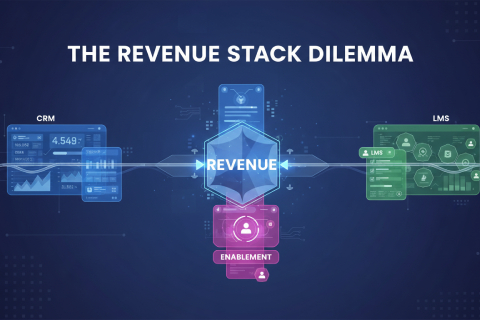

How to measure the ROI of sales enablement software

The Return on Investment (ROI) of sales enablement software measures the financial benefits generated by the software compared to its cost.

How to measure the ROI of sales enablement software

The Return on Investment (ROI) of sales enablement software measures the financial benefits generated by the software compared to its cost. This metric quantifies how effectively the investment in sales enablement tools translates into improved sales performance, efficiency gains, and ultimately, increased revenue. Understanding and tracking this ROI is critical for justifying software expenditures, optimising sales strategies, and demonstrating the tangible value of enablement initiatives to the business.

For a Small to Medium-sized Enterprise (SME), this means understanding how the software helps your sales team sell more effectively and efficiently, directly impacting your revenue and operational costs.

What to consider while measuring the ROI of sales enablement software?
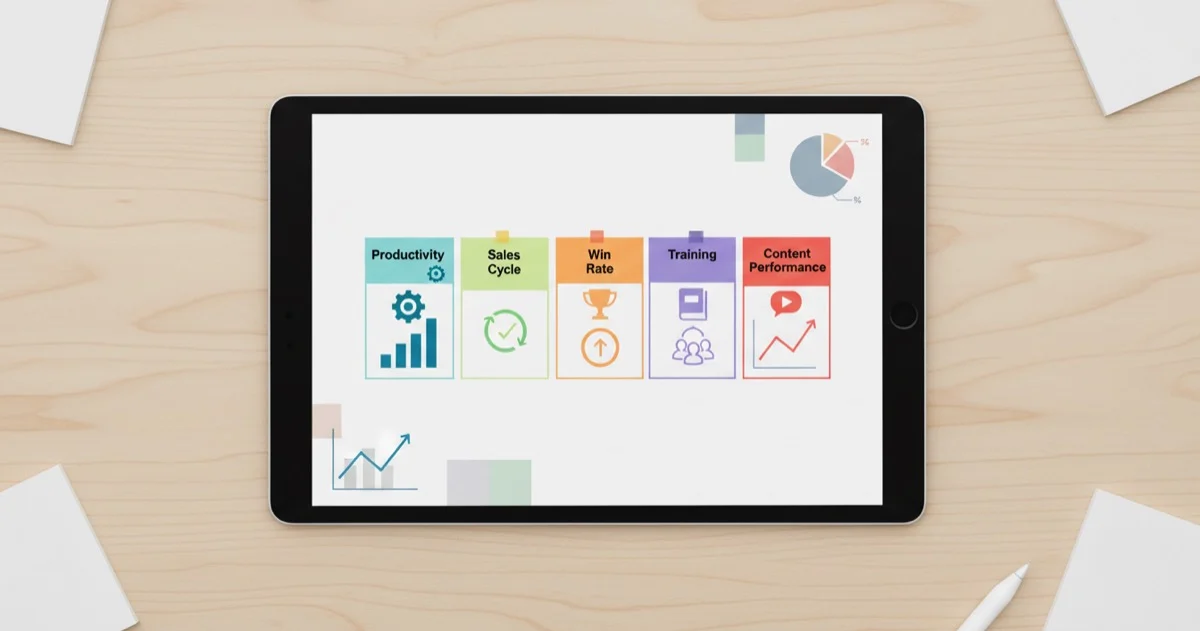
Here are the key areas where sales enablement software drives ROI for SMEs:

  1. Increased Sales Productivity and Efficiency

Sales enablement software centralises resources like sales content, training materials, and prospect insights. This reduces the time sales representatives spend searching for information or preparing for calls. When reps spend less time on administrative tasks and more time engaging with prospects, their output naturally increases.

ROI Contribution

More selling time per rep directly translates to more completed sales activities, leading to a higher volume of closed deals.

How to Measure: 

Track the average time reps spend on non-selling activities before and after implementation. Monitor the increase in calls, meetings, or proposals per rep.

  1. Shorter Sales Cycles

By providing immediate access to the right content (e.g., case studies, product sheets, pricing guides) and guiding reps on what to use at each stage of the buyer journey, the software helps move deals forward faster. Reps can answer questions promptly and proactively address objections, reducing delays.

ROI Contribution:

Faster deal closures mean revenue is recognised sooner, and sales resources are freed up to pursue new opportunities more quickly.

How to Measure: 

Compare your average sales cycle length (from first contact to close) before and after adopting the software.

  1. Higher Win Rates

Sales enablement ensures your sales team delivers consistent, compelling messaging and uses the most effective sales content. It can also provide coaching and training tools that improve sales skills and objection handling. This leads to more persuasive presentations and pitches.

ROI Contribution: 

A higher percentage of your qualified opportunities converts into paying customers, directly increasing your revenue without needing more leads.

How to Measure: 

Track your sales win rate (the percentage of opportunities that close-won) over time. Monitor conversion rates at different stages of your sales funnel.

  1. Reduced Training and Onboarding Costs

For SMEs, quickly getting new sales hires productive is critical. Sales enablement software streamlines onboarding with centralised training modules, role-playing scenarios, and easy access to product and market knowledge. This reduces the time and resources managers need to dedicate to training.

ROI Contribution:

New hires become productive faster, contributing to revenue sooner. Training costs are lowered due to standardised, accessible materials.

How to Measure: 

Track the time-to-first-deal or time-to-quota attainment for new sales reps. Compare the resources (time, money) spent on training before and after implementation.

  1. Improved Content Effectiveness

The software often includes analytics that show which sales content is being used, by whom, and which pieces are most effective in closing deals. This data helps your marketing team create more impactful content and retire underperforming assets.

ROI Contribution: 

Marketing budgets are spent more effectively on content that directly supports sales, avoiding wasted effort on materials that don't convert.

How to Measure: 

Monitor content usage rates by your sales team. Analyze which content assets are correlated with higher win rates or faster deal progression.

Why is measuring the ROI of sales enablement software Important?

Measuring the Return on Investment (ROI) of sales enablement software is crucial because it directly quantifies the financial impact and value that the software brings to an organisation. Sales enablement software is an investment designed to equip sales teams with the content, training, and tools they need to sell more effectively. Measuring its ROI answers the fundamental question: "Is this investment paying off?"

Understanding the ROI allows businesses to justify the initial expenditure and ongoing costs. Without a clear ROI, the software is merely an expense. With it, it becomes a strategic asset that demonstrably contributes to the company's bottom line. It shows whether the software is actively helping to increase revenue, reduce operational costs, or improve sales efficiency.

ROI also serves as a critical performance indicator for the sales enablement strategy itself. By tracking metrics such as improved win rates, shorter sales cycles, larger average deal sizes, or increased sales representative productivity, businesses can directly link these positive outcomes to the software's implementation. This data proves the software's effectiveness in achieving its intended goals.

Furthermore, a clear ROI enables informed decision-making regarding future technology investments and budget allocation. If the software shows a strong positive return, it supports scaling the solution, investing in additional features, or renewing subscriptions. Conversely, a low or negative ROI signals that the strategy or tool needs adjustment, or that the investment may not be worthwhile.

Finally, demonstrating ROI provides tangible evidence to executive leadership and stakeholders that the sales enablement program is not just an operational cost, but a strategic lever for growth. It moves the discussion from subjective benefits to objective financial gains, securing continued support and resources for the sales team's success.

How to calculate the ROI of a Sales Enablement Software?
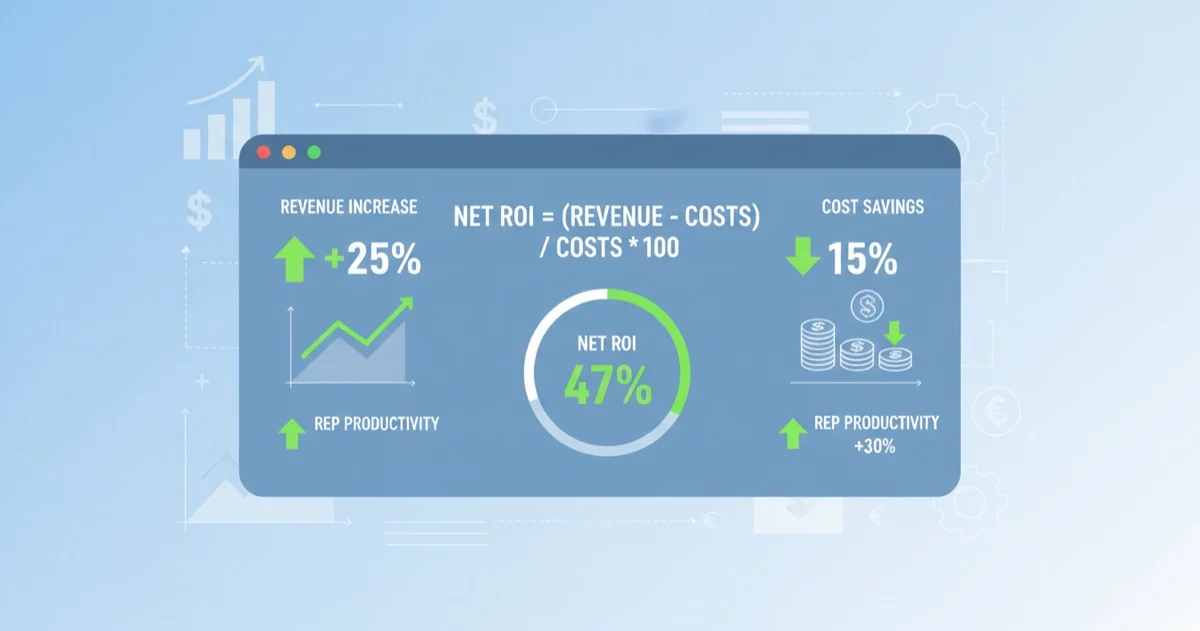
To calculate ROI, you typically compare the total financial gain (increased revenue, cost savings) against the total cost of the software and its implementation.

  • Example 1: Increased Revenue:
    • If your average rep closes 5 deals per month at $10,000 each ($50,000/month).
    • Sales enablement increases their close rate by 10%, leading to 5.5 deals per month ($55,000/month).
    • That's an extra $5,000 per rep per month in revenue. Multiply by your number of reps and 12 months.
    • Compare this total revenue increase to the annual cost of the software.
  • Example 2: Cost Savings (Faster Onboarding):
    • If a new rep takes 6 months to become fully productive, generating $20,000/month, that's $120,000 in lost revenue potential during ramp-up.
    • Sales enablement reduces ramp-up to 4 months, meaning 2 extra months of full productivity ($40,000 extra revenue per new rep).
    • Sum these savings for all new hires and compare to the software cost.

By tracking key metrics like sales cycle length, win rates, rep productivity, and content usage before and after implementing the software, SMEs can directly quantify the financial benefits and demonstrate a positive return on their investment.

Key Benefits of Measuring the ROI of Sales Enablement Software
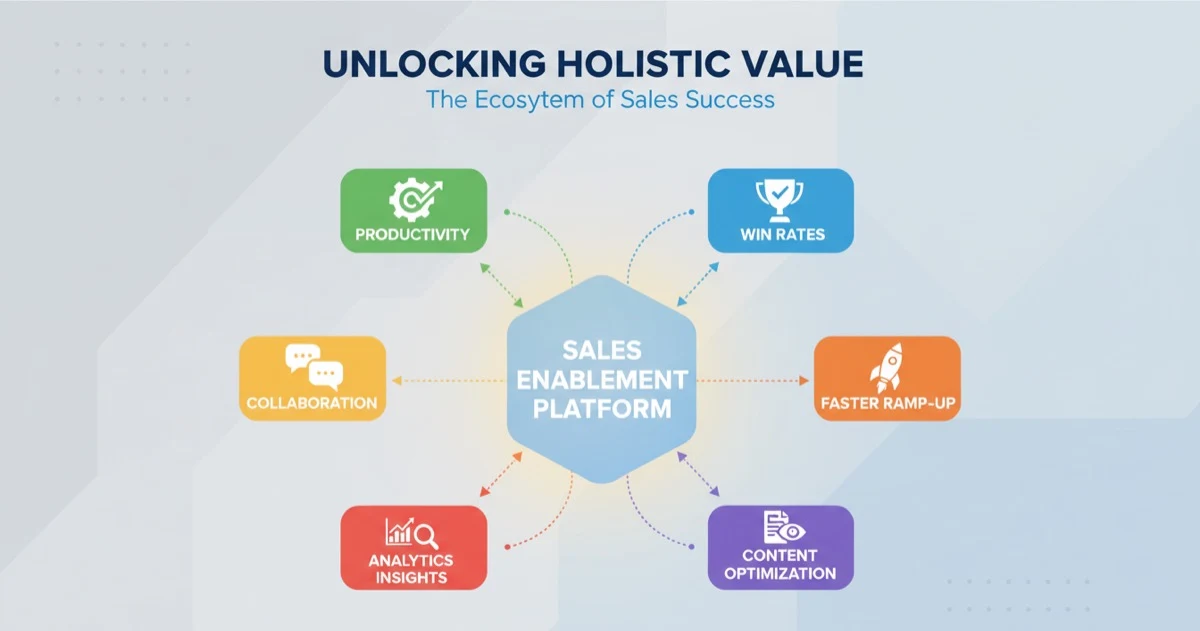
Sales enablement software provides a measurable return on investment (ROI) by directly impacting key sales performance metrics. It streamlines processes, equips sales teams with necessary resources, and provides insights that lead to increased revenue and reduced operational costs.

One core benefit contributing to ROI is increased sales productivity. The software centralises sales content, training materials, and prospect data, reducing the time sales representatives spend searching for information. This allows reps to dedicate more time to selling activities, such as prospecting, engaging with customers, and closing deals, directly translating to more sales opportunities pursued and completed.

Higher win rates and improved deal velocity are significant ROI drivers. Sales enablement tools provide reps with easy access to approved, high-performing content, relevant competitive intelligence, and guided selling playbooks. This ensures reps deliver consistent, compelling messages tailored to specific buyer needs and stages, improving their effectiveness and shortening the sales cycle. Faster closing times mean revenue is recognised sooner.

The software also leads to more effective sales content utilisation. It tracks which content performs best and provides insights into content gaps. Marketing can then create more impactful materials, and sales can confidently use content proven to advance deals. This optimisation reduces wasted marketing spend on underperforming assets and ensures sales efforts are supported by effective resources, directly improving conversion rates.

Reduced sales training costs and faster ramp-up times for new hires are clear financial benefits. Sales enablement platforms offer structured onboarding paths and ongoing training modules. New reps become productive sooner because they have immediate access to product knowledge, sales methodologies, and best practices, lowering the cost per hire and accelerating their contribution to revenue.

Finally, sales enablement software provides actionable insights for sales management. It offers analytics on content usage, rep engagement with training, and overall sales process effectiveness. This data allows managers to identify bottlenecks, pinpoint coaching opportunities, and optimise sales strategies, leading to continuous performance improvement across the entire sales organisation and more efficient allocation of resources.

Common Misconceptions about the ROI of Sales Enablement Software

Understanding the Return on Investment (ROI) for sales enablement software is critical for justifying its adoption and ongoing use. However, several common misconceptions often obscure a complete and accurate view of its value.

Misconception 1: ROI is solely measured by direct sales revenue increase.

Many stakeholders believe sales enablement software's ROI only comes from a direct, immediate bump in sales revenue. While increased revenue is a primary goal, this view is too narrow. The software also impacts efficiency, rep productivity, content effectiveness, and sales cycle duration, all of which indirectly contribute to revenue and cost savings.

Misconception 2: ROI is immediate and easily quantifiable.

Implementing new software and changing sales behaviours takes time. Expecting immediate, dramatic ROI within the first few weeks or even months is unrealistic. True ROI builds as reps integrate the tools into their workflow, content is optimised, and processes mature. Measurement requires consistent data collection over several sales cycles.

Misconception 3: The software itself generates ROI without additional effort.

Sales enablement software is a tool, not a magic solution. Its effectiveness is heavily dependent on proper implementation, ongoing training, relevant content, and strong leadership buy-in. Without a strategic approach to content creation, user adoption, and process integration, the software's potential ROI will not be fully realised.

Misconception 4: All ROI must be strictly quantitative and expressed in dollars.

While financial metrics are important, many benefits are qualitative or difficult to assign an immediate dollar value. These include improved sales rep confidence, better customer experience due to more relevant interactions, reduced rep ramp-up time, and lower sales rep turnover. These factors significantly impact long-term sales performance and organisational health.

Misconception 5: Measuring ROI is overly complex or impossible.

Measuring sales enablement ROI requires a structured approach, but it is achievable. Key Performance Indicators (KPIs) must be established *before* implementation. Examples include sales cycle length, win rates, average deal size, content utilisation rates, rep productivity metrics (e.g., proposals sent, meetings booked), and training completion rates. Tracking these metrics over time provides clear insights into the software's impact.

  • The “New Normal” for Pharma Sales post the lockdown
  • Why organizations look for Sales Enablement
  • How Sales Enablement is different from traditional LMS or CRM
  • The industry best practices for Sales Enablement
  • Implementation challenges and how to overcome them
  • Ensuring higher adoption

Chirag Parmar

Chirag Parmar is the Head of Marketing at Sharpsell.ai and a B2B marketing leader focused on scaling SaaS businesses through demand generation, brand strategy, and revenue-driven marketing. He builds scalable systems that deliver measurable business impact.

How to measure the ROI of sales enablement software

How to measure the ROI of sales enablement software

The Return on Investment (ROI) of sales enablement software measures the financial benefits generated by the software compared to its cost.
Chirag Parmar
February 26, 2026

The Return on Investment (ROI) of sales enablement software measures the financial benefits generated by the software compared to its cost. This metric quantifies how effectively the investment in sales enablement tools translates into improved sales performance, efficiency gains, and ultimately, increased revenue. Understanding and tracking this ROI is critical for justifying software expenditures, optimising sales strategies, and demonstrating the tangible value of enablement initiatives to the business.

For a Small to Medium-sized Enterprise (SME), this means understanding how the software helps your sales team sell more effectively and efficiently, directly impacting your revenue and operational costs.

What to consider while measuring the ROI of sales enablement software?

Here are the key areas where sales enablement software drives ROI for SMEs:

  1. Increased Sales Productivity and Efficiency

Sales enablement software centralises resources like sales content, training materials, and prospect insights. This reduces the time sales representatives spend searching for information or preparing for calls. When reps spend less time on administrative tasks and more time engaging with prospects, their output naturally increases.

ROI Contribution

More selling time per rep directly translates to more completed sales activities, leading to a higher volume of closed deals.

How to Measure: 

Track the average time reps spend on non-selling activities before and after implementation. Monitor the increase in calls, meetings, or proposals per rep.

  1. Shorter Sales Cycles

By providing immediate access to the right content (e.g., case studies, product sheets, pricing guides) and guiding reps on what to use at each stage of the buyer journey, the software helps move deals forward faster. Reps can answer questions promptly and proactively address objections, reducing delays.

ROI Contribution:

Faster deal closures mean revenue is recognised sooner, and sales resources are freed up to pursue new opportunities more quickly.

How to Measure: 

Compare your average sales cycle length (from first contact to close) before and after adopting the software.

  1. Higher Win Rates

Sales enablement ensures your sales team delivers consistent, compelling messaging and uses the most effective sales content. It can also provide coaching and training tools that improve sales skills and objection handling. This leads to more persuasive presentations and pitches.

ROI Contribution: 

A higher percentage of your qualified opportunities converts into paying customers, directly increasing your revenue without needing more leads.

How to Measure: 

Track your sales win rate (the percentage of opportunities that close-won) over time. Monitor conversion rates at different stages of your sales funnel.

  1. Reduced Training and Onboarding Costs

For SMEs, quickly getting new sales hires productive is critical. Sales enablement software streamlines onboarding with centralised training modules, role-playing scenarios, and easy access to product and market knowledge. This reduces the time and resources managers need to dedicate to training.

ROI Contribution:

New hires become productive faster, contributing to revenue sooner. Training costs are lowered due to standardised, accessible materials.

How to Measure: 

Track the time-to-first-deal or time-to-quota attainment for new sales reps. Compare the resources (time, money) spent on training before and after implementation.

  1. Improved Content Effectiveness

The software often includes analytics that show which sales content is being used, by whom, and which pieces are most effective in closing deals. This data helps your marketing team create more impactful content and retire underperforming assets.

ROI Contribution: 

Marketing budgets are spent more effectively on content that directly supports sales, avoiding wasted effort on materials that don't convert.

How to Measure: 

Monitor content usage rates by your sales team. Analyze which content assets are correlated with higher win rates or faster deal progression.

Why is measuring the ROI of sales enablement software Important?

Measuring the Return on Investment (ROI) of sales enablement software is crucial because it directly quantifies the financial impact and value that the software brings to an organisation. Sales enablement software is an investment designed to equip sales teams with the content, training, and tools they need to sell more effectively. Measuring its ROI answers the fundamental question: "Is this investment paying off?"

Understanding the ROI allows businesses to justify the initial expenditure and ongoing costs. Without a clear ROI, the software is merely an expense. With it, it becomes a strategic asset that demonstrably contributes to the company's bottom line. It shows whether the software is actively helping to increase revenue, reduce operational costs, or improve sales efficiency.

ROI also serves as a critical performance indicator for the sales enablement strategy itself. By tracking metrics such as improved win rates, shorter sales cycles, larger average deal sizes, or increased sales representative productivity, businesses can directly link these positive outcomes to the software's implementation. This data proves the software's effectiveness in achieving its intended goals.

Furthermore, a clear ROI enables informed decision-making regarding future technology investments and budget allocation. If the software shows a strong positive return, it supports scaling the solution, investing in additional features, or renewing subscriptions. Conversely, a low or negative ROI signals that the strategy or tool needs adjustment, or that the investment may not be worthwhile.

Finally, demonstrating ROI provides tangible evidence to executive leadership and stakeholders that the sales enablement program is not just an operational cost, but a strategic lever for growth. It moves the discussion from subjective benefits to objective financial gains, securing continued support and resources for the sales team's success.

How to calculate the ROI of a Sales Enablement Software?

To calculate ROI, you typically compare the total financial gain (increased revenue, cost savings) against the total cost of the software and its implementation.

  • Example 1: Increased Revenue:
    • If your average rep closes 5 deals per month at $10,000 each ($50,000/month).
    • Sales enablement increases their close rate by 10%, leading to 5.5 deals per month ($55,000/month).
    • That's an extra $5,000 per rep per month in revenue. Multiply by your number of reps and 12 months.
    • Compare this total revenue increase to the annual cost of the software.
  • Example 2: Cost Savings (Faster Onboarding):
    • If a new rep takes 6 months to become fully productive, generating $20,000/month, that's $120,000 in lost revenue potential during ramp-up.
    • Sales enablement reduces ramp-up to 4 months, meaning 2 extra months of full productivity ($40,000 extra revenue per new rep).
    • Sum these savings for all new hires and compare to the software cost.

By tracking key metrics like sales cycle length, win rates, rep productivity, and content usage before and after implementing the software, SMEs can directly quantify the financial benefits and demonstrate a positive return on their investment.

Key Benefits of Measuring the ROI of Sales Enablement Software

Sales enablement software provides a measurable return on investment (ROI) by directly impacting key sales performance metrics. It streamlines processes, equips sales teams with necessary resources, and provides insights that lead to increased revenue and reduced operational costs.

One core benefit contributing to ROI is increased sales productivity. The software centralises sales content, training materials, and prospect data, reducing the time sales representatives spend searching for information. This allows reps to dedicate more time to selling activities, such as prospecting, engaging with customers, and closing deals, directly translating to more sales opportunities pursued and completed.

Higher win rates and improved deal velocity are significant ROI drivers. Sales enablement tools provide reps with easy access to approved, high-performing content, relevant competitive intelligence, and guided selling playbooks. This ensures reps deliver consistent, compelling messages tailored to specific buyer needs and stages, improving their effectiveness and shortening the sales cycle. Faster closing times mean revenue is recognised sooner.

The software also leads to more effective sales content utilisation. It tracks which content performs best and provides insights into content gaps. Marketing can then create more impactful materials, and sales can confidently use content proven to advance deals. This optimisation reduces wasted marketing spend on underperforming assets and ensures sales efforts are supported by effective resources, directly improving conversion rates.

Reduced sales training costs and faster ramp-up times for new hires are clear financial benefits. Sales enablement platforms offer structured onboarding paths and ongoing training modules. New reps become productive sooner because they have immediate access to product knowledge, sales methodologies, and best practices, lowering the cost per hire and accelerating their contribution to revenue.

Finally, sales enablement software provides actionable insights for sales management. It offers analytics on content usage, rep engagement with training, and overall sales process effectiveness. This data allows managers to identify bottlenecks, pinpoint coaching opportunities, and optimise sales strategies, leading to continuous performance improvement across the entire sales organisation and more efficient allocation of resources.

Common Misconceptions about the ROI of Sales Enablement Software

Understanding the Return on Investment (ROI) for sales enablement software is critical for justifying its adoption and ongoing use. However, several common misconceptions often obscure a complete and accurate view of its value.

Misconception 1: ROI is solely measured by direct sales revenue increase.

Many stakeholders believe sales enablement software's ROI only comes from a direct, immediate bump in sales revenue. While increased revenue is a primary goal, this view is too narrow. The software also impacts efficiency, rep productivity, content effectiveness, and sales cycle duration, all of which indirectly contribute to revenue and cost savings.

Misconception 2: ROI is immediate and easily quantifiable.

Implementing new software and changing sales behaviours takes time. Expecting immediate, dramatic ROI within the first few weeks or even months is unrealistic. True ROI builds as reps integrate the tools into their workflow, content is optimised, and processes mature. Measurement requires consistent data collection over several sales cycles.

Misconception 3: The software itself generates ROI without additional effort.

Sales enablement software is a tool, not a magic solution. Its effectiveness is heavily dependent on proper implementation, ongoing training, relevant content, and strong leadership buy-in. Without a strategic approach to content creation, user adoption, and process integration, the software's potential ROI will not be fully realised.

Misconception 4: All ROI must be strictly quantitative and expressed in dollars.

While financial metrics are important, many benefits are qualitative or difficult to assign an immediate dollar value. These include improved sales rep confidence, better customer experience due to more relevant interactions, reduced rep ramp-up time, and lower sales rep turnover. These factors significantly impact long-term sales performance and organisational health.

Misconception 5: Measuring ROI is overly complex or impossible.

Measuring sales enablement ROI requires a structured approach, but it is achievable. Key Performance Indicators (KPIs) must be established *before* implementation. Examples include sales cycle length, win rates, average deal size, content utilisation rates, rep productivity metrics (e.g., proposals sent, meetings booked), and training completion rates. Tracking these metrics over time provides clear insights into the software's impact.

What’s a Rich Text element?

The rich text element allows you to create and format headings, paragraphs, blockquotes, images, and video all in one place instead of having to add and format them individually. Just double-click and easily create content.

Static and dynamic content editing

A rich text element can be used with static or dynamic content. For static content, just drop it into any page and begin editing. For dynamic content, add a rich text field to any collection and then connect a rich text element to that field in the settings panel. Voila!

How to customize formatting for each rich text

Headings, paragraphs, blockquotes, figures, images, and figure captions can all be styled after a class is added to the rich text element using the "When inside of" nested selector system.

zdxfhgfg

  1. sdnslk,xdv
  2. SDlknjsdv
  3. SDvlknj
  • sdgdf v

How to measure the ROI of sales enablement software

February 27, 2026
9 Min
Chirag Parmar
Chirag Parmar

The Return on Investment (ROI) of sales enablement software measures the financial benefits generated by the software compared to its cost. This metric quantifies how effectively the investment in sales enablement tools translates into improved sales performance, efficiency gains, and ultimately, increased revenue. Understanding and tracking this ROI is critical for justifying software expenditures, optimising sales strategies, and demonstrating the tangible value of enablement initiatives to the business.

For a Small to Medium-sized Enterprise (SME), this means understanding how the software helps your sales team sell more effectively and efficiently, directly impacting your revenue and operational costs.

What to consider while measuring the ROI of sales enablement software?

Here are the key areas where sales enablement software drives ROI for SMEs:

  1. Increased Sales Productivity and Efficiency

Sales enablement software centralises resources like sales content, training materials, and prospect insights. This reduces the time sales representatives spend searching for information or preparing for calls. When reps spend less time on administrative tasks and more time engaging with prospects, their output naturally increases.

ROI Contribution

More selling time per rep directly translates to more completed sales activities, leading to a higher volume of closed deals.

How to Measure: 

Track the average time reps spend on non-selling activities before and after implementation. Monitor the increase in calls, meetings, or proposals per rep.

  1. Shorter Sales Cycles

By providing immediate access to the right content (e.g., case studies, product sheets, pricing guides) and guiding reps on what to use at each stage of the buyer journey, the software helps move deals forward faster. Reps can answer questions promptly and proactively address objections, reducing delays.

ROI Contribution:

Faster deal closures mean revenue is recognised sooner, and sales resources are freed up to pursue new opportunities more quickly.

How to Measure: 

Compare your average sales cycle length (from first contact to close) before and after adopting the software.

  1. Higher Win Rates

Sales enablement ensures your sales team delivers consistent, compelling messaging and uses the most effective sales content. It can also provide coaching and training tools that improve sales skills and objection handling. This leads to more persuasive presentations and pitches.

ROI Contribution: 

A higher percentage of your qualified opportunities converts into paying customers, directly increasing your revenue without needing more leads.

How to Measure: 

Track your sales win rate (the percentage of opportunities that close-won) over time. Monitor conversion rates at different stages of your sales funnel.

  1. Reduced Training and Onboarding Costs

For SMEs, quickly getting new sales hires productive is critical. Sales enablement software streamlines onboarding with centralised training modules, role-playing scenarios, and easy access to product and market knowledge. This reduces the time and resources managers need to dedicate to training.

ROI Contribution:

New hires become productive faster, contributing to revenue sooner. Training costs are lowered due to standardised, accessible materials.

How to Measure: 

Track the time-to-first-deal or time-to-quota attainment for new sales reps. Compare the resources (time, money) spent on training before and after implementation.

  1. Improved Content Effectiveness

The software often includes analytics that show which sales content is being used, by whom, and which pieces are most effective in closing deals. This data helps your marketing team create more impactful content and retire underperforming assets.

ROI Contribution: 

Marketing budgets are spent more effectively on content that directly supports sales, avoiding wasted effort on materials that don't convert.

How to Measure: 

Monitor content usage rates by your sales team. Analyze which content assets are correlated with higher win rates or faster deal progression.

Why is measuring the ROI of sales enablement software Important?

Measuring the Return on Investment (ROI) of sales enablement software is crucial because it directly quantifies the financial impact and value that the software brings to an organisation. Sales enablement software is an investment designed to equip sales teams with the content, training, and tools they need to sell more effectively. Measuring its ROI answers the fundamental question: "Is this investment paying off?"

Understanding the ROI allows businesses to justify the initial expenditure and ongoing costs. Without a clear ROI, the software is merely an expense. With it, it becomes a strategic asset that demonstrably contributes to the company's bottom line. It shows whether the software is actively helping to increase revenue, reduce operational costs, or improve sales efficiency.

ROI also serves as a critical performance indicator for the sales enablement strategy itself. By tracking metrics such as improved win rates, shorter sales cycles, larger average deal sizes, or increased sales representative productivity, businesses can directly link these positive outcomes to the software's implementation. This data proves the software's effectiveness in achieving its intended goals.

Furthermore, a clear ROI enables informed decision-making regarding future technology investments and budget allocation. If the software shows a strong positive return, it supports scaling the solution, investing in additional features, or renewing subscriptions. Conversely, a low or negative ROI signals that the strategy or tool needs adjustment, or that the investment may not be worthwhile.

Finally, demonstrating ROI provides tangible evidence to executive leadership and stakeholders that the sales enablement program is not just an operational cost, but a strategic lever for growth. It moves the discussion from subjective benefits to objective financial gains, securing continued support and resources for the sales team's success.

How to calculate the ROI of a Sales Enablement Software?

To calculate ROI, you typically compare the total financial gain (increased revenue, cost savings) against the total cost of the software and its implementation.

  • Example 1: Increased Revenue:
    • If your average rep closes 5 deals per month at $10,000 each ($50,000/month).
    • Sales enablement increases their close rate by 10%, leading to 5.5 deals per month ($55,000/month).
    • That's an extra $5,000 per rep per month in revenue. Multiply by your number of reps and 12 months.
    • Compare this total revenue increase to the annual cost of the software.
  • Example 2: Cost Savings (Faster Onboarding):
    • If a new rep takes 6 months to become fully productive, generating $20,000/month, that's $120,000 in lost revenue potential during ramp-up.
    • Sales enablement reduces ramp-up to 4 months, meaning 2 extra months of full productivity ($40,000 extra revenue per new rep).
    • Sum these savings for all new hires and compare to the software cost.

By tracking key metrics like sales cycle length, win rates, rep productivity, and content usage before and after implementing the software, SMEs can directly quantify the financial benefits and demonstrate a positive return on their investment.

Key Benefits of Measuring the ROI of Sales Enablement Software

Sales enablement software provides a measurable return on investment (ROI) by directly impacting key sales performance metrics. It streamlines processes, equips sales teams with necessary resources, and provides insights that lead to increased revenue and reduced operational costs.

One core benefit contributing to ROI is increased sales productivity. The software centralises sales content, training materials, and prospect data, reducing the time sales representatives spend searching for information. This allows reps to dedicate more time to selling activities, such as prospecting, engaging with customers, and closing deals, directly translating to more sales opportunities pursued and completed.

Higher win rates and improved deal velocity are significant ROI drivers. Sales enablement tools provide reps with easy access to approved, high-performing content, relevant competitive intelligence, and guided selling playbooks. This ensures reps deliver consistent, compelling messages tailored to specific buyer needs and stages, improving their effectiveness and shortening the sales cycle. Faster closing times mean revenue is recognised sooner.

The software also leads to more effective sales content utilisation. It tracks which content performs best and provides insights into content gaps. Marketing can then create more impactful materials, and sales can confidently use content proven to advance deals. This optimisation reduces wasted marketing spend on underperforming assets and ensures sales efforts are supported by effective resources, directly improving conversion rates.

Reduced sales training costs and faster ramp-up times for new hires are clear financial benefits. Sales enablement platforms offer structured onboarding paths and ongoing training modules. New reps become productive sooner because they have immediate access to product knowledge, sales methodologies, and best practices, lowering the cost per hire and accelerating their contribution to revenue.

Finally, sales enablement software provides actionable insights for sales management. It offers analytics on content usage, rep engagement with training, and overall sales process effectiveness. This data allows managers to identify bottlenecks, pinpoint coaching opportunities, and optimise sales strategies, leading to continuous performance improvement across the entire sales organisation and more efficient allocation of resources.

Common Misconceptions about the ROI of Sales Enablement Software

Understanding the Return on Investment (ROI) for sales enablement software is critical for justifying its adoption and ongoing use. However, several common misconceptions often obscure a complete and accurate view of its value.

Misconception 1: ROI is solely measured by direct sales revenue increase.

Many stakeholders believe sales enablement software's ROI only comes from a direct, immediate bump in sales revenue. While increased revenue is a primary goal, this view is too narrow. The software also impacts efficiency, rep productivity, content effectiveness, and sales cycle duration, all of which indirectly contribute to revenue and cost savings.

Misconception 2: ROI is immediate and easily quantifiable.

Implementing new software and changing sales behaviours takes time. Expecting immediate, dramatic ROI within the first few weeks or even months is unrealistic. True ROI builds as reps integrate the tools into their workflow, content is optimised, and processes mature. Measurement requires consistent data collection over several sales cycles.

Misconception 3: The software itself generates ROI without additional effort.

Sales enablement software is a tool, not a magic solution. Its effectiveness is heavily dependent on proper implementation, ongoing training, relevant content, and strong leadership buy-in. Without a strategic approach to content creation, user adoption, and process integration, the software's potential ROI will not be fully realised.

Misconception 4: All ROI must be strictly quantitative and expressed in dollars.

While financial metrics are important, many benefits are qualitative or difficult to assign an immediate dollar value. These include improved sales rep confidence, better customer experience due to more relevant interactions, reduced rep ramp-up time, and lower sales rep turnover. These factors significantly impact long-term sales performance and organisational health.

Misconception 5: Measuring ROI is overly complex or impossible.

Measuring sales enablement ROI requires a structured approach, but it is achievable. Key Performance Indicators (KPIs) must be established *before* implementation. Examples include sales cycle length, win rates, average deal size, content utilisation rates, rep productivity metrics (e.g., proposals sent, meetings booked), and training completion rates. Tracking these metrics over time provides clear insights into the software's impact.

Readers also liked

6 Min
Chirag Parmar
Chirag Parmar
5 Min
Chirag Parmar
Chirag Parmar
7 Min
Chirag Parmar
Chirag Parmar
12 Min
Aman Vasishth
Aman Vasishth

Are you ready to unleash the power of Sales Playbooks for your team?

Thank you! You have been added to our subscriber list!
Oops! Something went wrong while submitting the form.