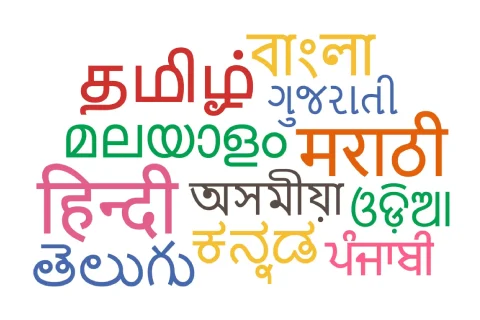
India is one of the world's fastest-growing consumer and enterprise markets, but it is also one of the most linguistically diverse. With hundreds of languages and thousands of dialects spoken across the country, sales conversations rarely happen in just English. Whether it's a relationship manager explaining an investment product in Hindi, a pharmaceutical representative discussing a new therapy in Tamil, a dealership executive selling a vehicle in Marathi, or an insurance advisor interacting with customers in Bengali, language plays a crucial role in shaping trust, understanding, and buying decisions.
For enterprise organizations with large frontline sales teams, this diversity presents a unique challenge. While products, pricing, sales processes, and compliance requirements may be standardized, customer conversations are not. The same sales pitch that works in one region may need to be adapted linguistically and culturally in another. Representatives are expected to communicate complex product information, address objections, explain pricing, and build relationships in the language that customers are most comfortable with.
Yet, despite this reality, many sales training programs continue to rely on a one-size-fits-all approach.
Product training is often delivered in English. Roleplay sessions are conducted using scripted scenarios that do not reflect regional customer conversations. Assessments measure product knowledge but rarely evaluate whether sales representatives can confidently explain that knowledge in the customer's preferred language.
As a result, organizations frequently discover a gap between what their sales teams know and what they are able to communicate effectively in the field.
This is where multilingual AI roleplay is changing the way enterprise sales teams prepare for customer interactions.
Instead of limiting practice to classroom sessions or periodic manager-led roleplays, AI enables sales representatives to rehearse realistic customer conversations in multiple languages, receive immediate feedback, and continuously improve before meeting actual customers.
For organizations operating across India's diverse linguistic landscape, multilingual AI roleplay is no longer simply an innovative training method. It is becoming an essential capability for improving sales readiness, ensuring consistent customer experiences, and driving better sales execution at scale.
India's Linguistic Diversity Demands a Different Approach to Sales Training

India is home to extraordinary linguistic diversity. While English remains the language of business documentation and internal communication for many enterprises, customer conversations often happen in regional languages. Buyers naturally prefer to discuss financial decisions, healthcare products, insurance policies, automobiles, and major purchases in the language they understand best.
This preference is especially evident in industries where trust plays a significant role in the buying journey.
A customer considering a home loan may feel more comfortable discussing repayment terms in Hindi than in English. A farmer purchasing agricultural equipment may expect product demonstrations in Telugu or Kannada. A retail customer evaluating an insurance policy may ask detailed questions in Gujarati, while a pharmaceutical representative speaking with a doctor may alternate between English medical terminology and the local language during the discussion.
These multilingual interactions are part of everyday selling across India.
However, many enterprise sales training programs continue to prepare representatives primarily through English-based content.
Product manuals are written in English.
Certification modules are delivered in English.
Sales scripts are drafted in English.
Even roleplay exercises often assume that customer conversations will follow the same language and structure.
The challenge becomes apparent when representatives step into real customer meetings.
They know the product.They understand the features.They have completed every mandatory training module. Yet they hesitate when translating technical concepts into natural, customer-friendly language.Instead of speaking confidently, they pause to find the right words.
Complex product explanations become oversimplified. Important value propositions are omitted. Customer objections become more difficult to address. The issue is not insufficient product knowledge. It is insufficient conversational practice.
Why Traditional Roleplay Doesn't Scale

Roleplay has always been one of the most effective methods of preparing sales teams. It allows representatives to simulate customer interactions, practice handling objections, improve communication, and build confidence before entering real sales situations.
However, traditional roleplay has several limitations, particularly for large enterprise organizations.
First, it is difficult to scale.
A company employing thousands of frontline sales representatives cannot realistically conduct individual manager-led roleplay sessions every week. Managers already balance forecasting, pipeline reviews, coaching, hiring, customer escalations, and administrative responsibilities. Finding sufficient time for personalised practice becomes increasingly difficult as teams grow.
Second, traditional roleplays often lack consistency.
Different managers coach differently.
Some focus on product knowledge.
Others emphasise objection handling.
Some provide detailed feedback.
Others simply evaluate whether the conversation sounds convincing.
This inconsistency means representatives across different regions receive varying levels of coaching despite working for the same organization.
Third, roleplays are usually scheduled rather than continuous.
Representatives may participate in a workshop during onboarding or before a product launch, but weeks or even months can pass before they practice again. By then, product updates, competitor messaging, customer expectations, and market conditions may already have changed.
Finally, traditional roleplay rarely reflects India's multilingual reality.
A representative serving customers in Punjab may practice entirely in English despite conducting most customer meetings in Punjabi or Hindi. Another representative in Kerala may complete product certification successfully but never practice explaining the same solution in Malayalam before meeting customers.
The transition from classroom learning to real customer conversations therefore remains challenging.
The Confidence Gap in Frontline Selling

One of the biggest barriers to effective sales execution is not knowledge—it's confidence.
Many frontline sales representatives understand their products well but hesitate during live customer interactions because they are unsure how to communicate complex information naturally in the customer's preferred language.
This confidence gap becomes particularly visible during high-value or consultative sales.
Imagine a banking relationship manager explaining the benefits of a wealth management product. They know the investment strategy, expected returns, associated risks, and regulatory disclosures. However, when the customer asks for clarification in Hindi, the representative struggles to explain financial concepts clearly without reverting to technical English terms.
Similarly, consider an automotive sales consultant introducing the latest connected vehicle features. The consultant understands the technology but finds it difficult to simplify technical specifications into conversational Marathi or Tamil that resonates with first-time buyers.
The same challenge exists across industries.
Insurance advisors need to explain policy exclusions without creating confusion.
Pharmaceutical representatives must discuss clinical evidence while maintaining scientific accuracy.
Retail sales associates need to recommend products confidently while adapting to different customer communication styles.
In each case, confidence is built not by reading product documents but by practising realistic conversations repeatedly until they become natural.
This is precisely where multilingual AI roleplay creates measurable value.
Rather than practising once during onboarding, representatives can rehearse customer scenarios whenever they need to. They can simulate conversations in Hindi, Tamil, Marathi, Bengali, Kannada, Telugu, or other regional languages, receive immediate feedback on clarity, accuracy, confidence, and objection handling, and continue improving through repeated practice.
The result is not simply better language skills.
It is greater readiness for real customer conversations.
Why Multilingual AI Roleplay Matters More Than Ever

Enterprise sales environments are evolving rapidly. Product portfolios are expanding, customer expectations are rising, and buying decisions are becoming increasingly consultative. Organizations expect sales representatives to personalise every interaction while maintaining compliance, delivering consistent messaging, and explaining increasingly sophisticated products.
At the same time, frontline sales teams are becoming larger and more geographically distributed.
A single bank may employ thousands of relationship managers across multiple states. An insurance company may onboard hundreds of advisors every month. Pharmaceutical companies regularly launch new therapies requiring immediate field readiness. Automotive brands continuously introduce new vehicle variants and financing options.
Training these teams effectively using traditional methods alone is becoming increasingly difficult.
Multilingual AI roleplay addresses this challenge by making high-quality conversational practice available anytime, anywhere, and at scale. Instead of depending entirely on manager availability or classroom sessions, representatives gain continuous opportunities to improve their communication skills in the language they actually use with customers.
For enterprise organizations, this means faster onboarding, more consistent messaging across regions, greater confidence among frontline teams, and stronger customer interactions.
More importantly, it bridges one of the biggest gaps in modern sales training—the gap between learning a product and confidently selling it in the customer's language.
As India's enterprise sales landscape continues to evolve, organizations that invest in multilingual sales readiness will be better positioned to build trust, improve customer experiences, and execute sales conversations consistently across every market they serve.
How Multilingual AI Roleplay Accelerates Learning and Improves Sales Readiness

One of the biggest challenges enterprise sales organizations face is not training their sales teams—it is ensuring that training translates into confident customer conversations. A representative may complete every onboarding module, pass every product certification, and attend every coaching session, yet still struggle to explain a product clearly when sitting across from a customer.
This gap exists because knowledge alone does not build confidence. Confidence comes from practice.
Think about learning to drive a car. Reading the driving manual helps you understand traffic rules and road signs, but it does not prepare you for navigating a busy road. The real learning happens behind the wheel through repeated practice. Sales training works in much the same way. Product documents, presentations, and classroom sessions provide the foundation, but representatives only become confident when they repeatedly apply that knowledge in realistic customer conversations.
This is where multilingual AI roleplay creates a meaningful difference. Instead of treating roleplay as a one-time activity during onboarding, AI transforms it into an ongoing learning experience. Sales representatives can practise customer interactions whenever they need to, receive immediate feedback, improve their responses, and build confidence before engaging with actual customers.
For enterprise organizations managing thousands of frontline sellers, this continuous practice model is far more scalable than relying solely on classroom training or manager-led coaching.
Why Traditional Sales Training Has Limited Long-Term Impact

Most enterprise sales training follows a familiar pattern. A new product is launched, training sessions are organised, product experts conduct presentations, and representatives complete assessments to demonstrate their understanding. Once training is complete, sales teams return to the field and are expected to apply everything they have learned.
The challenge is that people naturally forget information that they do not use regularly.
A sales representative may remember the product's key features immediately after training, but after several weeks of handling customer meetings, administrative work, and multiple product discussions, much of that information begins to fade. New product launches, competitor updates, pricing changes, and revised compliance requirements add further complexity, making it difficult to recall every detail when needed.
Even when representatives remember the information, they may struggle to communicate it effectively in the customer's preferred language. Translating technical terminology into simple, conversational language while maintaining accuracy requires practice—something traditional training often does not provide.
As a result, customer conversations become inconsistent.
Some representatives explain products with clarity and confidence.
Others rely heavily on brochures or presentations.
Some skip important value propositions because they are unsure how to articulate them naturally.
These inconsistencies affect customer trust, product adoption, and overall sales performance.
Practice Builds Confidence Faster Than Passive Learning
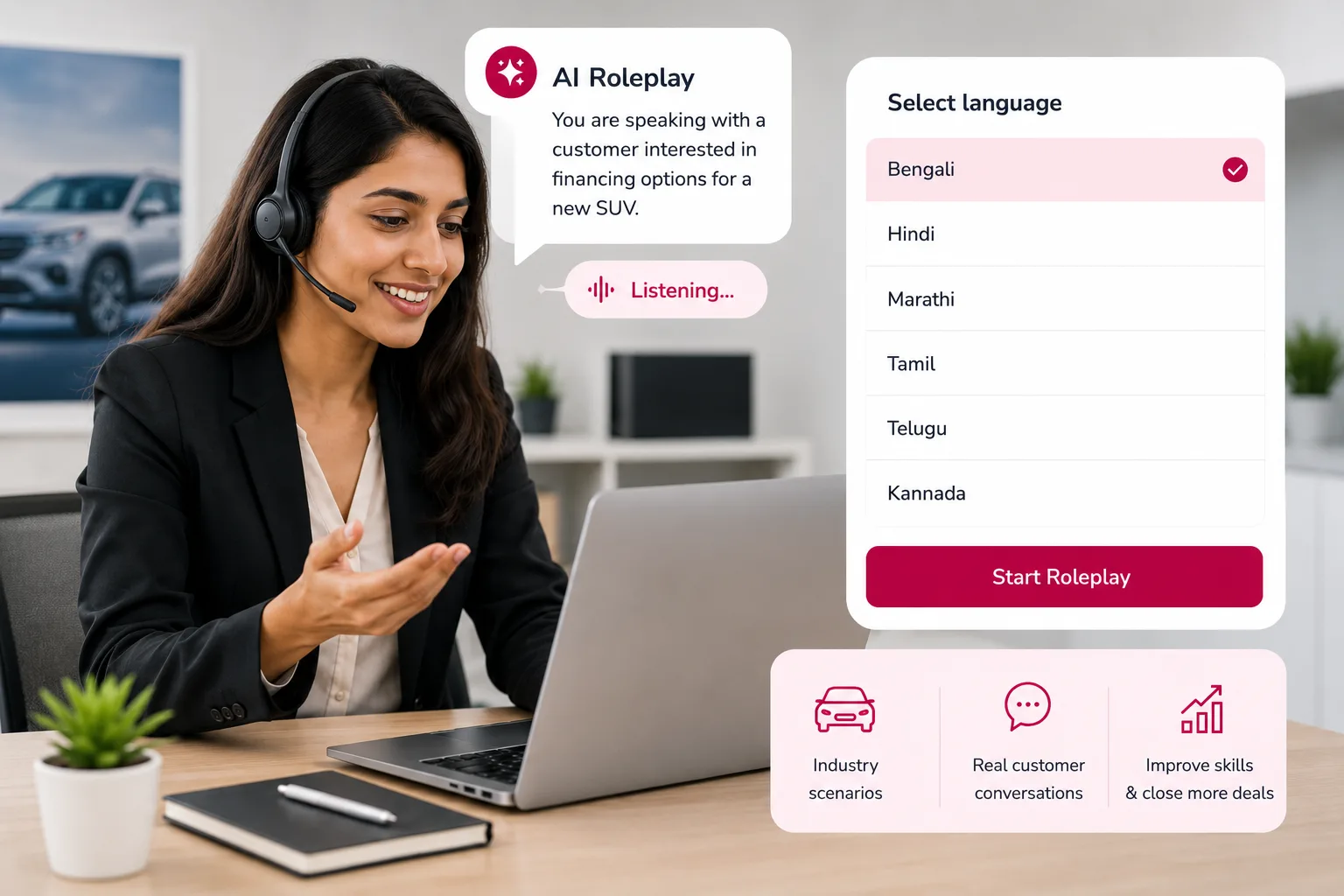
Educational research has consistently shown that active participation improves learning far more effectively than passive observation. People retain information better when they actively apply it rather than simply reading or listening to it.
For frontline sales teams, this means that explaining a product repeatedly, responding to customer objections, and handling different sales scenarios leads to stronger knowledge retention than attending another presentation or reading another product guide.
Multilingual AI roleplay applies this principle by allowing representatives to practise realistic customer interactions instead of passively consuming information.
A banking relationship manager can rehearse explaining a home loan to a first-time buyer in Hindi.
An insurance advisor can practise responding to objections about premium costs in Marathi.
A pharmaceutical representative can simulate discussions with doctors while balancing English medical terminology with regional language communication.
An automotive consultant can practise explaining financing options and connected vehicle features in Tamil before meeting showroom visitors.
Each conversation reinforces both product knowledge and communication skills simultaneously.
Because representatives receive instant feedback after every roleplay, they can immediately identify areas for improvement. They understand whether they explained the product clearly, addressed customer concerns effectively, followed the recommended sales process, or missed important talking points.
Learning becomes continuous rather than occasional.
Faster Onboarding for Growing Sales Teams
For organizations hiring large numbers of frontline sales representatives, onboarding speed is a critical business metric. Every additional week a new hire takes to become productive delays revenue generation and increases training costs.
Traditional onboarding often follows a fixed schedule. New representatives spend several days or weeks attending classroom sessions, reviewing product manuals, completing certifications, and shadowing experienced colleagues before they begin customer interactions.
While this approach builds foundational knowledge, it does not always prepare representatives for the unpredictable nature of real customer conversations.
Customers rarely follow scripts.
They ask unexpected questions.
They compare competitors.
They raise objections.
They request examples.
They switch between languages during the discussion.
Without sufficient conversational practice, new representatives often lack the confidence to handle these situations independently.
Multilingual AI roleplay shortens this learning curve by allowing new hires to experience dozens of realistic customer scenarios before they ever meet a customer.
Instead of participating in one or two practice sessions during onboarding, they can complete multiple roleplays every day, covering different products, industries, customer personas, and languages.
By the time they begin field visits, they have already rehearsed situations they are likely to encounter in the real world.
This accelerated learning process reduces onboarding time while improving overall sales readiness.
Preparing Representatives for Real Customer Conversations

One of the biggest limitations of conventional sales training is that it often focuses on ideal customer interactions.
Training scenarios usually assume that customers are attentive, interested, and willing to follow a structured conversation.
Actual customer meetings are far more dynamic.
A customer may interrupt with pricing questions before the product has been introduced. Another may compare competing brands immediately. Some may express frustration based on previous experiences. Others may challenge product claims or ask detailed technical questions.
In multilingual markets like India, conversations also shift naturally between languages.
A customer might begin the discussion in English, ask technical questions using English terminology, and then switch to Hindi, Gujarati, or Kannada when discussing pricing or personal preferences.
Sales representatives need to adapt seamlessly.
Multilingual AI roleplay prepares representatives for this reality by exposing them to a wide variety of conversation styles rather than a single scripted interaction.
Representatives learn how to think, respond, and communicate naturally instead of memorising fixed answers.
This flexibility is particularly valuable for consultative selling, where success depends on understanding customer needs rather than delivering rehearsed product pitches.
Consistency Across Regions Without Sacrificing Local Relevance
One of the biggest challenges for enterprise sales leaders is maintaining consistent customer experiences across geographically distributed teams.
A customer in Delhi should receive the same quality of product explanation as a customer in Chennai.
A banking customer in Mumbai should hear the same core value proposition as someone visiting a branch in Kolkata.
However, consistency does not mean using identical words everywhere.
The message should remain consistent, while the language and examples should feel natural to the customer.
Multilingual AI roleplay helps organizations achieve this balance.
Sales leaders can standardise key product messaging, compliance requirements, qualification questions, and sales methodologies while allowing representatives to deliver them fluently in regional languages.
This ensures that customers receive accurate information regardless of where they interact with the organisation, while still experiencing conversations that feel personalised and culturally familiar.
The result is a stronger brand experience across every region.
Better Coaching Through Measurable Practice

Traditional roleplay sessions are often limited by time and manager availability. A sales manager may only observe a handful of practice conversations each month, making it difficult to provide consistent coaching across large teams.
AI-powered roleplay changes this by generating measurable performance insights after every practice session.
Instead of relying solely on subjective observations, managers gain visibility into how representatives perform across multiple areas, including communication clarity, product knowledge, objection handling, questioning techniques, confidence, and adherence to recommended sales processes.
Patterns become easier to identify.
If multiple representatives struggle to explain a newly launched product, additional training can be introduced before customer experience is affected.
If a particular objection consistently causes difficulty across regions, enablement teams can strengthen sales messaging or develop new coaching resources.
Coaching becomes proactive rather than reactive because it is driven by ongoing practice rather than occasional observation.
Building a Sales Team That Learns Continuously
Enterprise sales environments are constantly changing. Products evolve, customer expectations shift, competitors introduce new offerings, and regulatory requirements are updated. In such a dynamic environment, sales readiness cannot depend on periodic training sessions alone.
Organizations need a learning model that evolves alongside the business.
Multilingual AI roleplay supports this by making practice a regular part of the sales workflow rather than an event that happens only during onboarding or annual training programmes. Representatives continuously strengthen their communication skills, reinforce product knowledge, and prepare for new customer scenarios without waiting for the next classroom session.
For enterprises operating across India's multilingual markets, this approach delivers benefits that extend far beyond training. It builds confident sales teams, accelerates onboarding, improves knowledge retention, standardises customer conversations, and enables managers to coach more effectively at scale.
Most importantly, it helps frontline representatives bridge the gap between knowing what to say and being able to say it naturally, confidently, and in the language their customers trust the most.
How Multilingual AI Roleplay Improves Sales Execution Across Industries

For enterprise sales organizations, the success of a training program is not measured by the number of employees who complete a certification or attend a workshop. It is measured by what happens when a sales representative sits across from a customer. Can they explain the product clearly? Can they answer difficult questions with confidence? Can they adapt their communication style to suit the customer's language and level of understanding? Most importantly, can they deliver a consistent buying experience regardless of where the conversation takes place?
These are the questions that define sales execution.
Sales execution is the ability to consistently apply product knowledge, messaging, and sales best practices during real customer interactions. While training provides the knowledge, execution determines whether that knowledge translates into business outcomes.
Multilingual AI roleplay strengthens this connection by allowing representatives to practise realistic conversations before they happen in the field. Instead of memorising scripts, they develop the confidence to communicate naturally, adapt to different customer personalities, and handle objections effectively in the language that customers are most comfortable using.
For organizations operating across India's diverse markets, this creates a measurable improvement in sales execution.
Better Customer Conversations Build Greater Trust

Trust is one of the most important factors in any sales conversation, particularly when customers are making significant financial or personal decisions. Whether someone is investing in a financial product, purchasing health insurance, buying a vehicle, or selecting enterprise software, they want to feel confident that they fully understand what they are buying.
Language plays a significant role in building that confidence.
Customers often switch to their preferred language when discussing pricing, asking questions, or seeking clarification about complex terms and conditions. Even if they understand English, they usually feel more comfortable making important decisions in a language they use every day.
When representatives struggle to explain products naturally in that language, customer confidence begins to decline. Conversations become slower, technical terms replace simple explanations, and opportunities to build rapport are lost.
Multilingual AI roleplay prepares representatives for these situations by allowing them to practise exactly the type of conversations they are likely to have with customers. Instead of translating information mentally during a live meeting, they become comfortable communicating naturally, making conversations more engaging and easier for customers to understand.
The outcome is not just better communication, it is stronger relationships built on clarity and trust.
Banking and Financial Services
Banks and financial institutions manage some of the most consultative sales conversations in the country. Relationship managers regularly explain home loans, personal loans, investment products, wealth management services, insurance, credit cards, and digital banking solutions.
Many of these products involve technical financial concepts, regulatory disclosures, eligibility criteria, and long-term commitments. While internal training is often delivered in English, customer discussions frequently shift to Hindi, Marathi, Tamil, Gujarati, Bengali, or other regional languages.
Consider a customer exploring a home loan for the first time. They may ask detailed questions about interest rates, repayment schedules, processing fees, prepayment charges, and tax benefits. A representative who understands these concepts but struggles to explain them clearly in the customer's preferred language may unintentionally create confusion or reduce customer confidence.
Through multilingual AI roleplay, relationship managers can repeatedly practise these conversations, refine their explanations, and build confidence before interacting with actual customers. This helps ensure that every customer receives accurate, consistent, and easy-to-understand information regardless of the branch they visit.
Insurance
Insurance products are often perceived as complex because they involve exclusions, waiting periods, premiums, riders, claim processes, and policy conditions. Customers naturally have questions, and many of those questions arise only during the conversation itself.
An insurance advisor may begin explaining a health insurance policy in English but quickly find that the customer prefers discussing family coverage, claim settlement, or waiting periods in Hindi or another regional language.
Without sufficient practice, representatives may simplify explanations too much, overlook important policy details, or rely heavily on printed brochures instead of having meaningful conversations.
Multilingual AI roleplay enables advisors to practise handling common objections, explaining policy features, discussing claims, and recommending suitable products in multiple languages. This not only improves confidence but also helps maintain consistency in how products are positioned across different regions.
Pharmaceutical Sales
Pharmaceutical sales require a unique combination of scientific accuracy and effective communication. Medical representatives must explain clinical evidence, treatment benefits, dosage information, and product differentiation while responding to questions from healthcare professionals.
Although medical terminology is largely communicated in English, conversations often shift into regional languages when discussing practical applications, patient adherence, or local prescribing patterns.
Traditional roleplays cannot realistically cover every possible conversation that a representative may encounter.
AI-powered multilingual roleplay provides representatives with opportunities to simulate different doctor interactions, practise responding to objections, and improve scientific communication while maintaining confidence across multiple languages.
As a result, representatives become better prepared for real-world discussions, leading to more consistent messaging and stronger engagement with healthcare professionals.
Automotive Retail
Vehicle purchases involve multiple conversations rather than a single transaction. Sales consultants explain specifications, financing options, exchange programmes, connected technologies, warranties, service packages, accessories, and ownership costs before customers make a final decision.
Each customer has different priorities.
One buyer may focus on safety features.
Another may want to understand financing options.
A commercial vehicle customer may prioritise fuel efficiency and operating costs.
Many of these discussions take place in regional languages, particularly outside metropolitan cities.
A consultant who can confidently explain advanced technology in the customer's preferred language creates a far better buying experience than one who relies entirely on English brochures or technical terminology.
Through multilingual AI roleplay, consultants can practise handling financing questions, explaining vehicle features, discussing exchange programmes, and responding to customer concerns before stepping onto the showroom floor.
This leads to more confident conversations and higher-quality customer interactions.
Supporting New Product Launches Across India

Product launches are often one of the most demanding periods for enterprise sales teams. New features, updated pricing, revised messaging, promotional campaigns, and competitive positioning must all be communicated to frontline representatives within a short timeframe.
Traditional training programmes usually involve webinars, classroom sessions, product manuals, and certification assessments. While these methods help representatives understand the product, they do not necessarily prepare them to explain it confidently in customer conversations.
This challenge becomes even greater when products are launched simultaneously across multiple regions.
A representative in Karnataka may need to introduce the same product in Kannada that another representative is explaining in Bengali in West Bengal or Hindi in Uttar Pradesh.
Multilingual AI roleplay accelerates readiness by allowing representatives to practise launch messaging immediately after training. Instead of waiting for manager-led coaching sessions, they can simulate customer questions, refine product explanations, and improve confidence independently.
This ensures that product messaging remains consistent nationwide while still feeling natural to customers in every region.
Reducing the Gap Between Top Performers and New Hires

Every enterprise has experienced sales representatives who communicate effortlessly with customers. They know how to simplify complex concepts, build rapport quickly, handle objections calmly, and guide conversations toward successful outcomes.
New hires, however, often require months of field experience before developing similar confidence.
This creates a performance gap between experienced representatives and newer team members.
Multilingual AI roleplay helps reduce this gap by giving new hires access to the type of conversational practice that previously depended on manager availability or real customer interactions.
Instead of learning solely through observation, they gain hands-on experience by practising realistic scenarios repeatedly until they become comfortable. They can experiment, make mistakes, receive feedback, and improve in a safe environment before speaking with actual customers.
As a result, organizations reduce ramp-up time while creating a more consistent sales experience across teams.
From Product Knowledge to Sales Confidence

Enterprise organizations invest heavily in training because they understand that knowledgeable sales representatives are essential for business growth. However, knowledge alone rarely determines success in customer-facing roles.
Customers do not evaluate representatives based on how much they know. They evaluate them based on how clearly they communicate, how confidently they answer questions, and how effectively they address concerns.
Multilingual AI roleplay bridges this critical gap by transforming product knowledge into conversational confidence. It allows representatives to move beyond memorising features and begin practising meaningful customer interactions that reflect the realities of India's multilingual marketplace.
For organizations with large frontline sales teams, this shift has a direct impact on sales execution. Representatives become more confident, customer conversations become more consistent, and managers gain greater confidence that training is translating into measurable business outcomes.
As enterprises continue expanding across India's diverse linguistic and cultural landscape, organizations that invest in multilingual conversational readiness will be better equipped to build trust, improve customer experiences, and deliver consistent sales performance at scale.
How AI Makes Sales Coaching Scalable and Why Multilingual Roleplay Is the Future of Enterprise Sales Training
One of the biggest limitations of traditional sales coaching is that it depends heavily on manager availability. In smaller teams, managers can observe customer interactions, conduct regular roleplay sessions, and provide individual feedback. However, as organizations grow, this approach becomes increasingly difficult to sustain.
A sales manager responsible for 15 or 20 representatives may be able to schedule regular coaching sessions. But what happens when an organization has hundreds or even thousands of frontline sales professionals spread across multiple cities, states, or business units?
Continuous Practice Creates Continuous Improvement
Learning is not a one-time event. Every new product launch, pricing revision, regulatory update, or competitive change requires sales teams to adapt. Yet many organizations still rely on periodic training programs delivered once every few months.
Between these sessions, representatives continue meeting customers while trying to remember everything they learned.
Over time, product knowledge fades, messaging becomes inconsistent, and old selling habits begin to return.
Multilingual AI roleplay addresses this challenge by encouraging continuous practice.
When a new product is launched, representatives can immediately practise introducing it through realistic customer scenarios. If pricing changes, they can rehearse conversations explaining the revised commercial model. If a competitor introduces a new offering, they can prepare responses to common customer objections before encountering them in the field.
Because practice is available on demand, learning becomes an ongoing process rather than an occasional event.
This helps organizations maintain sales readiness even as products, markets, and customer expectations continue to evolve.
The reality is that managers simply cannot observe every customer conversation or conduct personalized roleplays frequently enough to support every representative. As a result, coaching often becomes reactive instead of proactive. Feedback is provided only after performance issues become visible through missed targets or customer complaints.
Multilingual AI roleplay changes this model by making coaching continuous, scalable, and available whenever representatives need it. Instead of waiting for their next review session, sales professionals can practise conversations independently, receive instant feedback, and improve their communication skills before meeting customers.
This creates a learning environment where development becomes part of everyday work rather than an activity that happens only during formal training sessions.

AI Provides Consistent Feedback Across Every Region

Traditional coaching quality often varies depending on the experience and coaching style of individual managers.
One manager may focus heavily on objection handling.
Another may prioritize relationship building.
A third may concentrate on product knowledge or compliance.
While each approach has value, inconsistent coaching can lead to inconsistent customer experiences across different regions.
AI introduces a standardized layer of feedback.
Every representative is evaluated against the same sales framework, regardless of location. Whether someone is practising a banking conversation in Hindi, an insurance consultation in Marathi, or an automotive sales pitch in Tamil, they receive structured feedback based on predefined business objectives.
The AI can evaluate whether important product benefits were communicated, whether key customer questions were addressed, whether compliance statements were included where required, and whether the representative followed the recommended sales journey.
This does not replace managers. Instead, it gives them a stronger foundation for coaching by highlighting specific areas where additional guidance is needed.
Managers spend less time identifying problems and more time helping representatives improve.
Data-Driven Coaching Replaces Assumptions

One of the biggest advantages of AI-powered roleplay is the ability to generate measurable learning insights.
Traditional roleplay sessions are valuable, but they often rely on subjective observations. Managers remember certain conversations, provide verbal feedback, and move on to the next participant.
Over time, it becomes difficult to identify broader learning patterns across hundreds or thousands of representatives.
AI makes these patterns visible.
If a large percentage of representatives struggle to explain a newly launched product, learning teams can identify the issue immediately.
If representatives across multiple regions consistently mishandle a particular customer objection, sales enablement teams can update messaging before customer experience begins to suffer.
If new hires require additional support with pricing conversations, onboarding programs can be adjusted accordingly.
Instead of relying on intuition, organizations use real performance data to strengthen both training and sales execution.
Supporting Managers Instead of Replacing Them

A common misconception about AI coaching is that it replaces the role of sales managers.
In reality, it enables managers to focus on the areas where human coaching creates the greatest value.
AI can assess conversation structure, identify missing talking points, measure practice frequency, and provide immediate feedback after every roleplay.
Managers, on the other hand, bring experience, judgement, emotional intelligence, and strategic thinking.
They help representatives navigate complex customer relationships, improve negotiation skills, develop account strategies, and build long-term confidence.
Together, AI and managers create a much stronger coaching model than either could achieve independently.
Representatives arrive at coaching sessions having already practised multiple scenarios and received foundational feedback.
Managers can therefore spend less time correcting basic mistakes and more time discussing advanced selling techniques, customer strategy, and relationship management.
Measuring the Business Impact of Multilingual AI Roleplay

Training initiatives are increasingly expected to demonstrate measurable business outcomes rather than simply reporting completion rates.
Enterprise leaders want to understand whether learning investments improve productivity, accelerate onboarding, increase conversions, and strengthen customer experiences.
Multilingual AI roleplay supports these objectives in several ways.
Organizations can reduce the time required for new hires to become customer-ready because representatives gain practical experience before entering the field.
Sales conversations become more consistent across regions because every representative practises the same messaging while delivering it naturally in local languages.
Managers spend less time conducting repetitive roleplays and more time providing strategic coaching.
Customer interactions improve because representatives communicate with greater confidence, clarity, and accuracy.
Knowledge retention also improves because learning is reinforced continuously through practice instead of relying solely on classroom sessions.
Collectively, these improvements contribute to stronger sales execution, better customer experiences, and higher productivity across frontline teams.
Why Multilingual AI Roleplay Is Becoming a Strategic Advantage

India's sales landscape is changing rapidly.
Organizations are expanding into Tier 2 and Tier 3 cities.
Regional language adoption is increasing across digital platforms.
Customers expect more personalised and consultative buying experiences.
Product portfolios continue to become more sophisticated.
At the same time, enterprises are hiring larger frontline sales teams that must become productive faster than ever before.
Traditional training methods alone are no longer sufficient to prepare representatives for this environment.
Multilingual AI roleplay provides a practical way to scale high-quality conversational practice across geographically distributed teams while maintaining consistency in messaging and customer experience.
Instead of relying on periodic classroom sessions and manager availability, organizations can build a culture of continuous learning where representatives regularly practise, improve, and prepare for real customer interactions.
This approach is particularly valuable in India because language is more than a communication tool—it is a key driver of trust. Customers are more likely to engage, ask questions, and make informed decisions when conversations happen in a language they are comfortable with.
Helping representatives communicate naturally in those languages strengthens not only individual performance but also the overall customer experience.
Conclusion
For years, enterprise sales training has focused on building product knowledge through classroom sessions, presentations, certifications, and documentation. While these methods remain important, they address only one part of the learning journey.
The real challenge begins when representatives step into customer meetings and must translate that knowledge into clear, confident, and persuasive conversations.
In a multilingual market like India, this challenge becomes even greater. Frontline sales teams are expected to communicate complex products across different regions, languages, and customer segments while maintaining consistent messaging and delivering exceptional customer experiences.
Multilingual AI roleplay bridges this gap by transforming learning into practice. It enables sales representatives to rehearse realistic customer scenarios, receive immediate feedback, improve continuously, and build confidence before engaging with customers. At the same time, it gives managers valuable coaching insights and helps organizations standardise sales conversations without losing the flexibility required for regional markets.
For enterprises managing large frontline sales teams, multilingual AI roleplay is no longer just an innovation in sales training—it is becoming a strategic capability that improves onboarding, accelerates readiness, strengthens sales execution, and creates more meaningful customer interactions.
What’s a Rich Text element?
The rich text element allows you to create and format headings, paragraphs, blockquotes, images, and video all in one place instead of having to add and format them individually. Just double-click and easily create content.
Static and dynamic content editing
A rich text element can be used with static or dynamic content. For static content, just drop it into any page and begin editing. For dynamic content, add a rich text field to any collection and then connect a rich text element to that field in the settings panel. Voila!
How to customize formatting for each rich text
Headings, paragraphs, blockquotes, figures, images, and figure captions can all be styled after a class is added to the rich text element using the "When inside of" nested selector system.
zdxfhgfg
- sdnslk,xdv
- SDlknjsdv
- SDvlknj
- sdgdf v