The Hybrid Edge: How India's Top Companies are Combining AI and Human Sales Teams in 2026

In sectors like BFSI and Automotive, the conversion gap is widening. Despite record lead volumes, enterprise sales teams are struggling with a 40% drop in response speed.

The Hybrid Edge: How India's Top Companies are Combining AI and Human Sales Teams in 2026

The Hybrid Edge: How India's Top Companies are Combining AI and Human Sales Teams in 2026

In sectors like BFSI and Automotive, the conversion gap is widening. Despite record lead volumes, enterprise sales teams are struggling with a 40% drop in response speed. Frontline agents are currently overwhelmed by manual administrative tasks and data entry, leaving almost no room for the high-stakes negotiations that drive revenue. Relying solely on human intuition in 2026 is no longer a viable strategy for scaling distributed teams across India's diverse geographies.

India’s market leaders have stopped debating whether to replace humans with AI. Instead, they are deploying AI-powered sales execution systems to handle the heavy lifting of lead qualification and real-time content personalisation. This shift allows field agents to focus exclusively on closing. By integrating AI playbooks directly into the daily workflow, companies are ensuring that every interaction—whether in a metro city or a tier-3 town—meets a consistent, high-performance standard.

The companies winning right now are those that treat AI as a tactical co-pilot rather than a standalone tool. They use real-time lead activation to ensure no prospect goes cold, while human agents provide the empathy and strategic advice necessary for complex financial or automotive purchases. Failing to adopt this hybrid model today means conceding market share to competitors who can now execute sales cycles twice as fast with half the operational friction.

Why are India's top enterprises moving away from human-only sales models?

Revenue leakage in India’s enterprise sector has reached a critical tipping point. The traditional human-only sales model is failing because it cannot keep pace with the hyper-accelerated expectations of the 2026 Indian consumer. Whether in Banking, Insurance, or Automotive, the "lead-to-response" window has shrunk from hours to seconds. A human agent, burdened by manual lead tracking and administrative overhead, simply cannot activate a lead fast enough. When a prospective car buyer or loan applicant expresses interest, the decay of that lead begins instantly. If your frontline team takes four hours to respond, your competitor’s AI-enabled system has already engaged, qualified, and scheduled a demo.

Enterprises are moving toward hybrid models because of the massive execution gap between corporate strategy and field performance. In distributed geographies—from Tier 1 hubs to RURBAN markets—maintaining a consistent pitch is nearly impossible with humans alone. A sales rep in Lucknow might describe a complex ULIP or a construction material’s USP entirely differently from a rep in Bengaluru. This inconsistency erodes brand trust and leads to massive non-compliance risks. AI-powered sales execution systems solve this by providing real-time, standardised playbooks that ensure every agent, regardless of their experience level, performs like a top-tier veteran.

The cost of attrition and the "time-to-productivity" for new hires are also driving this shift. In industries like Pharma and NBFC, sales churn is notoriously high. Relying on months of classroom training is no longer viable. Companies are now deploying "Just-in-time" enablement, where the AI coaches the agent during the actual sales interaction. If a customer raises a complex objection about interest rates or drug efficacy, the agent doesn't need to "get back to them." The system provides an instant battlecard or an interactive product illustrator, closing the deal on the spot.

Pro Tip: 

Stop treating your Sales Enablement platform as a content repository. Instead, treat it as a "Co-pilot" that pushes the right content to the agent exactly when the lead status changes in the CRM. True enablement is proactive, not reactive.

How does AI-led activation accelerate field team performance?
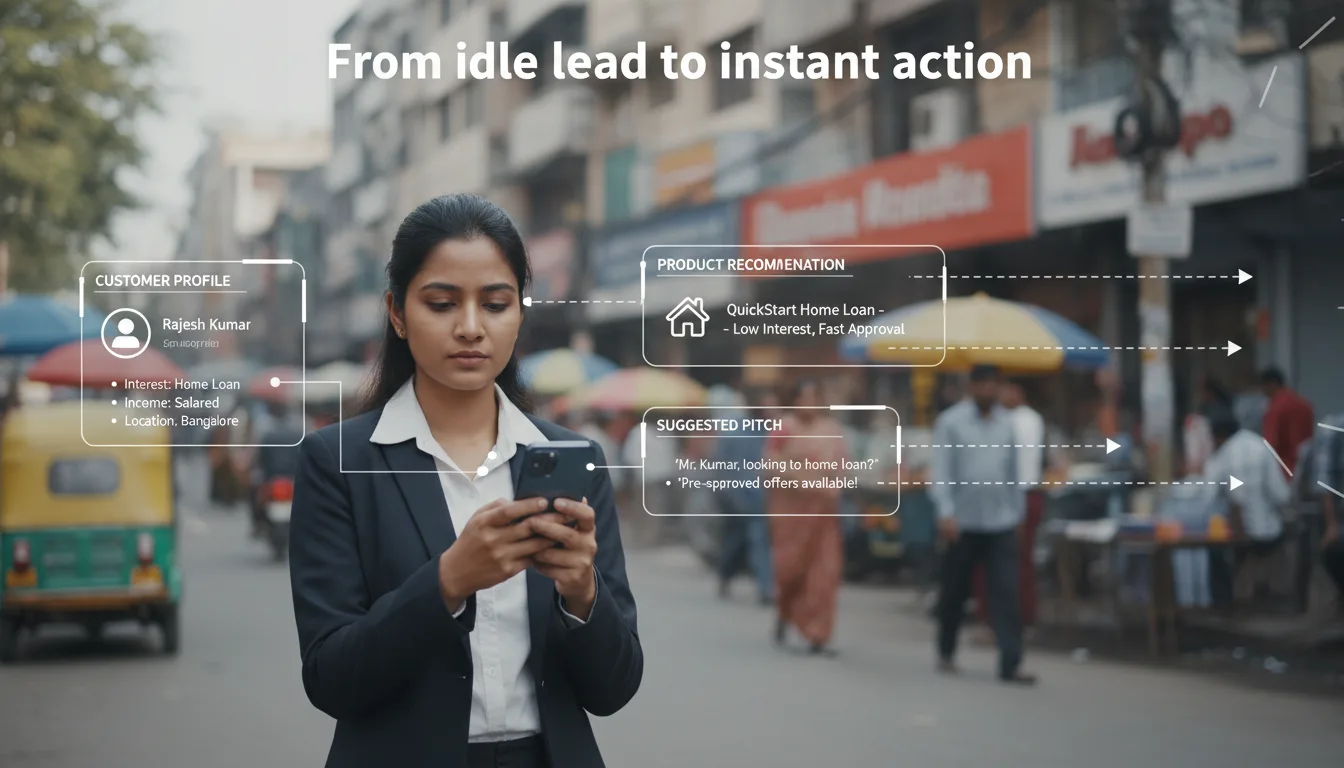
Lead decay is no longer measured in days or hours; in 2026, it is measured in minutes. Every second a high-intent lead sits idle in a CRM, the probability of conversion drops by double digits. For enterprise field teams in high-stakes sectors like Insurance, Banking, and Automotive, the gap between lead generation and lead activation is where revenue goes to die. AI lead activation solves this by stripping away the manual friction that historically paralysed distributed sales forces. It moves the needle from passive "lead management" to aggressive "lead pursuit" by ensuring the agent is equipped to engage the consumer the moment the intent is highest.

Field teams often struggle with "analysis paralysis" when faced with a new lead. They spend valuable time researching the prospect, looking for the right marketing collateral, or waiting for instructions from a manager. AI lead activation eliminates this downtime by delivering a ready-to-use execution package directly to the agent’s mobile device. This package includes the lead’s specific pain points, the most relevant product recommendation based on their profile, and the exact pitch deck or interactive illustrator needed to close the deal. This level of preparedness ensures that the first interaction is not a discovery call, but a high-value consultation that respects the consumer's time.

The acceleration of field performance through AI activation is driven by four critical levers:

  1. Zero-Latency Routing: 

Automated lead assignment ensures the right agent—based on geography, expertise, and current workload—receives the lead instantaneously. There is no manual intervention required, meaning the "speed-to-lead" is slashed from hours to seconds.

  1. Contextual Intelligence: 

Instead of a name and a phone number, field agents receive a comprehensive brief. For an NBFC agent, this means knowing a prospect’s credit potential and preferred loan tenure before the call. For an Automotive salesperson, it means knowing which specific car model and features the consumer was browsing on the website.

  1. Just-in-Time Enablement: 

AI identifies the specific stage of the funnel and serves the exact sales play required. If a prospect raises a specific objection regarding interest rates or premium costs, the AI surfaces a real-time battlecard or a dynamic ROI calculator to address the concern on the spot.

  1. Behavioural Consistency: 

AI ensures that every agent, regardless of their experience level, follows the highest-performing sales sequence. It replicates the behaviours of top-tier performers across the entire field force, effectively raising the floor of the team's overall performance.

When field teams are empowered with AI-led activation, their productivity is not just improved; it is multiplied. Managers no longer need to spend their days chasing agents for status updates. Instead, the AI tracks engagement metrics—did the agent call? Did they share the proposal? Did the consumer open the link?—and alerts the manager only when a lead is at risk of stalling. This allows leadership to focus on strategic coaching rather than administrative policing.

The impact on the end consumer is equally significant. In 2026, consumers expect a seamless transition from their digital journey to their physical interaction with a brand. If a consumer provides data on a website, they expect the field agent to already have that information. AI lead activation ensures this continuity, preventing the frustration of repetitive questioning and building immediate trust.

Pro Tip: 

Stop treating all leads as equal in your field distribution logic. Use AI to calculate a "Propensity to Close" score for every incoming lead. Route high-propensity leads only to your "Closer" cohort—the top 20% of your field force—to maximise the ROI on your most expensive human capital while routing standard leads to the rest of the team for nurturing.

Can AI Copilots standardise sales execution across distributed geographies?
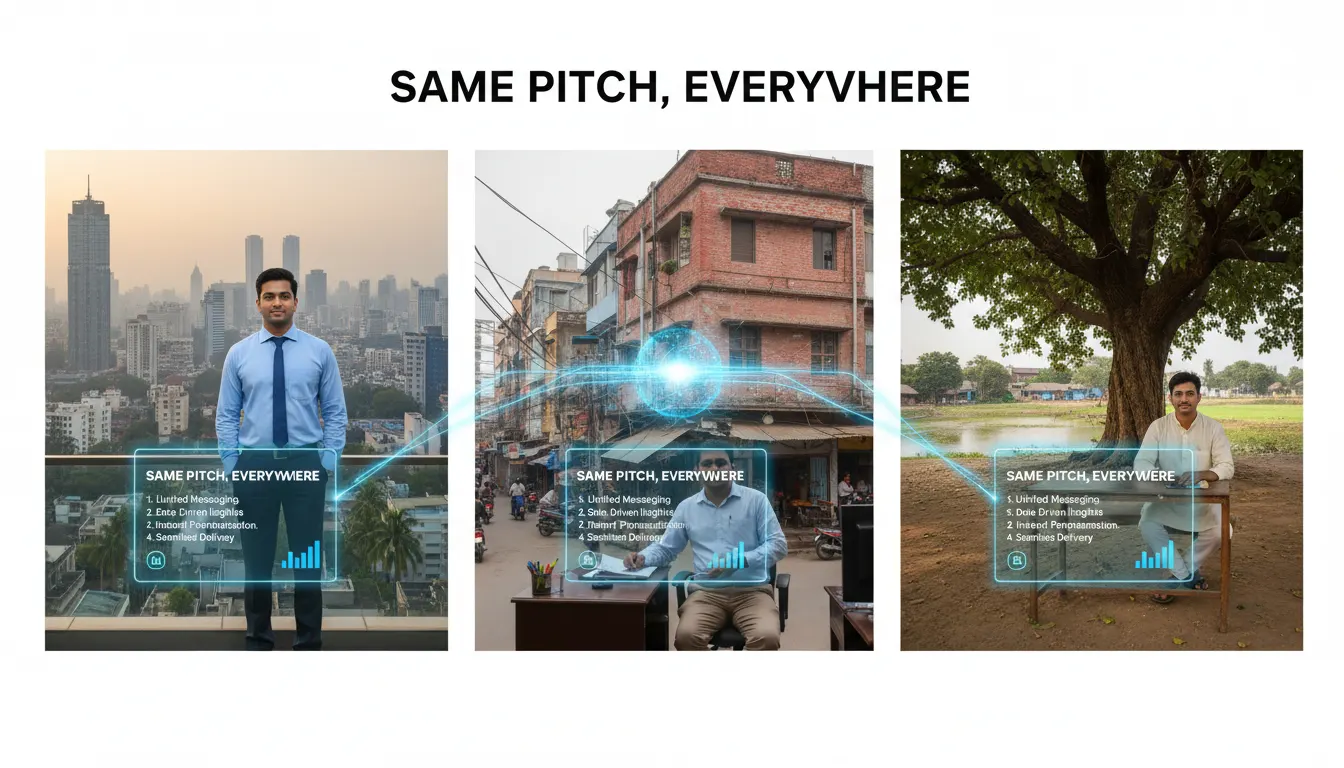
Revenue leakage in distributed sales teams is frequently a direct result of execution variance. When your sales force spans thousands of pin codes—from Tier 1 metros to rural hubs—the quality of the customer interaction often depends entirely on the individual agent's experience rather than the company’s gold-standard strategy. This inconsistency is the primary hurdle to scaling growth in 2026. AI Copilots solve this by moving sales enablement from "periodic training" to "real-time execution."

Traditional training models fail because knowledge decays within days of a workshop. In industries like Banking, Insurance, or Pharma, where regulations and product specs change weekly, an agent in a remote geography might be pitching outdated information or failing to handle objections correctly. An AI Copilot acts as a live navigation system, ensuring that whether a lead is being handled in Mumbai or a small town in Bihar, the pitch, the interactive illustrations, and the objection handling remain identical in quality and compliance.

Standardisation occurs through three critical layers:

  1. Contextual Playbook Automation: 

Instead of an agent searching through a PDF, the AI Copilot surface the exact battlecard or product illustrator needed based on the lead’s profile. If a customer in the Automotive sector asks about resale value versus a competitor, the Copilot pushes the specific comparison data instantly.

  1. Dynamic Objection Handling: 

Sales cycles in NBFCs or Construction Materials often stall at the same five or six friction points. AI Copilots provide vetted, high-conversion responses in real-time. This eliminates the "creative" but often incorrect answers provided by unguided agents.

  1. Localised Content Delivery: 

Standardization does not mean being rigid. AI Copilots can deliver the core brand message while automatically adjusting for regional languages or specific local schemes, ensuring the salesperson feels supported rather than monitored.

To implement this effectively across a distributed geography, leaders must focus on immediate utility for the frontline. The goal is to reduce the cognitive load on the salesperson. When the AI handles the "what to say" and "what to show," the agent can focus on building the relationship.

Pro Tip: 

Do not use AI Copilots as a surveillance tool; use them as a "Co-Pilot" in the truest sense. Focus your initial rollout on "Win-Loss" signals. Program the AI to trigger specific "Save-the-Deal" prompts when it detects a salesperson is losing momentum during a live interaction or post-meeting follow-up. When agents see the AI directly helping them hit their targets and earn more commissions, adoption rates skyrocket, and execution naturally standardises.

What is the secret to scaling high-impact sales behaviours with AI?

The failure of traditional sales training lies in its reliance on memory. In 2026, the cognitive load on frontline agents in sectors like insurance, banking, and automotive is at an all-time high. Expecting a distributed field force to remember every product nuance, regulatory update, and objection handler is a strategy for failure. The secret to scaling high-impact sales behaviours with AI is shifting from "training for later" to "enablement in the moment." You must stop trying to change the person and start changing the environment in which they work.

High-impact behaviours are the specific actions your top 1% of performers take—the way they frame a value proposition, how they handle a price objection, and their speed of follow-up. Scaling these behaviours across thousands of agents requires an AI-powered execution system that acts as a digital twin of your best manager. This isn't about generic chatbots; it is about localised, context-aware guidance that tells an agent exactly what to say and what to share while they are standing in front of a customer.

Speed of activation is the most critical metric. If a lead comes in and your agent lacks the confidence or the materials to respond immediately with a personalised pitch, that lead is dead. AI scales high-impact behaviour by automating the creation of these personalised assets. Whether it is an interactive product illustrator for a complex loan or a personalised video pitch for a new SUV, AI ensures the "behaviour" of providing high-quality, relevant content happens every single time, without the agent needing to be a creative expert.

Pro Tip: 

Stop measuring "completion rates" of training materials. Instead, measure the "usage rate" of specific sales plays during live customer interactions. If your AI isn't being used in the field to handle real-world objections, it isn't scaling behaviour; it’s just another piece of ignored software. Real-world execution is the only metric that matters in 2026.

How do top NBFCs use AI to master real-time objection handling?

In the high-stakes environment of 2026, an NBFC agent has exactly seven seconds to counter a "high interest rate" objection before a prospect mentally checks out. Top-tier NBFCs no longer rely on memory or physical manuals. They have shifted to real-time Sales Execution Systems that act as a digital co-pilot during the live conversation. When a customer expresses hesitation about processing fees or competitor rates, AI-powered systems detect these specific keywords and immediately surface the exact rebuttal needed to keep the deal alive.

The urgency stems from a fragmented market where customers compare four different loan offers simultaneously on their smartphones. If your field agent or tele-caller pauses to search for a response, the window of influence closes. Leading firms use AI to bridge the "capability gap" between their top 5% of performers and the rest of the distributed workforce. By injecting expert-level objection handling directly into the workflow, these organisations ensure that every agent speaks with the authority of the National Sales Manager.

Real-time objection handling in NBFCs now focuses on four critical execution pillars:

  1. Live Contextual Battlecards: 

As the prospect mentions a competitor’s name, the AI triggers a dynamic battlecard. This isn't a static PDF. It is a live data feed showing real-time interest rate comparisons, hidden fee structures of competitors, and specific value propositions that the agent can use to pivot the conversation back to their own product's strengths.

  1. Sentiment and Tone Adjustment: 

Modern AI monitors the emotional trajectory of the call. If the customer’s voice shows rising frustration regarding documentation requirements, the system prompts the agent to switch to an "empathy-first" script, offering to simplify the process through digital KYC or doorstep service. This prevents a standard objection from escalating into a lost lead.

  1. Dynamic EMI Structuring: 

When a customer objects to the monthly outflow, AI tools allow agents to instantly run "what-if" scenarios. The agent can visually demonstrate how a slightly longer tenure or a different repayment structure reduces the immediate burden, turning a "no" into a "how do I sign?"

  1. Instant Compliance Safeguards: 

In the NBFC sector, mis-selling is a massive risk. AI provides real-time alerts if an agent makes an unauthorised promise while trying to overcome an objection. This ensures that the push for a conversion never compromises regulatory standing.

Pro Tip: 

Do not just provide the "what to say." Use your AI platform to provide the "how to say it." Real-time prompts should include behavioural cues—like "slow down your speech" or "lower your pitch"—when a customer presents a complex financial objection. This technical nuance is often what separates a successful resolution from a confrontational failure.

Why is just-in-time content critical for automotive sales conversions?
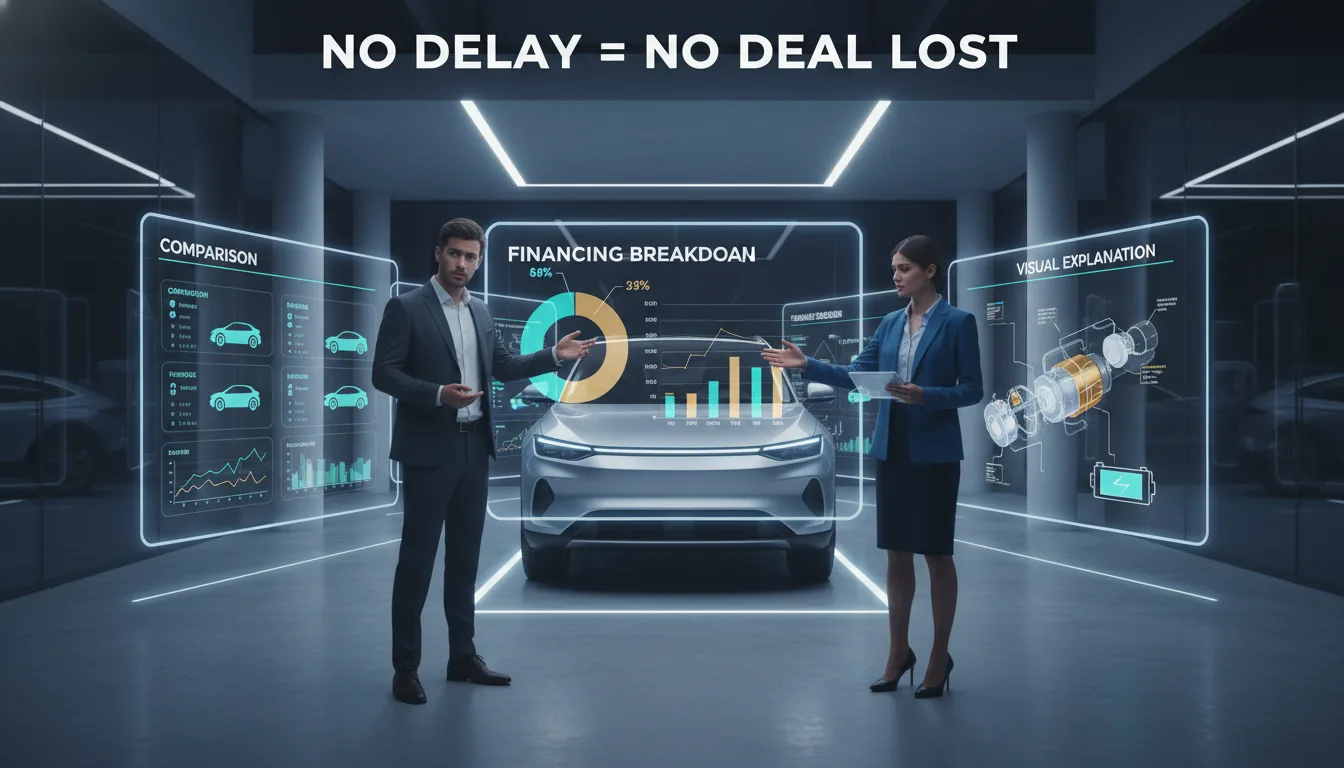
The modern car buyer is over-informed yet under-decided. By the time a prospect enters a showroom or engages a sales agent in 2026, they have already spent dozens of hours researching models, watching video reviews, and comparing prices online. They do not come to you for basic specifications; they come for validation and the resolution of very specific friction points. If your sales team cannot provide a hyper-localised comparison or a detailed financing breakdown within seconds of the request, that lead is effectively dead. The window of conversion in automotive sales is narrow, and the cost of a "let me get back to you on that" is a lost multi-million rupee sale to the dealership down the street.

Just-in-time (JIT) content is the only way to combat the "information asymmetry" where customers often know more about specific trim levels than the sales consultants themselves. In an era where vehicle technology, battery ranges, and ADAS features evolve monthly, expecting sales reps to memorise every detail is a recipe for failure. JIT content acts as an external brain. When a customer asks about the total cost of ownership (TCO) comparing a hybrid versus an internal combustion engine, the rep needs an interactive calculator or a visual breakdown immediately. This immediate response maintains the emotional momentum of the sale. Every second a rep spends walking back to a desk to find a brochure or calling a manager to verify a feature is a second the customer spends looking at a competitor's inventory on their smartphone.

The speed of information delivery is directly proportional to trust. In high-value retail like automotive, accuracy is the bedrock of credibility. Providing outdated brochures or incorrect interest rates destroys that trust instantly. JIT content ensures that the salesperson is always equipped with the latest, brand-approved data—whether it is a comparison against a newly launched rival or the latest festive financing scheme. This is about removing every possible excuse for a customer to leave the showroom without a booking.

​​Pro Tip: 

Stop focusing on the "average" customer and start enabling "edge-case" expertise. Configure your sales enablement platform to trigger specific content based on the customer’s persona—such as a "Safety-First Parent" versus a "Tech-Savvy Early Adopter." When the content served matches the specific psychological driver of the buyer in real-time, your conversion rates will climb because the customer feels understood, not just sold to.

How does AI-driven role-play improve frontline sales readiness?

Frontline sales teams in industries like insurance, banking, and automotive are often forced to "practice" on live prospects. This approach is expensive and leads to massive lead leakage. When an agent is unprepared for a complex objection regarding a policy's surrender value or a vehicle's financing options, that lead is effectively dead. AI-driven role-play solves this by moving the learning curve away from the customer and into a controlled, digital environment. It ensures that every agent, regardless of their location, meets a minimum baseline of competency before they ever pick up the phone or walk onto a showroom floor.

Traditional role-playing is fundamentally broken because it does not scale. A sales manager with fifty subordinates cannot possibly provide the personalised, repetitive coaching required to build muscle memory. AI role-play removes this bottleneck by allowing thousands of agents to practice simultaneously. These systems simulate realistic customer personas—ranging from the "sceptical shopper" to the "price-sensitive buyer"—allowing agents to fail safely. By the time they engage with a real human, the agent has already navigated the most difficult parts of the conversation multiple times. This immediate transition from theory to simulated practice is what builds true frontline readiness.

Objective, data-backed feedback is the core driver of improvement. Human coaching is often subjective and prone to bias; a manager might focus on an agent's "energy" while ignoring their failure to mention a critical compliance disclosure. AI role-play platforms analyse specific metrics: sentiment, keyword usage, pace of speech, and adherence to the sales playbook. This allows managers to stop guessing why certain territories are underperforming. The data highlights exactly where the breakdown occurs—whether it is an inability to handle pricing objections or a failure to transition from the pitch to the close.

In high-stakes sectors like NBFCs or Pharma, the speed of information change is a major hurdle. When a new regulation or product feature is launched, frontline teams must adapt instantly. AI role-play allows for the rapid deployment of new scenarios across the entire organisation. Within hours, an entire sales force can be certified on a new script through simulated interactions. This agility ensures that the brand message remains consistent and compliant, preventing "message drift", which often occurs in distributed teams.

Pro Tip: 

Do not just build scenarios for "perfect" sales. Create "stress-test" scenarios where the AI persona is intentionally difficult, distracted, or misinformed. Training your frontline to maintain composure and regain control of a derailed conversation is more valuable than practising a script where the customer always says "yes."

What metrics define successful AI-human sales collaboration in 2026?

Lead-to-Meeting Conversion Speed is the first non-negotiable metric. In 2026, the gap between lead generation and human contact must be measured in seconds, not minutes. If your AI Lead Activation system flags a high-intent prospect, the success of the collaboration is defined by how quickly the human agent acts on that prompt. High-performing teams now track the "Activation Delta"—the time difference between an AI-qualified trigger and the first human outreach. A delay of more than 120 seconds in industries like Banking or Insurance results in a 60% drop in engagement. If your frontline is not hitting this window, the AI is a cost centre, not a revenue driver.

The Playbook Adherence Index (PAI) measures how closely sales agents follow AI-recommended strategies during live interactions. Use your Copilot data to track whether agents are utilising the real-time objection-handling cards and battlecards provided. Successful collaboration is visible when the "Top Performer" behaviours are replicated by the bottom 60% of the workforce. If the AI suggests a specific interactive product illustration and the agent ignores it, your enablement has failed. You must measure the correlation between AI-prompted behaviour and actual deal closure rates to validate that the human-AI loop is functioning.

Content Personalisation Throughput is another critical indicator. Sales agents should no longer spend time creating decks or brochures. Success in 2026 is measured by the volume of hyper-personalised collateral generated by AI and actually shared by the agent. If an agent in the Automotive or Pharma sector is still using generic PDFs instead of AI-tailored interactive tools, the collaboration is broken. Track the "Share-to-View" ratio: how many AI-customised assets did the agent send, and what was the customer’s engagement time with that specific content? High engagement indicates the AI provided the right context and the human delivered it at the right moment.

Capability Gap Closure Speed defines the long-term ROI of sales enablement. In a distributed sales environment, you cannot wait for quarterly training sessions. You must measure how fast an agent moves from a "Low Performer" to "Quota Attainment" using AI-driven learning journeys and role-plays. If the AI identifies a weakness in closing techniques and provides just-in-time coaching, the metric to track is the "Skill Correction Cycle"—the time it takes for an agent’s performance to improve after the AI flags a specific deficiency. Successful collaboration means the AI coaches and the human executes, resulting in a measurable lift in win rates within 30 days.

Pro Tip: 

Stop looking at total sales volume as the only indicator of AI success. Instead, track "Shadow Utilisation"—the frequency with which agents manually override AI recommendations. If overrides are high and conversion is low, your human team is resisting the system. If overrides are low and conversion is high, you have achieved true sales execution synergy.

How are interactive AI tools transforming complex pharma sales pitches?

Pharma sales teams are currently facing a crisis of access and engagement. Healthcare Professionals (HCPs) have significantly reduced the time they allocate to medical representatives, often limiting interactions to less than two minutes. In this high-pressure window, static brochures and generic slide decks are no longer sufficient. Interactive AI tools are fundamentally altering this dynamic by shifting the sales pitch from a one-way monologue to a data-driven, clinical dialogue.

The primary transformation lies in dynamic detailing. Unlike traditional e-detailing, AI-powered interactive product illustrators allow reps to visualise complex mechanisms of action (MoA) and clinical trial data in real-time. If a physician asks about a specific patient demographic—such as elderly patients with comorbid renal issues—the rep can instantly filter data sets within the app to show relevant efficacy and safety profiles. This immediate responsiveness builds high levels of clinical trust, positioning the rep as a solution provider rather than a mere information relayer.

AI-driven sales execution systems also eliminate the "knowledge gap" that often occurs with complex drug launches. With hundreds of pages of clinical data to memorise, reps frequently struggle to stay on message while remaining compliant. Interactive AI tools solve this by providing "just-in-time" content. During a pitch, an AI Copilot can suggest the most relevant scientific paper or objection-handling battlecard based on the specific concerns raised by the HCP. This ensures that every interaction is both high-impact and fully aligned with regulatory guidelines.

The use of interactive AI also streamlines the post-call process. Instead of generic follow-up emails, reps can use AI to generate personalised "Leave-Behind" summaries that highlight only the specific clinical data points the doctor expressed interest in during the meeting. This level of personalisation is critical in 2026, where the volume of medical information is overwhelming for practitioners.

Furthermore, AI-driven learning journeys ensure that capability gaps are identified and closed in real-time. If the data shows that reps across a specific geography are struggling to explain a drug’s safety profile, the system can automatically push out a micro-learning module to those specific individuals. This creates a self-healing sales force that evolves as fast as the clinical landscape.

Pro Tip:

Do not use interactive AI just for "show." The goal is to reduce the cognitive load on the doctor. Use your AI tools to pre-calculate dosage requirements or potential cost-savings for specific patient cohorts during the pitch. When you turn a complex scientific discussion into a clear, visual clinical decision-support tool, you move from being a vendor to an indispensable clinical partner.

Does AI sales enablement provide a measurable ROI for BFSI leaders?
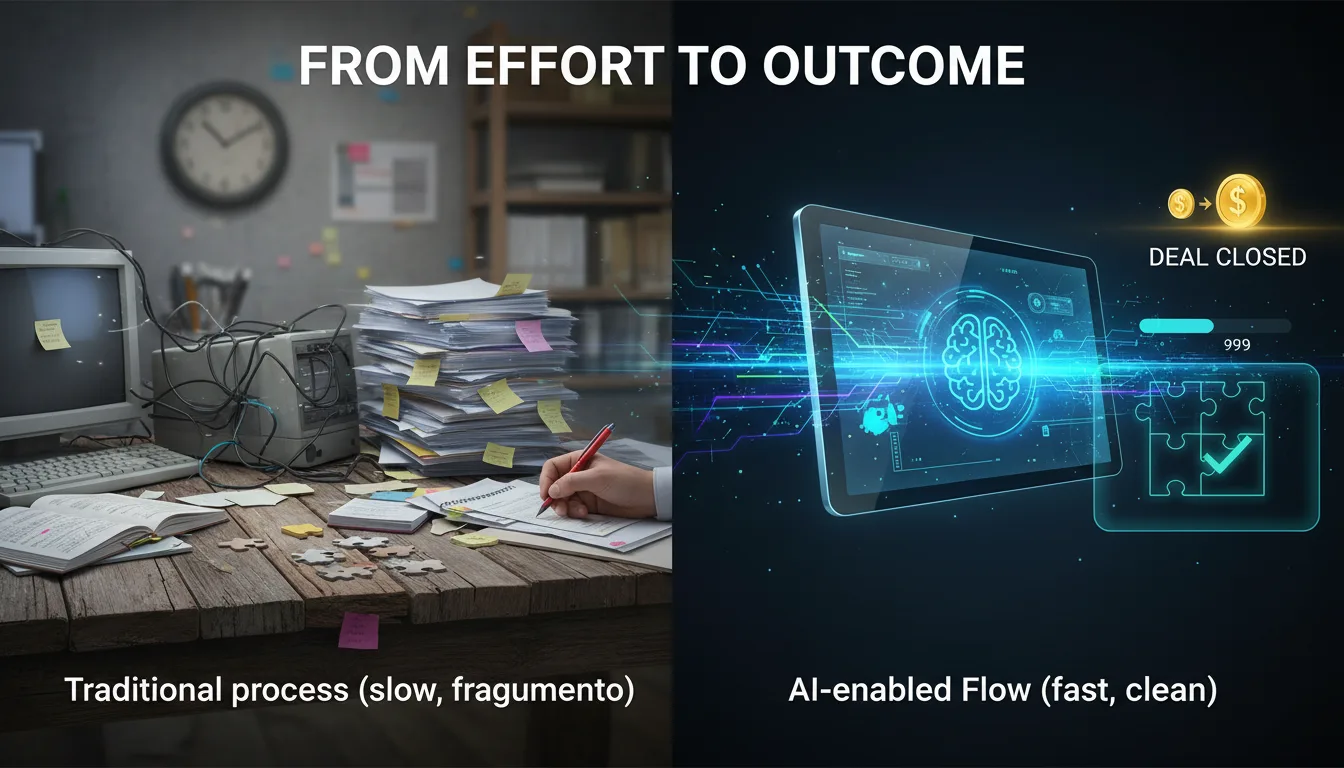
BFSI leaders are currently losing millions in potential revenue because of a widening execution gap between their top 5% of performers and the rest of their distributed sales force. In 2026, the cost of "lead decay" is at an all-time high. If your field agents or bank relationship managers take more than ten minutes to respond to a high-intent lead, the conversion probability drops by nearly 400%. AI sales enablement provides a direct, measurable ROI by fixing this specific friction point through automated lead activation and real-time guidance.

ROI in the BFSI sector is measured by three critical levers: lead-to-closure velocity, average ticket size, and time-to-productivity for new hires. Traditional training methods fail because they rely on classroom memory, which vanishes the moment an agent faces a sceptical customer. AI-powered playbooks, however, ensure that every agent has a "copilot" in their pocket. For instance, when an insurance agent uses an Interactive Product Illustrator instead of a static PDF, the customer’s understanding of complex riders increases, leading to a 15-20% higher upsell rate. This is a hard metric that directly impacts the bottom line.

The second area of measurable ROI is the drastic reduction in "ramp-up" time. In the NBFC and Banking sectors, agent turnover is notoriously high. It traditionally takes 3 to 6 months for a new hire to become fully productive. By deploying AI role-plays and just-in-time learning journeys, organisations are seeing this window shrink by 50%. You are no longer paying for months of sub-par performance; agents become high-performers within weeks because they are practising against AI that simulates real-world customer objections specific to personal loans, credit cards, or wealth management products.

Lead leakage is the third "silent killer" of BFSI profitability. Most organisations spend heavily on lead generation but lack the infrastructure to ensure those leads are handled with the correct pitch. AI sales enablement systems provide "Pitch Fidelity." They track whether the frontline is actually using the latest compliance-approved messaging and battlecards. When you can correlate the use of specific sales assets—like a personalised tax-saving calculator—directly to a closed deal, the ROI of your marketing spend becomes transparent and defensible.

To capture this ROI immediately, BFSI leaders must stop viewing enablement as a "support function" and start treating it as a core "revenue engine." The urgency stems from the fact that your competitors are already using AI to automate the boring parts of sales—like data entry and content searching—allowing their agents to focus entirely on the human element of closing.

Pro Tip: 

Focus your AI deployment on "Just-in-Time" enablement rather than "Just-in-Case" training. Instead of forcing agents to sit through hours of videos they will forget, serve them a 30-second AI-generated "objection handler" card the moment a lead for a specific high-value product is assigned to them in the CRM. Execution happens in the moment, not in the classroom.

Final Thoughts:

The window to gain a competitive advantage through hybrid sales models is closing. In 2026, the distinction between market leaders and laggards in sectors like Banking, Insurance, and Automotive is defined by execution speed. Companies that rely on static sales materials and manual coaching are failing to keep pace with the real-time demands of the Indian buyer. If your frontline agents are still searching for the right collateral while sitting in a client meeting, you are losing revenue to competitors who have already automated their sales playbooks.

Relying on human intuition alone is no longer a viable strategy for distributed teams. The "Hybrid Edge" is about removing the guesswork from the sales cycle. Top-performing firms are now using AI to ensure every agent—regardless of their location or experience level—delivers a high-impact, personalised pitch every single time. This is not a futuristic concept; it is the current operational standard for organisations looking to maintain consistency across thousands of field representatives.

Waiting another quarter to modernise your sales enablement stack will result in irreversible capability gaps. Your sales managers cannot be everywhere at once, but an AI-powered execution system can. By providing agents with just-in-time content, interactive product illustrators, and instant objection handling, you move from a reactive sales culture to a proactive revenue engine. The technology is battle-tested, and the results are measurable in conversion rates and reduced onboarding times.

Stop settling for inconsistent frontline performance and manual lead management. Every day without a unified AI sales playbook is a day of lost data and missed targets. Take control of your sales execution and equip your team with the tools required to win in today’s market.

Book a briefing with Sharpsell.ai today to see how India's enterprise leaders are scaling high-impact sales behaviours across their entire organisation.

  • The “New Normal” for Pharma Sales post the lockdown
  • Why organizations look for Sales Enablement
  • How Sales Enablement is different from traditional LMS or CRM
  • The industry best practices for Sales Enablement
  • Implementation challenges and how to overcome them
  • Ensuring higher adoption

Chirag Parmar

Chirag Parmar is the Head of Marketing at Sharpsell.ai and a B2B marketing leader focused on scaling SaaS businesses through demand generation, brand strategy, and revenue-driven marketing. He builds scalable systems that deliver measurable business impact.

The Hybrid Edge: How India's Top Companies are Combining AI and Human Sales Teams in 2026

The Hybrid Edge: How India's Top Companies are Combining AI and Human Sales Teams in 2026

In sectors like BFSI and Automotive, the conversion gap is widening. Despite record lead volumes, enterprise sales teams are struggling with a 40% drop in response speed.
Chirag Parmar
February 26, 2026

The Hybrid Edge: How India's Top Companies are Combining AI and Human Sales Teams in 2026

In sectors like BFSI and Automotive, the conversion gap is widening. Despite record lead volumes, enterprise sales teams are struggling with a 40% drop in response speed. Frontline agents are currently overwhelmed by manual administrative tasks and data entry, leaving almost no room for the high-stakes negotiations that drive revenue. Relying solely on human intuition in 2026 is no longer a viable strategy for scaling distributed teams across India's diverse geographies.

India’s market leaders have stopped debating whether to replace humans with AI. Instead, they are deploying AI-powered sales execution systems to handle the heavy lifting of lead qualification and real-time content personalisation. This shift allows field agents to focus exclusively on closing. By integrating AI playbooks directly into the daily workflow, companies are ensuring that every interaction—whether in a metro city or a tier-3 town—meets a consistent, high-performance standard.

The companies winning right now are those that treat AI as a tactical co-pilot rather than a standalone tool. They use real-time lead activation to ensure no prospect goes cold, while human agents provide the empathy and strategic advice necessary for complex financial or automotive purchases. Failing to adopt this hybrid model today means conceding market share to competitors who can now execute sales cycles twice as fast with half the operational friction.

Why are India's top enterprises moving away from human-only sales models?

Revenue leakage in India’s enterprise sector has reached a critical tipping point. The traditional human-only sales model is failing because it cannot keep pace with the hyper-accelerated expectations of the 2026 Indian consumer. Whether in Banking, Insurance, or Automotive, the "lead-to-response" window has shrunk from hours to seconds. A human agent, burdened by manual lead tracking and administrative overhead, simply cannot activate a lead fast enough. When a prospective car buyer or loan applicant expresses interest, the decay of that lead begins instantly. If your frontline team takes four hours to respond, your competitor’s AI-enabled system has already engaged, qualified, and scheduled a demo.

Enterprises are moving toward hybrid models because of the massive execution gap between corporate strategy and field performance. In distributed geographies—from Tier 1 hubs to RURBAN markets—maintaining a consistent pitch is nearly impossible with humans alone. A sales rep in Lucknow might describe a complex ULIP or a construction material’s USP entirely differently from a rep in Bengaluru. This inconsistency erodes brand trust and leads to massive non-compliance risks. AI-powered sales execution systems solve this by providing real-time, standardised playbooks that ensure every agent, regardless of their experience level, performs like a top-tier veteran.

The cost of attrition and the "time-to-productivity" for new hires are also driving this shift. In industries like Pharma and NBFC, sales churn is notoriously high. Relying on months of classroom training is no longer viable. Companies are now deploying "Just-in-time" enablement, where the AI coaches the agent during the actual sales interaction. If a customer raises a complex objection about interest rates or drug efficacy, the agent doesn't need to "get back to them." The system provides an instant battlecard or an interactive product illustrator, closing the deal on the spot.

Pro Tip: 

Stop treating your Sales Enablement platform as a content repository. Instead, treat it as a "Co-pilot" that pushes the right content to the agent exactly when the lead status changes in the CRM. True enablement is proactive, not reactive.

How does AI-led activation accelerate field team performance?

Lead decay is no longer measured in days or hours; in 2026, it is measured in minutes. Every second a high-intent lead sits idle in a CRM, the probability of conversion drops by double digits. For enterprise field teams in high-stakes sectors like Insurance, Banking, and Automotive, the gap between lead generation and lead activation is where revenue goes to die. AI lead activation solves this by stripping away the manual friction that historically paralysed distributed sales forces. It moves the needle from passive "lead management" to aggressive "lead pursuit" by ensuring the agent is equipped to engage the consumer the moment the intent is highest.

Field teams often struggle with "analysis paralysis" when faced with a new lead. They spend valuable time researching the prospect, looking for the right marketing collateral, or waiting for instructions from a manager. AI lead activation eliminates this downtime by delivering a ready-to-use execution package directly to the agent’s mobile device. This package includes the lead’s specific pain points, the most relevant product recommendation based on their profile, and the exact pitch deck or interactive illustrator needed to close the deal. This level of preparedness ensures that the first interaction is not a discovery call, but a high-value consultation that respects the consumer's time.

The acceleration of field performance through AI activation is driven by four critical levers:

  1. Zero-Latency Routing: 

Automated lead assignment ensures the right agent—based on geography, expertise, and current workload—receives the lead instantaneously. There is no manual intervention required, meaning the "speed-to-lead" is slashed from hours to seconds.

  1. Contextual Intelligence: 

Instead of a name and a phone number, field agents receive a comprehensive brief. For an NBFC agent, this means knowing a prospect’s credit potential and preferred loan tenure before the call. For an Automotive salesperson, it means knowing which specific car model and features the consumer was browsing on the website.

  1. Just-in-Time Enablement: 

AI identifies the specific stage of the funnel and serves the exact sales play required. If a prospect raises a specific objection regarding interest rates or premium costs, the AI surfaces a real-time battlecard or a dynamic ROI calculator to address the concern on the spot.

  1. Behavioural Consistency: 

AI ensures that every agent, regardless of their experience level, follows the highest-performing sales sequence. It replicates the behaviours of top-tier performers across the entire field force, effectively raising the floor of the team's overall performance.

When field teams are empowered with AI-led activation, their productivity is not just improved; it is multiplied. Managers no longer need to spend their days chasing agents for status updates. Instead, the AI tracks engagement metrics—did the agent call? Did they share the proposal? Did the consumer open the link?—and alerts the manager only when a lead is at risk of stalling. This allows leadership to focus on strategic coaching rather than administrative policing.

The impact on the end consumer is equally significant. In 2026, consumers expect a seamless transition from their digital journey to their physical interaction with a brand. If a consumer provides data on a website, they expect the field agent to already have that information. AI lead activation ensures this continuity, preventing the frustration of repetitive questioning and building immediate trust.

Pro Tip: 

Stop treating all leads as equal in your field distribution logic. Use AI to calculate a "Propensity to Close" score for every incoming lead. Route high-propensity leads only to your "Closer" cohort—the top 20% of your field force—to maximise the ROI on your most expensive human capital while routing standard leads to the rest of the team for nurturing.

Can AI Copilots standardise sales execution across distributed geographies?

Revenue leakage in distributed sales teams is frequently a direct result of execution variance. When your sales force spans thousands of pin codes—from Tier 1 metros to rural hubs—the quality of the customer interaction often depends entirely on the individual agent's experience rather than the company’s gold-standard strategy. This inconsistency is the primary hurdle to scaling growth in 2026. AI Copilots solve this by moving sales enablement from "periodic training" to "real-time execution."

Traditional training models fail because knowledge decays within days of a workshop. In industries like Banking, Insurance, or Pharma, where regulations and product specs change weekly, an agent in a remote geography might be pitching outdated information or failing to handle objections correctly. An AI Copilot acts as a live navigation system, ensuring that whether a lead is being handled in Mumbai or a small town in Bihar, the pitch, the interactive illustrations, and the objection handling remain identical in quality and compliance.

Standardisation occurs through three critical layers:

  1. Contextual Playbook Automation: 

Instead of an agent searching through a PDF, the AI Copilot surface the exact battlecard or product illustrator needed based on the lead’s profile. If a customer in the Automotive sector asks about resale value versus a competitor, the Copilot pushes the specific comparison data instantly.

  1. Dynamic Objection Handling: 

Sales cycles in NBFCs or Construction Materials often stall at the same five or six friction points. AI Copilots provide vetted, high-conversion responses in real-time. This eliminates the "creative" but often incorrect answers provided by unguided agents.

  1. Localised Content Delivery: 

Standardization does not mean being rigid. AI Copilots can deliver the core brand message while automatically adjusting for regional languages or specific local schemes, ensuring the salesperson feels supported rather than monitored.

To implement this effectively across a distributed geography, leaders must focus on immediate utility for the frontline. The goal is to reduce the cognitive load on the salesperson. When the AI handles the "what to say" and "what to show," the agent can focus on building the relationship.

Pro Tip: 

Do not use AI Copilots as a surveillance tool; use them as a "Co-Pilot" in the truest sense. Focus your initial rollout on "Win-Loss" signals. Program the AI to trigger specific "Save-the-Deal" prompts when it detects a salesperson is losing momentum during a live interaction or post-meeting follow-up. When agents see the AI directly helping them hit their targets and earn more commissions, adoption rates skyrocket, and execution naturally standardises.

What is the secret to scaling high-impact sales behaviours with AI?

The failure of traditional sales training lies in its reliance on memory. In 2026, the cognitive load on frontline agents in sectors like insurance, banking, and automotive is at an all-time high. Expecting a distributed field force to remember every product nuance, regulatory update, and objection handler is a strategy for failure. The secret to scaling high-impact sales behaviours with AI is shifting from "training for later" to "enablement in the moment." You must stop trying to change the person and start changing the environment in which they work.

High-impact behaviours are the specific actions your top 1% of performers take—the way they frame a value proposition, how they handle a price objection, and their speed of follow-up. Scaling these behaviours across thousands of agents requires an AI-powered execution system that acts as a digital twin of your best manager. This isn't about generic chatbots; it is about localised, context-aware guidance that tells an agent exactly what to say and what to share while they are standing in front of a customer.

Speed of activation is the most critical metric. If a lead comes in and your agent lacks the confidence or the materials to respond immediately with a personalised pitch, that lead is dead. AI scales high-impact behaviour by automating the creation of these personalised assets. Whether it is an interactive product illustrator for a complex loan or a personalised video pitch for a new SUV, AI ensures the "behaviour" of providing high-quality, relevant content happens every single time, without the agent needing to be a creative expert.

Pro Tip: 

Stop measuring "completion rates" of training materials. Instead, measure the "usage rate" of specific sales plays during live customer interactions. If your AI isn't being used in the field to handle real-world objections, it isn't scaling behaviour; it’s just another piece of ignored software. Real-world execution is the only metric that matters in 2026.

How do top NBFCs use AI to master real-time objection handling?

In the high-stakes environment of 2026, an NBFC agent has exactly seven seconds to counter a "high interest rate" objection before a prospect mentally checks out. Top-tier NBFCs no longer rely on memory or physical manuals. They have shifted to real-time Sales Execution Systems that act as a digital co-pilot during the live conversation. When a customer expresses hesitation about processing fees or competitor rates, AI-powered systems detect these specific keywords and immediately surface the exact rebuttal needed to keep the deal alive.

The urgency stems from a fragmented market where customers compare four different loan offers simultaneously on their smartphones. If your field agent or tele-caller pauses to search for a response, the window of influence closes. Leading firms use AI to bridge the "capability gap" between their top 5% of performers and the rest of the distributed workforce. By injecting expert-level objection handling directly into the workflow, these organisations ensure that every agent speaks with the authority of the National Sales Manager.

Real-time objection handling in NBFCs now focuses on four critical execution pillars:

  1. Live Contextual Battlecards: 

As the prospect mentions a competitor’s name, the AI triggers a dynamic battlecard. This isn't a static PDF. It is a live data feed showing real-time interest rate comparisons, hidden fee structures of competitors, and specific value propositions that the agent can use to pivot the conversation back to their own product's strengths.

  1. Sentiment and Tone Adjustment: 

Modern AI monitors the emotional trajectory of the call. If the customer’s voice shows rising frustration regarding documentation requirements, the system prompts the agent to switch to an "empathy-first" script, offering to simplify the process through digital KYC or doorstep service. This prevents a standard objection from escalating into a lost lead.

  1. Dynamic EMI Structuring: 

When a customer objects to the monthly outflow, AI tools allow agents to instantly run "what-if" scenarios. The agent can visually demonstrate how a slightly longer tenure or a different repayment structure reduces the immediate burden, turning a "no" into a "how do I sign?"

  1. Instant Compliance Safeguards: 

In the NBFC sector, mis-selling is a massive risk. AI provides real-time alerts if an agent makes an unauthorised promise while trying to overcome an objection. This ensures that the push for a conversion never compromises regulatory standing.

Pro Tip: 

Do not just provide the "what to say." Use your AI platform to provide the "how to say it." Real-time prompts should include behavioural cues—like "slow down your speech" or "lower your pitch"—when a customer presents a complex financial objection. This technical nuance is often what separates a successful resolution from a confrontational failure.

Why is just-in-time content critical for automotive sales conversions?

The modern car buyer is over-informed yet under-decided. By the time a prospect enters a showroom or engages a sales agent in 2026, they have already spent dozens of hours researching models, watching video reviews, and comparing prices online. They do not come to you for basic specifications; they come for validation and the resolution of very specific friction points. If your sales team cannot provide a hyper-localised comparison or a detailed financing breakdown within seconds of the request, that lead is effectively dead. The window of conversion in automotive sales is narrow, and the cost of a "let me get back to you on that" is a lost multi-million rupee sale to the dealership down the street.

Just-in-time (JIT) content is the only way to combat the "information asymmetry" where customers often know more about specific trim levels than the sales consultants themselves. In an era where vehicle technology, battery ranges, and ADAS features evolve monthly, expecting sales reps to memorise every detail is a recipe for failure. JIT content acts as an external brain. When a customer asks about the total cost of ownership (TCO) comparing a hybrid versus an internal combustion engine, the rep needs an interactive calculator or a visual breakdown immediately. This immediate response maintains the emotional momentum of the sale. Every second a rep spends walking back to a desk to find a brochure or calling a manager to verify a feature is a second the customer spends looking at a competitor's inventory on their smartphone.

The speed of information delivery is directly proportional to trust. In high-value retail like automotive, accuracy is the bedrock of credibility. Providing outdated brochures or incorrect interest rates destroys that trust instantly. JIT content ensures that the salesperson is always equipped with the latest, brand-approved data—whether it is a comparison against a newly launched rival or the latest festive financing scheme. This is about removing every possible excuse for a customer to leave the showroom without a booking.

​​Pro Tip: 

Stop focusing on the "average" customer and start enabling "edge-case" expertise. Configure your sales enablement platform to trigger specific content based on the customer’s persona—such as a "Safety-First Parent" versus a "Tech-Savvy Early Adopter." When the content served matches the specific psychological driver of the buyer in real-time, your conversion rates will climb because the customer feels understood, not just sold to.

How does AI-driven role-play improve frontline sales readiness?

Frontline sales teams in industries like insurance, banking, and automotive are often forced to "practice" on live prospects. This approach is expensive and leads to massive lead leakage. When an agent is unprepared for a complex objection regarding a policy's surrender value or a vehicle's financing options, that lead is effectively dead. AI-driven role-play solves this by moving the learning curve away from the customer and into a controlled, digital environment. It ensures that every agent, regardless of their location, meets a minimum baseline of competency before they ever pick up the phone or walk onto a showroom floor.

Traditional role-playing is fundamentally broken because it does not scale. A sales manager with fifty subordinates cannot possibly provide the personalised, repetitive coaching required to build muscle memory. AI role-play removes this bottleneck by allowing thousands of agents to practice simultaneously. These systems simulate realistic customer personas—ranging from the "sceptical shopper" to the "price-sensitive buyer"—allowing agents to fail safely. By the time they engage with a real human, the agent has already navigated the most difficult parts of the conversation multiple times. This immediate transition from theory to simulated practice is what builds true frontline readiness.

Objective, data-backed feedback is the core driver of improvement. Human coaching is often subjective and prone to bias; a manager might focus on an agent's "energy" while ignoring their failure to mention a critical compliance disclosure. AI role-play platforms analyse specific metrics: sentiment, keyword usage, pace of speech, and adherence to the sales playbook. This allows managers to stop guessing why certain territories are underperforming. The data highlights exactly where the breakdown occurs—whether it is an inability to handle pricing objections or a failure to transition from the pitch to the close.

In high-stakes sectors like NBFCs or Pharma, the speed of information change is a major hurdle. When a new regulation or product feature is launched, frontline teams must adapt instantly. AI role-play allows for the rapid deployment of new scenarios across the entire organisation. Within hours, an entire sales force can be certified on a new script through simulated interactions. This agility ensures that the brand message remains consistent and compliant, preventing "message drift", which often occurs in distributed teams.

Pro Tip: 

Do not just build scenarios for "perfect" sales. Create "stress-test" scenarios where the AI persona is intentionally difficult, distracted, or misinformed. Training your frontline to maintain composure and regain control of a derailed conversation is more valuable than practising a script where the customer always says "yes."

What metrics define successful AI-human sales collaboration in 2026?

Lead-to-Meeting Conversion Speed is the first non-negotiable metric. In 2026, the gap between lead generation and human contact must be measured in seconds, not minutes. If your AI Lead Activation system flags a high-intent prospect, the success of the collaboration is defined by how quickly the human agent acts on that prompt. High-performing teams now track the "Activation Delta"—the time difference between an AI-qualified trigger and the first human outreach. A delay of more than 120 seconds in industries like Banking or Insurance results in a 60% drop in engagement. If your frontline is not hitting this window, the AI is a cost centre, not a revenue driver.

The Playbook Adherence Index (PAI) measures how closely sales agents follow AI-recommended strategies during live interactions. Use your Copilot data to track whether agents are utilising the real-time objection-handling cards and battlecards provided. Successful collaboration is visible when the "Top Performer" behaviours are replicated by the bottom 60% of the workforce. If the AI suggests a specific interactive product illustration and the agent ignores it, your enablement has failed. You must measure the correlation between AI-prompted behaviour and actual deal closure rates to validate that the human-AI loop is functioning.

Content Personalisation Throughput is another critical indicator. Sales agents should no longer spend time creating decks or brochures. Success in 2026 is measured by the volume of hyper-personalised collateral generated by AI and actually shared by the agent. If an agent in the Automotive or Pharma sector is still using generic PDFs instead of AI-tailored interactive tools, the collaboration is broken. Track the "Share-to-View" ratio: how many AI-customised assets did the agent send, and what was the customer’s engagement time with that specific content? High engagement indicates the AI provided the right context and the human delivered it at the right moment.

Capability Gap Closure Speed defines the long-term ROI of sales enablement. In a distributed sales environment, you cannot wait for quarterly training sessions. You must measure how fast an agent moves from a "Low Performer" to "Quota Attainment" using AI-driven learning journeys and role-plays. If the AI identifies a weakness in closing techniques and provides just-in-time coaching, the metric to track is the "Skill Correction Cycle"—the time it takes for an agent’s performance to improve after the AI flags a specific deficiency. Successful collaboration means the AI coaches and the human executes, resulting in a measurable lift in win rates within 30 days.

Pro Tip: 

Stop looking at total sales volume as the only indicator of AI success. Instead, track "Shadow Utilisation"—the frequency with which agents manually override AI recommendations. If overrides are high and conversion is low, your human team is resisting the system. If overrides are low and conversion is high, you have achieved true sales execution synergy.

How are interactive AI tools transforming complex pharma sales pitches?

Pharma sales teams are currently facing a crisis of access and engagement. Healthcare Professionals (HCPs) have significantly reduced the time they allocate to medical representatives, often limiting interactions to less than two minutes. In this high-pressure window, static brochures and generic slide decks are no longer sufficient. Interactive AI tools are fundamentally altering this dynamic by shifting the sales pitch from a one-way monologue to a data-driven, clinical dialogue.

The primary transformation lies in dynamic detailing. Unlike traditional e-detailing, AI-powered interactive product illustrators allow reps to visualise complex mechanisms of action (MoA) and clinical trial data in real-time. If a physician asks about a specific patient demographic—such as elderly patients with comorbid renal issues—the rep can instantly filter data sets within the app to show relevant efficacy and safety profiles. This immediate responsiveness builds high levels of clinical trust, positioning the rep as a solution provider rather than a mere information relayer.

AI-driven sales execution systems also eliminate the "knowledge gap" that often occurs with complex drug launches. With hundreds of pages of clinical data to memorise, reps frequently struggle to stay on message while remaining compliant. Interactive AI tools solve this by providing "just-in-time" content. During a pitch, an AI Copilot can suggest the most relevant scientific paper or objection-handling battlecard based on the specific concerns raised by the HCP. This ensures that every interaction is both high-impact and fully aligned with regulatory guidelines.

The use of interactive AI also streamlines the post-call process. Instead of generic follow-up emails, reps can use AI to generate personalised "Leave-Behind" summaries that highlight only the specific clinical data points the doctor expressed interest in during the meeting. This level of personalisation is critical in 2026, where the volume of medical information is overwhelming for practitioners.

Furthermore, AI-driven learning journeys ensure that capability gaps are identified and closed in real-time. If the data shows that reps across a specific geography are struggling to explain a drug’s safety profile, the system can automatically push out a micro-learning module to those specific individuals. This creates a self-healing sales force that evolves as fast as the clinical landscape.

Pro Tip:

Do not use interactive AI just for "show." The goal is to reduce the cognitive load on the doctor. Use your AI tools to pre-calculate dosage requirements or potential cost-savings for specific patient cohorts during the pitch. When you turn a complex scientific discussion into a clear, visual clinical decision-support tool, you move from being a vendor to an indispensable clinical partner.

Does AI sales enablement provide a measurable ROI for BFSI leaders?

BFSI leaders are currently losing millions in potential revenue because of a widening execution gap between their top 5% of performers and the rest of their distributed sales force. In 2026, the cost of "lead decay" is at an all-time high. If your field agents or bank relationship managers take more than ten minutes to respond to a high-intent lead, the conversion probability drops by nearly 400%. AI sales enablement provides a direct, measurable ROI by fixing this specific friction point through automated lead activation and real-time guidance.

ROI in the BFSI sector is measured by three critical levers: lead-to-closure velocity, average ticket size, and time-to-productivity for new hires. Traditional training methods fail because they rely on classroom memory, which vanishes the moment an agent faces a sceptical customer. AI-powered playbooks, however, ensure that every agent has a "copilot" in their pocket. For instance, when an insurance agent uses an Interactive Product Illustrator instead of a static PDF, the customer’s understanding of complex riders increases, leading to a 15-20% higher upsell rate. This is a hard metric that directly impacts the bottom line.

The second area of measurable ROI is the drastic reduction in "ramp-up" time. In the NBFC and Banking sectors, agent turnover is notoriously high. It traditionally takes 3 to 6 months for a new hire to become fully productive. By deploying AI role-plays and just-in-time learning journeys, organisations are seeing this window shrink by 50%. You are no longer paying for months of sub-par performance; agents become high-performers within weeks because they are practising against AI that simulates real-world customer objections specific to personal loans, credit cards, or wealth management products.

Lead leakage is the third "silent killer" of BFSI profitability. Most organisations spend heavily on lead generation but lack the infrastructure to ensure those leads are handled with the correct pitch. AI sales enablement systems provide "Pitch Fidelity." They track whether the frontline is actually using the latest compliance-approved messaging and battlecards. When you can correlate the use of specific sales assets—like a personalised tax-saving calculator—directly to a closed deal, the ROI of your marketing spend becomes transparent and defensible.

To capture this ROI immediately, BFSI leaders must stop viewing enablement as a "support function" and start treating it as a core "revenue engine." The urgency stems from the fact that your competitors are already using AI to automate the boring parts of sales—like data entry and content searching—allowing their agents to focus entirely on the human element of closing.

Pro Tip: 

Focus your AI deployment on "Just-in-Time" enablement rather than "Just-in-Case" training. Instead of forcing agents to sit through hours of videos they will forget, serve them a 30-second AI-generated "objection handler" card the moment a lead for a specific high-value product is assigned to them in the CRM. Execution happens in the moment, not in the classroom.

Final Thoughts:

The window to gain a competitive advantage through hybrid sales models is closing. In 2026, the distinction between market leaders and laggards in sectors like Banking, Insurance, and Automotive is defined by execution speed. Companies that rely on static sales materials and manual coaching are failing to keep pace with the real-time demands of the Indian buyer. If your frontline agents are still searching for the right collateral while sitting in a client meeting, you are losing revenue to competitors who have already automated their sales playbooks.

Relying on human intuition alone is no longer a viable strategy for distributed teams. The "Hybrid Edge" is about removing the guesswork from the sales cycle. Top-performing firms are now using AI to ensure every agent—regardless of their location or experience level—delivers a high-impact, personalised pitch every single time. This is not a futuristic concept; it is the current operational standard for organisations looking to maintain consistency across thousands of field representatives.

Waiting another quarter to modernise your sales enablement stack will result in irreversible capability gaps. Your sales managers cannot be everywhere at once, but an AI-powered execution system can. By providing agents with just-in-time content, interactive product illustrators, and instant objection handling, you move from a reactive sales culture to a proactive revenue engine. The technology is battle-tested, and the results are measurable in conversion rates and reduced onboarding times.

Stop settling for inconsistent frontline performance and manual lead management. Every day without a unified AI sales playbook is a day of lost data and missed targets. Take control of your sales execution and equip your team with the tools required to win in today’s market.

Book a briefing with Sharpsell.ai today to see how India's enterprise leaders are scaling high-impact sales behaviours across their entire organisation.

What’s a Rich Text element?

The rich text element allows you to create and format headings, paragraphs, blockquotes, images, and video all in one place instead of having to add and format them individually. Just double-click and easily create content.

Static and dynamic content editing

A rich text element can be used with static or dynamic content. For static content, just drop it into any page and begin editing. For dynamic content, add a rich text field to any collection and then connect a rich text element to that field in the settings panel. Voila!

How to customize formatting for each rich text

Headings, paragraphs, blockquotes, figures, images, and figure captions can all be styled after a class is added to the rich text element using the "When inside of" nested selector system.

zdxfhgfg

  1. sdnslk,xdv
  2. SDlknjsdv
  3. SDvlknj
  • sdgdf v

The Hybrid Edge: How India's Top Companies are Combining AI and Human Sales Teams in 2026

March 26, 2026
9 min.
Chirag Parmar
Chirag Parmar

The Hybrid Edge: How India's Top Companies are Combining AI and Human Sales Teams in 2026

In sectors like BFSI and Automotive, the conversion gap is widening. Despite record lead volumes, enterprise sales teams are struggling with a 40% drop in response speed. Frontline agents are currently overwhelmed by manual administrative tasks and data entry, leaving almost no room for the high-stakes negotiations that drive revenue. Relying solely on human intuition in 2026 is no longer a viable strategy for scaling distributed teams across India's diverse geographies.

India’s market leaders have stopped debating whether to replace humans with AI. Instead, they are deploying AI-powered sales execution systems to handle the heavy lifting of lead qualification and real-time content personalisation. This shift allows field agents to focus exclusively on closing. By integrating AI playbooks directly into the daily workflow, companies are ensuring that every interaction—whether in a metro city or a tier-3 town—meets a consistent, high-performance standard.

The companies winning right now are those that treat AI as a tactical co-pilot rather than a standalone tool. They use real-time lead activation to ensure no prospect goes cold, while human agents provide the empathy and strategic advice necessary for complex financial or automotive purchases. Failing to adopt this hybrid model today means conceding market share to competitors who can now execute sales cycles twice as fast with half the operational friction.

Why are India's top enterprises moving away from human-only sales models?

Revenue leakage in India’s enterprise sector has reached a critical tipping point. The traditional human-only sales model is failing because it cannot keep pace with the hyper-accelerated expectations of the 2026 Indian consumer. Whether in Banking, Insurance, or Automotive, the "lead-to-response" window has shrunk from hours to seconds. A human agent, burdened by manual lead tracking and administrative overhead, simply cannot activate a lead fast enough. When a prospective car buyer or loan applicant expresses interest, the decay of that lead begins instantly. If your frontline team takes four hours to respond, your competitor’s AI-enabled system has already engaged, qualified, and scheduled a demo.

Enterprises are moving toward hybrid models because of the massive execution gap between corporate strategy and field performance. In distributed geographies—from Tier 1 hubs to RURBAN markets—maintaining a consistent pitch is nearly impossible with humans alone. A sales rep in Lucknow might describe a complex ULIP or a construction material’s USP entirely differently from a rep in Bengaluru. This inconsistency erodes brand trust and leads to massive non-compliance risks. AI-powered sales execution systems solve this by providing real-time, standardised playbooks that ensure every agent, regardless of their experience level, performs like a top-tier veteran.

The cost of attrition and the "time-to-productivity" for new hires are also driving this shift. In industries like Pharma and NBFC, sales churn is notoriously high. Relying on months of classroom training is no longer viable. Companies are now deploying "Just-in-time" enablement, where the AI coaches the agent during the actual sales interaction. If a customer raises a complex objection about interest rates or drug efficacy, the agent doesn't need to "get back to them." The system provides an instant battlecard or an interactive product illustrator, closing the deal on the spot.

Pro Tip: 

Stop treating your Sales Enablement platform as a content repository. Instead, treat it as a "Co-pilot" that pushes the right content to the agent exactly when the lead status changes in the CRM. True enablement is proactive, not reactive.

How does AI-led activation accelerate field team performance?

Lead decay is no longer measured in days or hours; in 2026, it is measured in minutes. Every second a high-intent lead sits idle in a CRM, the probability of conversion drops by double digits. For enterprise field teams in high-stakes sectors like Insurance, Banking, and Automotive, the gap between lead generation and lead activation is where revenue goes to die. AI lead activation solves this by stripping away the manual friction that historically paralysed distributed sales forces. It moves the needle from passive "lead management" to aggressive "lead pursuit" by ensuring the agent is equipped to engage the consumer the moment the intent is highest.

Field teams often struggle with "analysis paralysis" when faced with a new lead. They spend valuable time researching the prospect, looking for the right marketing collateral, or waiting for instructions from a manager. AI lead activation eliminates this downtime by delivering a ready-to-use execution package directly to the agent’s mobile device. This package includes the lead’s specific pain points, the most relevant product recommendation based on their profile, and the exact pitch deck or interactive illustrator needed to close the deal. This level of preparedness ensures that the first interaction is not a discovery call, but a high-value consultation that respects the consumer's time.

The acceleration of field performance through AI activation is driven by four critical levers:

  1. Zero-Latency Routing: 

Automated lead assignment ensures the right agent—based on geography, expertise, and current workload—receives the lead instantaneously. There is no manual intervention required, meaning the "speed-to-lead" is slashed from hours to seconds.

  1. Contextual Intelligence: 

Instead of a name and a phone number, field agents receive a comprehensive brief. For an NBFC agent, this means knowing a prospect’s credit potential and preferred loan tenure before the call. For an Automotive salesperson, it means knowing which specific car model and features the consumer was browsing on the website.

  1. Just-in-Time Enablement: 

AI identifies the specific stage of the funnel and serves the exact sales play required. If a prospect raises a specific objection regarding interest rates or premium costs, the AI surfaces a real-time battlecard or a dynamic ROI calculator to address the concern on the spot.

  1. Behavioural Consistency: 

AI ensures that every agent, regardless of their experience level, follows the highest-performing sales sequence. It replicates the behaviours of top-tier performers across the entire field force, effectively raising the floor of the team's overall performance.

When field teams are empowered with AI-led activation, their productivity is not just improved; it is multiplied. Managers no longer need to spend their days chasing agents for status updates. Instead, the AI tracks engagement metrics—did the agent call? Did they share the proposal? Did the consumer open the link?—and alerts the manager only when a lead is at risk of stalling. This allows leadership to focus on strategic coaching rather than administrative policing.

The impact on the end consumer is equally significant. In 2026, consumers expect a seamless transition from their digital journey to their physical interaction with a brand. If a consumer provides data on a website, they expect the field agent to already have that information. AI lead activation ensures this continuity, preventing the frustration of repetitive questioning and building immediate trust.

Pro Tip: 

Stop treating all leads as equal in your field distribution logic. Use AI to calculate a "Propensity to Close" score for every incoming lead. Route high-propensity leads only to your "Closer" cohort—the top 20% of your field force—to maximise the ROI on your most expensive human capital while routing standard leads to the rest of the team for nurturing.

Can AI Copilots standardise sales execution across distributed geographies?

Revenue leakage in distributed sales teams is frequently a direct result of execution variance. When your sales force spans thousands of pin codes—from Tier 1 metros to rural hubs—the quality of the customer interaction often depends entirely on the individual agent's experience rather than the company’s gold-standard strategy. This inconsistency is the primary hurdle to scaling growth in 2026. AI Copilots solve this by moving sales enablement from "periodic training" to "real-time execution."

Traditional training models fail because knowledge decays within days of a workshop. In industries like Banking, Insurance, or Pharma, where regulations and product specs change weekly, an agent in a remote geography might be pitching outdated information or failing to handle objections correctly. An AI Copilot acts as a live navigation system, ensuring that whether a lead is being handled in Mumbai or a small town in Bihar, the pitch, the interactive illustrations, and the objection handling remain identical in quality and compliance.

Standardisation occurs through three critical layers:

  1. Contextual Playbook Automation: 

Instead of an agent searching through a PDF, the AI Copilot surface the exact battlecard or product illustrator needed based on the lead’s profile. If a customer in the Automotive sector asks about resale value versus a competitor, the Copilot pushes the specific comparison data instantly.

  1. Dynamic Objection Handling: 

Sales cycles in NBFCs or Construction Materials often stall at the same five or six friction points. AI Copilots provide vetted, high-conversion responses in real-time. This eliminates the "creative" but often incorrect answers provided by unguided agents.

  1. Localised Content Delivery: 

Standardization does not mean being rigid. AI Copilots can deliver the core brand message while automatically adjusting for regional languages or specific local schemes, ensuring the salesperson feels supported rather than monitored.

To implement this effectively across a distributed geography, leaders must focus on immediate utility for the frontline. The goal is to reduce the cognitive load on the salesperson. When the AI handles the "what to say" and "what to show," the agent can focus on building the relationship.

Pro Tip: 

Do not use AI Copilots as a surveillance tool; use them as a "Co-Pilot" in the truest sense. Focus your initial rollout on "Win-Loss" signals. Program the AI to trigger specific "Save-the-Deal" prompts when it detects a salesperson is losing momentum during a live interaction or post-meeting follow-up. When agents see the AI directly helping them hit their targets and earn more commissions, adoption rates skyrocket, and execution naturally standardises.

What is the secret to scaling high-impact sales behaviours with AI?

The failure of traditional sales training lies in its reliance on memory. In 2026, the cognitive load on frontline agents in sectors like insurance, banking, and automotive is at an all-time high. Expecting a distributed field force to remember every product nuance, regulatory update, and objection handler is a strategy for failure. The secret to scaling high-impact sales behaviours with AI is shifting from "training for later" to "enablement in the moment." You must stop trying to change the person and start changing the environment in which they work.

High-impact behaviours are the specific actions your top 1% of performers take—the way they frame a value proposition, how they handle a price objection, and their speed of follow-up. Scaling these behaviours across thousands of agents requires an AI-powered execution system that acts as a digital twin of your best manager. This isn't about generic chatbots; it is about localised, context-aware guidance that tells an agent exactly what to say and what to share while they are standing in front of a customer.

Speed of activation is the most critical metric. If a lead comes in and your agent lacks the confidence or the materials to respond immediately with a personalised pitch, that lead is dead. AI scales high-impact behaviour by automating the creation of these personalised assets. Whether it is an interactive product illustrator for a complex loan or a personalised video pitch for a new SUV, AI ensures the "behaviour" of providing high-quality, relevant content happens every single time, without the agent needing to be a creative expert.

Pro Tip: 

Stop measuring "completion rates" of training materials. Instead, measure the "usage rate" of specific sales plays during live customer interactions. If your AI isn't being used in the field to handle real-world objections, it isn't scaling behaviour; it’s just another piece of ignored software. Real-world execution is the only metric that matters in 2026.

How do top NBFCs use AI to master real-time objection handling?

In the high-stakes environment of 2026, an NBFC agent has exactly seven seconds to counter a "high interest rate" objection before a prospect mentally checks out. Top-tier NBFCs no longer rely on memory or physical manuals. They have shifted to real-time Sales Execution Systems that act as a digital co-pilot during the live conversation. When a customer expresses hesitation about processing fees or competitor rates, AI-powered systems detect these specific keywords and immediately surface the exact rebuttal needed to keep the deal alive.

The urgency stems from a fragmented market where customers compare four different loan offers simultaneously on their smartphones. If your field agent or tele-caller pauses to search for a response, the window of influence closes. Leading firms use AI to bridge the "capability gap" between their top 5% of performers and the rest of the distributed workforce. By injecting expert-level objection handling directly into the workflow, these organisations ensure that every agent speaks with the authority of the National Sales Manager.

Real-time objection handling in NBFCs now focuses on four critical execution pillars:

  1. Live Contextual Battlecards: 

As the prospect mentions a competitor’s name, the AI triggers a dynamic battlecard. This isn't a static PDF. It is a live data feed showing real-time interest rate comparisons, hidden fee structures of competitors, and specific value propositions that the agent can use to pivot the conversation back to their own product's strengths.

  1. Sentiment and Tone Adjustment: 

Modern AI monitors the emotional trajectory of the call. If the customer’s voice shows rising frustration regarding documentation requirements, the system prompts the agent to switch to an "empathy-first" script, offering to simplify the process through digital KYC or doorstep service. This prevents a standard objection from escalating into a lost lead.

  1. Dynamic EMI Structuring: 

When a customer objects to the monthly outflow, AI tools allow agents to instantly run "what-if" scenarios. The agent can visually demonstrate how a slightly longer tenure or a different repayment structure reduces the immediate burden, turning a "no" into a "how do I sign?"

  1. Instant Compliance Safeguards: 

In the NBFC sector, mis-selling is a massive risk. AI provides real-time alerts if an agent makes an unauthorised promise while trying to overcome an objection. This ensures that the push for a conversion never compromises regulatory standing.

Pro Tip: 

Do not just provide the "what to say." Use your AI platform to provide the "how to say it." Real-time prompts should include behavioural cues—like "slow down your speech" or "lower your pitch"—when a customer presents a complex financial objection. This technical nuance is often what separates a successful resolution from a confrontational failure.

Why is just-in-time content critical for automotive sales conversions?

The modern car buyer is over-informed yet under-decided. By the time a prospect enters a showroom or engages a sales agent in 2026, they have already spent dozens of hours researching models, watching video reviews, and comparing prices online. They do not come to you for basic specifications; they come for validation and the resolution of very specific friction points. If your sales team cannot provide a hyper-localised comparison or a detailed financing breakdown within seconds of the request, that lead is effectively dead. The window of conversion in automotive sales is narrow, and the cost of a "let me get back to you on that" is a lost multi-million rupee sale to the dealership down the street.

Just-in-time (JIT) content is the only way to combat the "information asymmetry" where customers often know more about specific trim levels than the sales consultants themselves. In an era where vehicle technology, battery ranges, and ADAS features evolve monthly, expecting sales reps to memorise every detail is a recipe for failure. JIT content acts as an external brain. When a customer asks about the total cost of ownership (TCO) comparing a hybrid versus an internal combustion engine, the rep needs an interactive calculator or a visual breakdown immediately. This immediate response maintains the emotional momentum of the sale. Every second a rep spends walking back to a desk to find a brochure or calling a manager to verify a feature is a second the customer spends looking at a competitor's inventory on their smartphone.

The speed of information delivery is directly proportional to trust. In high-value retail like automotive, accuracy is the bedrock of credibility. Providing outdated brochures or incorrect interest rates destroys that trust instantly. JIT content ensures that the salesperson is always equipped with the latest, brand-approved data—whether it is a comparison against a newly launched rival or the latest festive financing scheme. This is about removing every possible excuse for a customer to leave the showroom without a booking.

​​Pro Tip: 

Stop focusing on the "average" customer and start enabling "edge-case" expertise. Configure your sales enablement platform to trigger specific content based on the customer’s persona—such as a "Safety-First Parent" versus a "Tech-Savvy Early Adopter." When the content served matches the specific psychological driver of the buyer in real-time, your conversion rates will climb because the customer feels understood, not just sold to.

How does AI-driven role-play improve frontline sales readiness?

Frontline sales teams in industries like insurance, banking, and automotive are often forced to "practice" on live prospects. This approach is expensive and leads to massive lead leakage. When an agent is unprepared for a complex objection regarding a policy's surrender value or a vehicle's financing options, that lead is effectively dead. AI-driven role-play solves this by moving the learning curve away from the customer and into a controlled, digital environment. It ensures that every agent, regardless of their location, meets a minimum baseline of competency before they ever pick up the phone or walk onto a showroom floor.

Traditional role-playing is fundamentally broken because it does not scale. A sales manager with fifty subordinates cannot possibly provide the personalised, repetitive coaching required to build muscle memory. AI role-play removes this bottleneck by allowing thousands of agents to practice simultaneously. These systems simulate realistic customer personas—ranging from the "sceptical shopper" to the "price-sensitive buyer"—allowing agents to fail safely. By the time they engage with a real human, the agent has already navigated the most difficult parts of the conversation multiple times. This immediate transition from theory to simulated practice is what builds true frontline readiness.

Objective, data-backed feedback is the core driver of improvement. Human coaching is often subjective and prone to bias; a manager might focus on an agent's "energy" while ignoring their failure to mention a critical compliance disclosure. AI role-play platforms analyse specific metrics: sentiment, keyword usage, pace of speech, and adherence to the sales playbook. This allows managers to stop guessing why certain territories are underperforming. The data highlights exactly where the breakdown occurs—whether it is an inability to handle pricing objections or a failure to transition from the pitch to the close.

In high-stakes sectors like NBFCs or Pharma, the speed of information change is a major hurdle. When a new regulation or product feature is launched, frontline teams must adapt instantly. AI role-play allows for the rapid deployment of new scenarios across the entire organisation. Within hours, an entire sales force can be certified on a new script through simulated interactions. This agility ensures that the brand message remains consistent and compliant, preventing "message drift", which often occurs in distributed teams.

Pro Tip: 

Do not just build scenarios for "perfect" sales. Create "stress-test" scenarios where the AI persona is intentionally difficult, distracted, or misinformed. Training your frontline to maintain composure and regain control of a derailed conversation is more valuable than practising a script where the customer always says "yes."

What metrics define successful AI-human sales collaboration in 2026?

Lead-to-Meeting Conversion Speed is the first non-negotiable metric. In 2026, the gap between lead generation and human contact must be measured in seconds, not minutes. If your AI Lead Activation system flags a high-intent prospect, the success of the collaboration is defined by how quickly the human agent acts on that prompt. High-performing teams now track the "Activation Delta"—the time difference between an AI-qualified trigger and the first human outreach. A delay of more than 120 seconds in industries like Banking or Insurance results in a 60% drop in engagement. If your frontline is not hitting this window, the AI is a cost centre, not a revenue driver.

The Playbook Adherence Index (PAI) measures how closely sales agents follow AI-recommended strategies during live interactions. Use your Copilot data to track whether agents are utilising the real-time objection-handling cards and battlecards provided. Successful collaboration is visible when the "Top Performer" behaviours are replicated by the bottom 60% of the workforce. If the AI suggests a specific interactive product illustration and the agent ignores it, your enablement has failed. You must measure the correlation between AI-prompted behaviour and actual deal closure rates to validate that the human-AI loop is functioning.

Content Personalisation Throughput is another critical indicator. Sales agents should no longer spend time creating decks or brochures. Success in 2026 is measured by the volume of hyper-personalised collateral generated by AI and actually shared by the agent. If an agent in the Automotive or Pharma sector is still using generic PDFs instead of AI-tailored interactive tools, the collaboration is broken. Track the "Share-to-View" ratio: how many AI-customised assets did the agent send, and what was the customer’s engagement time with that specific content? High engagement indicates the AI provided the right context and the human delivered it at the right moment.

Capability Gap Closure Speed defines the long-term ROI of sales enablement. In a distributed sales environment, you cannot wait for quarterly training sessions. You must measure how fast an agent moves from a "Low Performer" to "Quota Attainment" using AI-driven learning journeys and role-plays. If the AI identifies a weakness in closing techniques and provides just-in-time coaching, the metric to track is the "Skill Correction Cycle"—the time it takes for an agent’s performance to improve after the AI flags a specific deficiency. Successful collaboration means the AI coaches and the human executes, resulting in a measurable lift in win rates within 30 days.

Pro Tip: 

Stop looking at total sales volume as the only indicator of AI success. Instead, track "Shadow Utilisation"—the frequency with which agents manually override AI recommendations. If overrides are high and conversion is low, your human team is resisting the system. If overrides are low and conversion is high, you have achieved true sales execution synergy.

How are interactive AI tools transforming complex pharma sales pitches?

Pharma sales teams are currently facing a crisis of access and engagement. Healthcare Professionals (HCPs) have significantly reduced the time they allocate to medical representatives, often limiting interactions to less than two minutes. In this high-pressure window, static brochures and generic slide decks are no longer sufficient. Interactive AI tools are fundamentally altering this dynamic by shifting the sales pitch from a one-way monologue to a data-driven, clinical dialogue.

The primary transformation lies in dynamic detailing. Unlike traditional e-detailing, AI-powered interactive product illustrators allow reps to visualise complex mechanisms of action (MoA) and clinical trial data in real-time. If a physician asks about a specific patient demographic—such as elderly patients with comorbid renal issues—the rep can instantly filter data sets within the app to show relevant efficacy and safety profiles. This immediate responsiveness builds high levels of clinical trust, positioning the rep as a solution provider rather than a mere information relayer.

AI-driven sales execution systems also eliminate the "knowledge gap" that often occurs with complex drug launches. With hundreds of pages of clinical data to memorise, reps frequently struggle to stay on message while remaining compliant. Interactive AI tools solve this by providing "just-in-time" content. During a pitch, an AI Copilot can suggest the most relevant scientific paper or objection-handling battlecard based on the specific concerns raised by the HCP. This ensures that every interaction is both high-impact and fully aligned with regulatory guidelines.

The use of interactive AI also streamlines the post-call process. Instead of generic follow-up emails, reps can use AI to generate personalised "Leave-Behind" summaries that highlight only the specific clinical data points the doctor expressed interest in during the meeting. This level of personalisation is critical in 2026, where the volume of medical information is overwhelming for practitioners.

Furthermore, AI-driven learning journeys ensure that capability gaps are identified and closed in real-time. If the data shows that reps across a specific geography are struggling to explain a drug’s safety profile, the system can automatically push out a micro-learning module to those specific individuals. This creates a self-healing sales force that evolves as fast as the clinical landscape.

Pro Tip:

Do not use interactive AI just for "show." The goal is to reduce the cognitive load on the doctor. Use your AI tools to pre-calculate dosage requirements or potential cost-savings for specific patient cohorts during the pitch. When you turn a complex scientific discussion into a clear, visual clinical decision-support tool, you move from being a vendor to an indispensable clinical partner.

Does AI sales enablement provide a measurable ROI for BFSI leaders?

BFSI leaders are currently losing millions in potential revenue because of a widening execution gap between their top 5% of performers and the rest of their distributed sales force. In 2026, the cost of "lead decay" is at an all-time high. If your field agents or bank relationship managers take more than ten minutes to respond to a high-intent lead, the conversion probability drops by nearly 400%. AI sales enablement provides a direct, measurable ROI by fixing this specific friction point through automated lead activation and real-time guidance.

ROI in the BFSI sector is measured by three critical levers: lead-to-closure velocity, average ticket size, and time-to-productivity for new hires. Traditional training methods fail because they rely on classroom memory, which vanishes the moment an agent faces a sceptical customer. AI-powered playbooks, however, ensure that every agent has a "copilot" in their pocket. For instance, when an insurance agent uses an Interactive Product Illustrator instead of a static PDF, the customer’s understanding of complex riders increases, leading to a 15-20% higher upsell rate. This is a hard metric that directly impacts the bottom line.

The second area of measurable ROI is the drastic reduction in "ramp-up" time. In the NBFC and Banking sectors, agent turnover is notoriously high. It traditionally takes 3 to 6 months for a new hire to become fully productive. By deploying AI role-plays and just-in-time learning journeys, organisations are seeing this window shrink by 50%. You are no longer paying for months of sub-par performance; agents become high-performers within weeks because they are practising against AI that simulates real-world customer objections specific to personal loans, credit cards, or wealth management products.

Lead leakage is the third "silent killer" of BFSI profitability. Most organisations spend heavily on lead generation but lack the infrastructure to ensure those leads are handled with the correct pitch. AI sales enablement systems provide "Pitch Fidelity." They track whether the frontline is actually using the latest compliance-approved messaging and battlecards. When you can correlate the use of specific sales assets—like a personalised tax-saving calculator—directly to a closed deal, the ROI of your marketing spend becomes transparent and defensible.

To capture this ROI immediately, BFSI leaders must stop viewing enablement as a "support function" and start treating it as a core "revenue engine." The urgency stems from the fact that your competitors are already using AI to automate the boring parts of sales—like data entry and content searching—allowing their agents to focus entirely on the human element of closing.

Pro Tip: 

Focus your AI deployment on "Just-in-Time" enablement rather than "Just-in-Case" training. Instead of forcing agents to sit through hours of videos they will forget, serve them a 30-second AI-generated "objection handler" card the moment a lead for a specific high-value product is assigned to them in the CRM. Execution happens in the moment, not in the classroom.

Final Thoughts:

The window to gain a competitive advantage through hybrid sales models is closing. In 2026, the distinction between market leaders and laggards in sectors like Banking, Insurance, and Automotive is defined by execution speed. Companies that rely on static sales materials and manual coaching are failing to keep pace with the real-time demands of the Indian buyer. If your frontline agents are still searching for the right collateral while sitting in a client meeting, you are losing revenue to competitors who have already automated their sales playbooks.

Relying on human intuition alone is no longer a viable strategy for distributed teams. The "Hybrid Edge" is about removing the guesswork from the sales cycle. Top-performing firms are now using AI to ensure every agent—regardless of their location or experience level—delivers a high-impact, personalised pitch every single time. This is not a futuristic concept; it is the current operational standard for organisations looking to maintain consistency across thousands of field representatives.

Waiting another quarter to modernise your sales enablement stack will result in irreversible capability gaps. Your sales managers cannot be everywhere at once, but an AI-powered execution system can. By providing agents with just-in-time content, interactive product illustrators, and instant objection handling, you move from a reactive sales culture to a proactive revenue engine. The technology is battle-tested, and the results are measurable in conversion rates and reduced onboarding times.

Stop settling for inconsistent frontline performance and manual lead management. Every day without a unified AI sales playbook is a day of lost data and missed targets. Take control of your sales execution and equip your team with the tools required to win in today’s market.

Book a briefing with Sharpsell.ai today to see how India's enterprise leaders are scaling high-impact sales behaviours across their entire organisation.

Readers also liked

Chirag Parmar
Chirag Parmar
9 min.
Chirag Parmar
Chirag Parmar
7 min.
Chirag Parmar
Chirag Parmar
9 Min
Chirag Parmar
Chirag Parmar

Are you ready to unleash the power of Sales Playbooks for your team?

Thank you! You have been added to our subscriber list!
Oops! Something went wrong while submitting the form.